A promotion does not always mean a bigger role. For years, organisations have used titles and hierarchical levels as markers of career progression.
But as businesses change faster, that model is increasingly being challenged. A new role may require entirely different skills, while an old designation may no longer reflect the value a person creates.
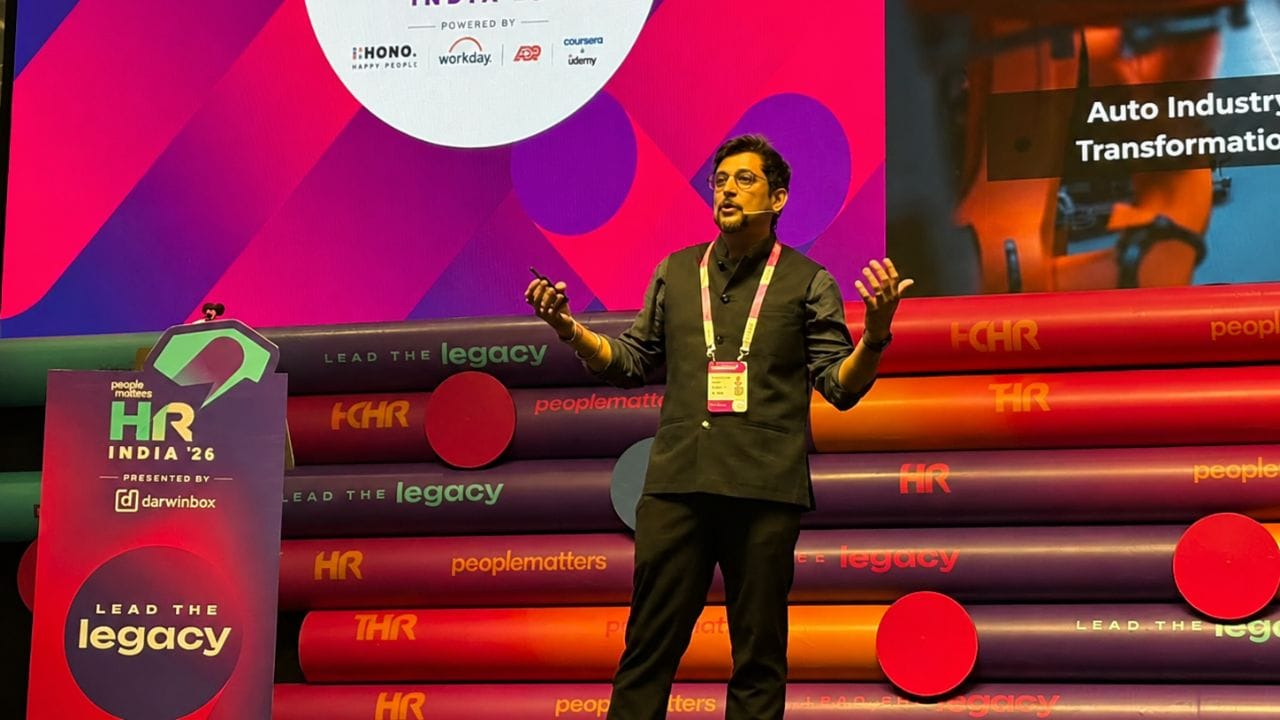
At TechHR India 2026, Dr Natwar Kadel, AVP, People Strategy, Hyundai Motor Company, explored what happens when organisations rethink the relationship between business growth and talent. His message was clear: as businesses transform, human capital cannot remain structured around yesterday's needs.
Beyond designations
Kadel discussed the shift from a traditional hierarchy of designations towards a role-based structure.
“We moved from 15 layers of designations to five levels, shifting progression from titles to roles, responsibilities and the value people create,” Kadel elaborated.
The thinking is straightforward. A promotion should reflect a meaningful change in what a person does and the value they create.
Preparing ahead
The transformation is also changing how the organisation approaches talent.
Rather than waiting for new capabilities to become critical and then looking outside for talent, the focus is on preparing existing employees for the business of the future.
Kadel highlighted, “ There is a need to build capabilities for areas such as electric mobility and AI.”
The firm is looking several years ahead to identify the skills it will need and is developing its workforce accordingly. The aim is to reduce dependence on external hiring and create internal talent pipelines that are ready when the business needs them.
Building capabilities
Kadel emphasised that capability frameworks cannot focus only on the present.
Organisations need to understand what their current business requires while also identifying the skills that will become important over the next five years.
For an automotive business moving towards electric mobility, this means thinking differently about existing manufacturing talent.
“As technologies change, employees need opportunities to transition into new areas rather than simply becoming redundant when an old capability is no longer required,” he noted.
From roles to skills
The next stage of the transformation is already being defined.
The focus will shift towards what employees can do, the skills they build and how those skills create opportunities for growth.
As Kadel put it, "By 2030, we want to be a skill-based organisation. You will not be known for your designation. You will be known for your skills, and that is where your growth will come from."
It is a significant shift in how organisations could think about careers.
Progression would no longer be limited to moving vertically through a hierarchy. Employees could grow by building new skills and moving across capabilities.
Connecting HR
Changing the structure alone, however, is not enough.
The organisation has linked job architecture with organisation design, capability, career progression and rewards. These elements are then connected across talent acquisition, talent management, learning, engagement and compensation.
The objective is to create an integrated human capital framework rather than separate HR processes.
The same principle applies to digital transformation. Technology should support the architecture rather than become an objective in itself.
Build, don't copy
Kadel also offered a broader lesson for leaders navigating workplace transformation.
Organisations should resist the temptation to adopt practices simply because they are popular elsewhere.
This was particularly evident in the discussion around hybrid work. A manufacturing business has different workforce requirements from an organisation where most employees work in enabling functions.
Flexibility, therefore, cannot have a universal formula.
As Kadel said, "Do not do anything because the world is doing it. You need to diagnose what works for your organisation and build that change organically."
The message is relevant beyond hybrid work. Transformation needs to reflect the organisation's business model, workforce and future direction.
What comes after roles
The next evolution could take the organisation beyond role-based structures towards skills, behavioural science and human intelligence.
As business models continue to change, HR will need to keep adapting its own architecture.
The bigger lesson is not to replicate another organisation's transformation journey. It is to understand where the business wants to go, identify the capabilities required to get there and build the people systems around that direction.
In a faster-changing workplace, the question may no longer be how many levels an employee has climbed.
It may be what they have learnt, what they can do and where those skills can take them next.