








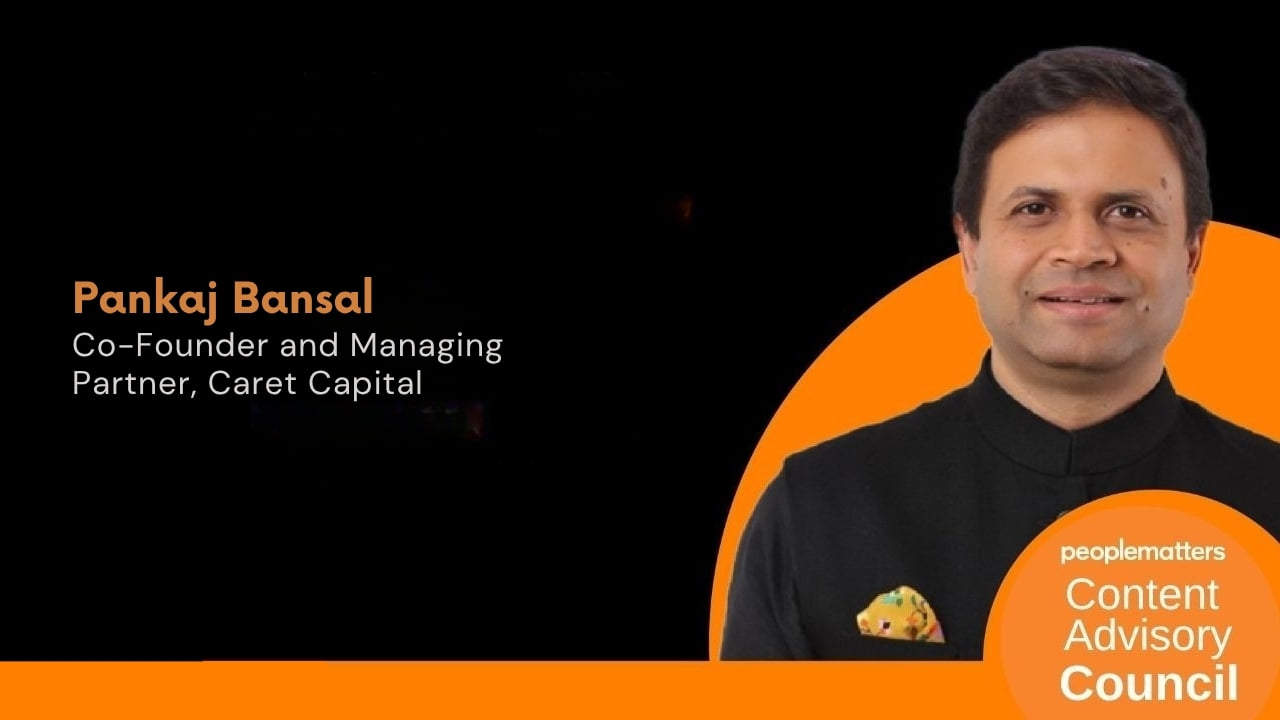
For decades, India’s job sector has struggled to command the attention and investment it truly deserves. While sectors like technology, finance, and manufacturing have their own identities and robust investment ecosystems, the realm of jobs—a cornerstone of any thriving society—has remained fragmented, informal, and under appreciated as a standalone industry. Pankaj Bansal, co-founder and managing partner at Caret Capital and a member of the People Matters Content Advisory Council, is determined to change that narrative.
Bansal’s conviction is rooted in hard numbers and lived reality: over 200 million blue-collar workers in India remain largely invisible, unorganised, and vulnerable. “They exist somewhere. We just don’t know where. They work on construction sites, but aren't formally recognised.
They’re the real working poor of India,” he says. The challenge, Bansal argues, is not just to discover and organise this massive workforce, but to uplift them—giving them access to payslips, social security, certificates, and the dignity of formal employment.
His portfolio company Arthum is an answer to that. “We are organising blue-collar workers, giving them certificates, access to loans, payslips, ESI, PF, everything. This brings them into the formal workforce, giving them protection and a path out of poverty.”
The difference, he notes, is stark: “When a worker receives a payslip and is included in the formal fold, their ability to access credit, healthcare, and social security changes overnight. Suddenly, they are not just surviving, but building futures for their families.”
Why investment in jobs has lagged and why that’s changing
Historically, the jobs sector has attracted little investment. Bansal points to two reasons: first, the paucity of success stories; second, a monopolistic market dominated by just one or two players, stifling innovation and limiting investor interest. “But things are changing, especially among blue-collar jobs. I’m seeing two or three new companies every month in this space. The number of entrepreneurs tackling jobs is growing.”
The lack of formalisation has left millions open to exploitation. “If we don’t organise this workforce, they remain subject to abuse and insecurity. The moment you give them a payslip, you open doors to loans, better healthcare, and social security. That’s how we transform lives.
His argument is clear: until jobs are recognised as a standalone, investable industry, the sector will never reach its potential. “We have made investments—Arthum and others—to prove to the world that jobs are a category. India will celebrate when this becomes mainstream.”
Startups: The true engines of job creation
Bansal’s optimism is rooted in India’s vibrant entrepreneurial scene. “The next 20 years belong to startups. The most meaningful job-creating companies are probably not even born yet. Every 8.1 years, an Indian company goes public—down from 14 years. India now leads the world in new listings. That’s a sign of entrepreneurs rising.”
He is clear that neither the government nor large corporations will lead India’s job revolution. “Startups are solving the hardest problems. They’re the ones who will create jobs at scale and bring the informal workforce into the mainstream.” Bansal believes the most impactful job creators of the next two decades are currently being built in small offices and homes across the country by founders who see opportunity where others see risk.
His own investments echo this belief, whether it’s a bike-riding company creating new jobs in mobility or digital platforms aggregating gig work. “My hope is with the entrepreneurs. They’re coming up daily, and they have the chance to define India’s next chapter.”
He adds, “Even if you look at my own family, my son has started a business in this space. Promoting entrepreneurship through my fund, my family (my son started JobsUPI with his business partner Shubham from IIMA to enable blue-collar workers to get discovered), my network, is how I can do my bit.” My company Taggd was the first RPO (recruitment process outsourcing in India)
The skill economy and the wage imperative
At the heart of Bansal’s philosophy is a shift from a role-based to a skill-based economy. “Wages are determined by geography, skills, and productivity. For blue-collar jobs, there’s almost no scientific way to verify skills. If we can bring in a transparent credentialing system—where you can check an electrician’s skill level on your phone—then wages will reflect true productivity.”
He’s blunt about India’s wage challenge: “The real problem isn’t the number of jobs, but wages. If wages rise, the entire economy rises. But our current wage structure is not sustainable; it must go up. Otherwise, our best talent will leave the country.” He points out that India is becoming the world’s talent factory.
“Look at the demand for Indian nurses, electricians, plumbers, teachers. If we don’t take care of this population—if we don’t raise their wages—they’ll go abroad. The key is not just creating jobs, but meaningful, well-paid jobs.”
Moreover, Bansal’s vision is not just about upskilling individuals, but about creating an ecosystem where skills are recognised and rewarded, productivity is measurable, and mobility—across companies, regions, and even countries—is possible. “If companies do not raise wages and productivity, talent will migrate. It’s as simple as that.”
Education, skilling, and the talent paradox
Despite a vast youth population, India faces a paradox: a shortage of employable talent. Bansal, who advises leading educational institutions and sits on government reform committees, sees hope in innovation.
“Institutions like Masters Union and Sunstone are breaking the mould—offering practical, skills-driven education, sometimes charging fees only after students are placed. Still, the responsibility for skilling lies with the individual.”
He acknowledges the slow pace of systemic change, pointing to the new education policy.
“It will take years to show its impact. Meanwhile, premium talent is leaving India because risk capital and frontier-tech ecosystems are still limited.” In his view, the answer isn't just more degrees, but relevant, market-driven skills and a culture that encourages people to own their professional growth.
Work Capital: Investing in people, not just technology
Against a backdrop of venture capital obsessed with automation and efficiency, Bansal’s approach is refreshingly contrarian. “There’s a misconception that you can only deliver strong returns by reducing jobs. But profit and meaning are not in conflict—they can coexist.”
He offers examples from his portfolio: electric two-wheeler businesses that create jobs for riders and gig platforms like AWIGN that have delivered 10x returns while building livelihoods. “It’s not about choosing between profit and purpose—it’s about pursuing both.”
For Bansal, evaluating startups is about more than just financials. “We look at the timing—is this the right market? Is there a scalable opportunity? What is the founder’s vision, and what impact can they create beyond returns?” He highlights Milo Drive, a company aiming to double drivers’ incomes through aggregation and AI. “They use technology to empower drivers, not replace them. This is how you use AI to uplift, not eliminate, human potential.”
He calls such founders “category builders”—those who are willing to shape an industry over a decade, not just chase short-term returns. “We want to back the category builders of Bharat for the next ten years.”
Exits, organisational culture, and the human factor
Bansal’s experience with high-profile exits—Peoplestrong to Goldman Sachs, Wheebox to ETS & Taggd to EMA Partners—has shaped his philosophy: “Put the enterprise at the centre. If the company succeeds, everyone—founders, investors, teams—wins.”
He’s candid about the hard people decisions needed for growth and transition: “Always have backups for key roles. Be honest and objective if someone needs to move on. It’s not betrayal—it’s about helping people find meaningful work as the business evolves.” Open, constant, and objective communication, he says, is the key to building resilient teams and cultures.
This emphasis on culture and communication has allowed his teams to stay together for decades, even growing headcount during transitions. “In our exits, we’ve committed to no retrenchments, and have planned for workforce growth. Health, relationships, and financial stability matter as much as returns.”
A call to action for HR and business leaders
As a People Matters Content Advisory Council member, Bansal challenges HR to move beyond buzzwords and deliver actionable leadership. “We need more content from founders—people who’ve built things and can share real-world lessons. CHROs must keep the India growth story in mind, allocate budgets for skilling, and understand business and technology as deeply as any CEO.”
He urges the next generation of HR leaders to come from business or develop a business lens. “If they can talk numbers and solutions, they’ll win the confidence of CEOs and even rise to the top roles themselves. The expectation now is for HR leaders to understand business and technology as deeply as any CEO.”
India’s moment of destiny
The conversation with Bansal ends on a note of hope and urgency. “We have a shot at destiny. Our economy is growing, entrepreneurs are rising, and opportunities abound. But there’s always the risk of missing the bus. My greatest hope is in entrepreneurs.”
By recasting jobs as an industry, empowering startups, and investing in both profit and purpose, Bansal’s vision is clear: India’s future depends on building not just companies—but a fair, prosperous society where every worker counts.