








In the corporate boardroom, a missed quarterly target triggers an uncomfortable slide deck, a board review, and a promise to recover margins by Q4. On the frontlines of high-altitude warfare, there is no next quarter.
“We don’t have the luxury to walk up to a widow and say, ‘Ma’am, next quarter your husband will be back,’” says Lt Gen KJS Dhillon, PVSM, UYSM, YSM, VSM (Retd). “Our profit and loss is calculated every second. This second, my buddy and I are safe; we are in profit. Next second, because of my mistake, he gets hit; we go into loss.”
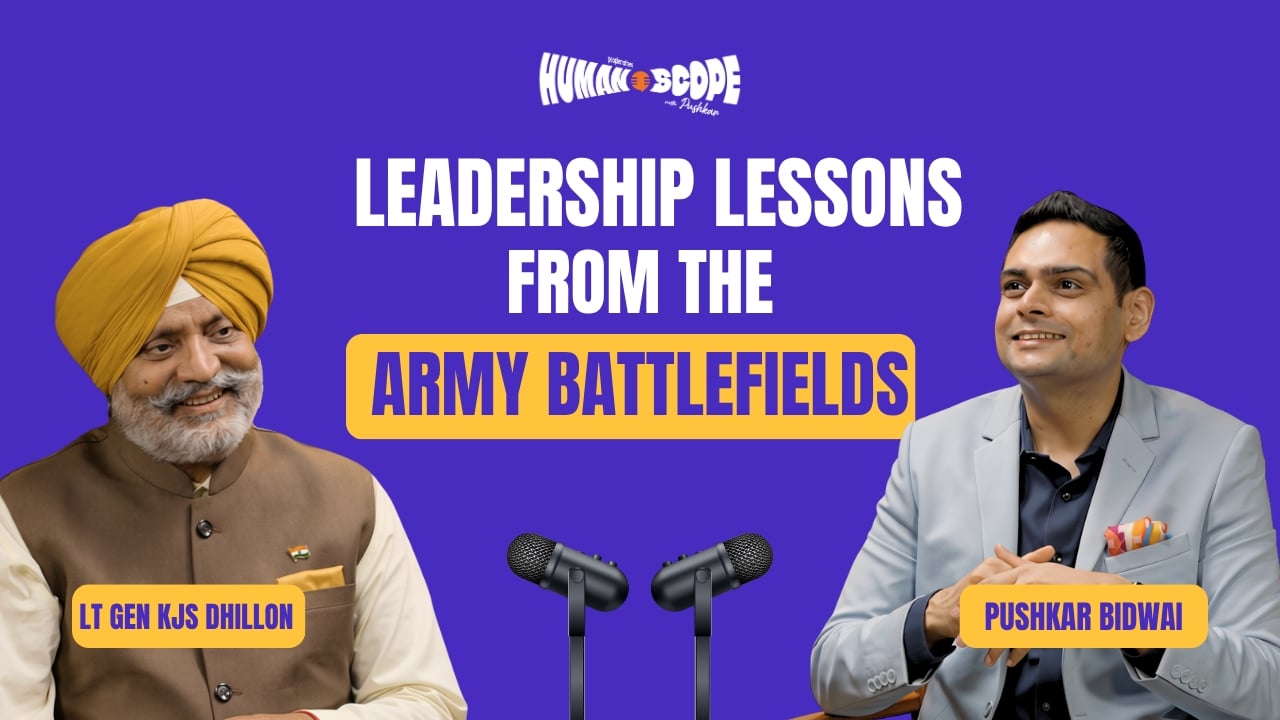
Having spent 44 years in uniform—leading troops through extreme high-altitude terrain and intense counter-insurgency operations—Lt Gen Dhillon brings a sobering, radically human perspective to modern leadership. In this Humanscope Podcast conversation with Pushkar Bidwai, CEO of People Matters, the former XV Corps Commander dismantled the corporate world's obsession with titles and metrics, offering instead a masterclass in what it actually means to lead from the front.
A legacy written in uniform
For Lt Gen Dhillon, the decision to enter military service was less of a calculated career choice and more of an inevitable calling rooted in family history. His military heritage traces back to his grandfather, who fought in the First World War. Raised among strong, uniform-clad role models while staying with his maternal grandparents—an elder uncle serving as an army officer and a younger uncle in the BSF—he absorbed a culture of discipline, service, and sacrifice into his daily life.
Growing up in northern India, where military service is deeply embedded across multi-generational family legacies, he attended Kendriya Vidyalaya inside a cantonment, lived in army barracks, and spent his after-school hours playing friendly matches with soldiers. In an era before social media and internet distractions, the armed forces were not merely one career path among many—they were the gold standard.
Enrolling in the National Defence Academy at sixteen and a half, he completed four years of rigorous academy training followed by forty years of active service, totalling 44 years in uniform.
Even his widely recognised moniker, "Tiny," carries the distinct cultural flavour of military tradition. Standing six-foot-three, he received the paradoxical nickname upon joining the 4th Battalion, the Rajputana Rifles, in 1983—a regiment custom in which officers were intentionally given nicknames opposite their physical appearance or personality traits. Beyond building instant camaraderie, the practice served a critical operational security function.
Officer Hamesha Aage: The frontline mandate
Lt Gen Dhillon’s leadership philosophy was forged early in his career. In January 1984, on a freezing morning at an altitude of 17,000 feet in Sikkim, the newly commissioned subaltern stood quietly behind his men during physical training, copying what he had seen instructors do at the National Defence Academy. The unit's Subedar Major walked over through the falling snow, offered a traditional greeting, and uttered a few words that would define the next four decades of Dhillon’s life: “Sab, officer hamesha aage.” (Sir, the officer is always in front).
That simple reminder became the bedrock of his career, culminating in his role commanding the XV Corps in Kashmir during pivotal moments like the abrogation of Article 370.
Leading from the front, Lt Gen Dhillon explains, it serves both a psychological and a tactical purpose. Psychologically, it builds trust and boosts morale—troops know their leader shares their risk. Tactically, it ensures the decision-maker possesses direct, first-hand intelligence rather than relying on delayed, third-party accounts filtering up from the ranks.
The Non-Negotiable Mission: Empathy as a strategic tool
Holding a non-negotiable mission does not mean relying solely on brute force or rigid authority. True frontline leadership often requires radically creative, empathetic thinking.
Nothing illustrates this better than Operation Maa, an initiative Lt Gen Dhillon designed during his tenure in Kashmir.
Over 30 years of counter-insurgency operations, he had noticed a recurring detail: letters recovered from fallen local militants were almost overwhelmingly addressed to their mothers. Recognising the deep cultural and emotional resonance of maternal influence in Kashmiri society, he flipped the traditional counter-terrorism playbook on its head.
Rather than relying purely on kinetic operations, he publicly appealed to mothers to ask their sons to return home. He avoided the word “surrender”—which carried a heavy social stigma—and instead promised safety, confidentiality, and rehabilitation.
The result? More than 50 young men laid down their arms and returned to their families within a single year.
“You call it empathy,” Lt Gen Dhillon notes. “I call it alternative thinking without losing sight of the mission. My task was to reduce terrorism. I accomplished it by saving lives instead of taking them.”
The Core Triad: Loyalty, honesty, and responsibility
When asked how organisations can cultivate genuine leaders rather than mere process managers, Lt Gen Dhillon distills military ethos into three core values: Wafadari (Loyalty), Imandari (Honesty), and Zimedari (Responsibility).
- Wafadari (Loyalty to purpose, not person): True loyalty is dedicated to the organisation, not the boss’s ego. “If loyalty means standing up and telling the boss, ‘Sir, you are wrong, this decision will harm the company,’ then you must have the courage of conviction,” says Dhillon. “If you are only loyal to your carry-home CTC, you are not a leader.”
- Imandari (Intellectual honesty): Honesty goes beyond financial integrity. It means being willing to evaluate decisions fairly from the other side, stay transparent with your team, and protect fragile ideas. Dhillon warns leaders against crushing dissent: “An idea is like an unborn child—fragile. If you dismiss a young employee’s idea simply because of their age, you may well have just killed a unicorn in the making.”
- Zimedari (Ownership of outcomes): When a team succeeds, a true leader steps back and lets the collective take the credit. When it fails, the leader absorbs the blow alone—a principle Dhillon compares to team dynamics in sport, where effective coaches take the hard questions after a painful loss.
Gut instincts in the age of AI
As technology reshapes modern battlefields—from autonomous drones to advanced data analytics—the debate between algorithmic precision and human judgment has reached a tipping point.
Lt Gen Dhillon views technology not as a replacement for human decision-making, but merely as an extension of the body. While artificial intelligence acts as a powerful “decision support system,” processing vast arrays of intelligence, it cannot replace intuition, lived experience, or moral accountability.
Recalling instances where high-tech intelligence suggested a green light for an operation, Dhillon spoke candidly about relying on his "black intuition"—a strong, visceral gut feeling that something was amiss. On multiple occasions, he called off operations despite favourable data, only for subsequent intelligence to prove that proceeding would have resulted in heavy casualties.
“If you depend only on intelligence and technology without the heart, you will fail,” Dhillon remarks. “If you depend only on the heart and ignore the technology and mission, you are equally ineffective. Leadership is a wholesome game.”
The Corporate Misconception: Why hire military veterans?
A central theme of the dialogue was the transition of military veterans into civilian enterprise. Corporate leaders often relegate veterans exclusively to physical security, facilities management, or logistics. Lt Gen Dhillon argues this represents a fundamental misunderstanding of military talent.
He shared an anecdote involving a retired Lieutenant Colonel who joined a major e-commerce firm in a backend planning role. When Lt Gen Dhillon publicly tweeted about a service delay regarding an appliance purchase, the retired officer reached out independently, traced the issue, and resolved it within 30 minutes—despite the task falling entirely outside his department.
When asked why he intervened, the veteran simply replied: “I work for this company now. If the company’s name is being dragged, it is my responsibility to fix it.”
That sense of institutional ownership—the belief that the organization’s reputation is one's personal duty—is what military training instills from day one.
“Consider the selection filter,” Lt Gen Dhillon points out. “At 16 or 17, a cadet is filtered out of hundreds of thousands through rigorous written, psychological, physical, and medical evaluations. Add 20 years of crisis management, leading teams in extreme conditions, and operational decision-making. That individual isn't just a security asset—they are a strategic asset.”
Redefining wealth and patriotism
As the conversation concluded, Lt Gen Dhillon offered a reassuring perspective for corporate leaders who often feel a quiet tension between financial ambition and national service.
Building an enterprise, generating employment, earning foreign reserves, and strengthening the economy, he emphasised, is its own form of nation-building.
“Making money is not a bad thing—never feel guilty about it,” Dhillon stated. “The soldier in uniform on the border and the corporate executive out of uniform are both contributing to the nation. Be proud of what you do, keep doing it, and do it with complete dedication.”
Watch the complete podcast, here.