








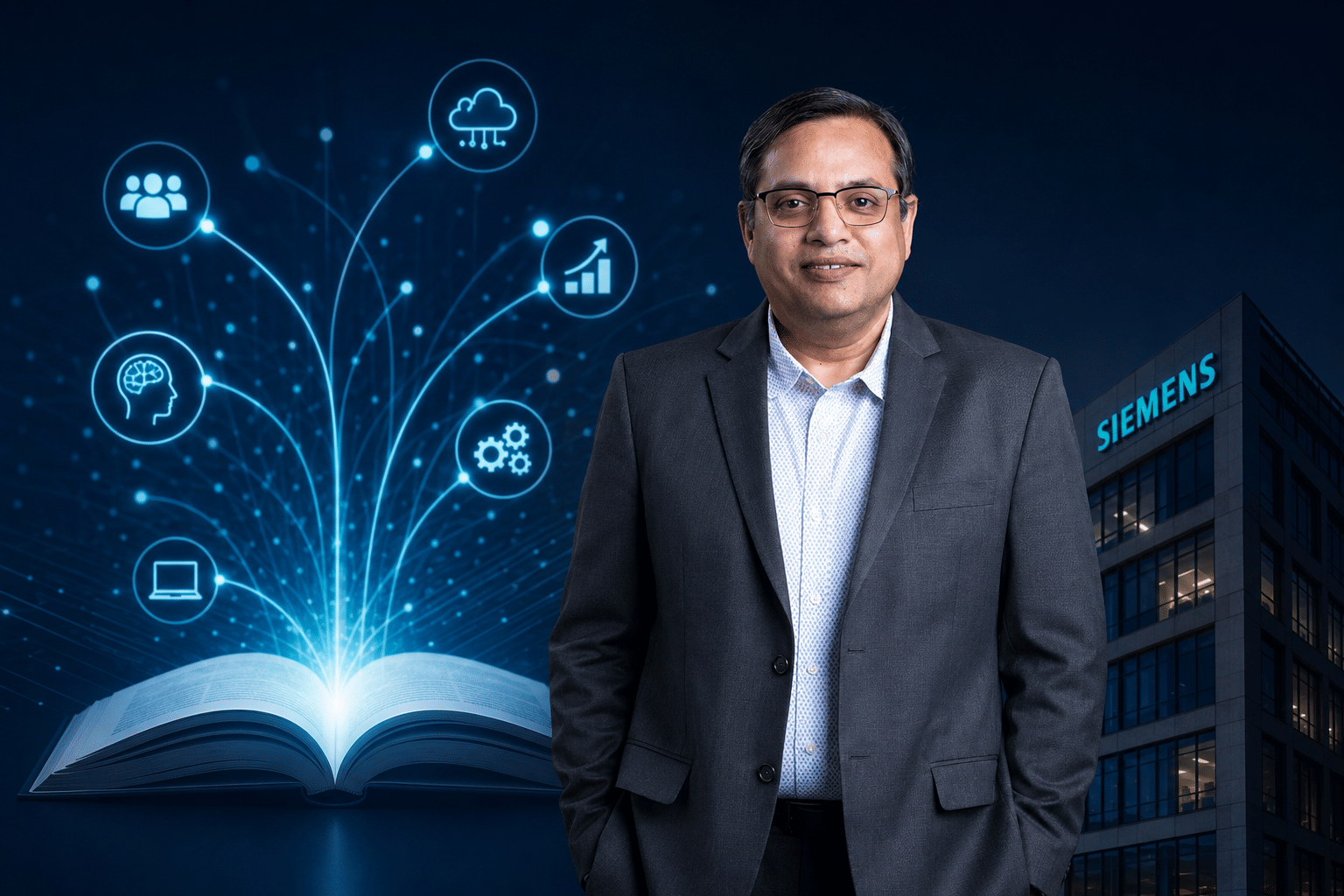
For years, engineering careers followed a relatively stable path. Professionals built expertise in a technology, advanced within a domain and expected experience to carry them through the next stage of their careers. Today, that certainty is fading.
The rapid adoption of artificial intelligence (AI), cloud, digital twins and the Internet of Things (IoT) is shortening the lifespan of technical expertise and reshaping what organisations expect from engineering talent.
According to Srikanth Vachaspati, Vice President and Head of People and Organisation at Siemens Technology and Services, responding to this shift requires more than reskilling initiatives. It calls for learning ecosystems that support continuous development throughout an employee's career.
Speaking to People Matters, Vachaspati outlined why organisations need to rethink talent development as engineering roles become increasingly dynamic and interdisciplinary.
Engineering careers are no longer built around one specialisation
Vachaspati believes the biggest change is not simply the emergence of new technologies, but the speed at which they are transforming work.
"The nature of engineering careers has fundamentally changed because the pace of technological evolution has accelerated dramatically. Earlier, professionals could build expertise in a particular technology or domain and rely on that knowledge for several years. Today, technologies such as AI, cloud, digital twins, and IoT are reshaping industries much faster, so the cycle for upskilling has become much shorter."
He says organisations are also moving away from narrowly defined technical roles.
As career paths increasingly cut across traditional functions, employers are looking for professionals who can combine domain expertise with broader capabilities and collaborate across disciplines.
"The ability to combine domain knowledge with high-value capabilities, collaborate across functions, and continuously adapt has become essential. Career progression is therefore no longer a linear journey it once was."
Instead of predictable career ladders, engineers are entering careers that evolve continuously.
"What we are seeing instead is a shift toward more dynamic careers, less predictable than before, but often more rewarding for those who adapt and demonstrate curiosity."
For Vachaspati, continuous learning is no longer optional. "Continuous learning, unlearning, and relearning is now a key part of career growth."
AI is raising the bar for engineering talent
While AI is automating repetitive work, Vachaspati believes its bigger impact lies in changing what organisations value in engineers.
"AI and automation are changing the role of engineers from being primarily executors of tasks to becoming problem solvers, systems thinkers, and innovation drivers."
Routine execution is giving way to work that demands judgement, interpretation and problem-solving.
He also points to what he describes as role compression, where professionals are expected to combine capabilities that previously sat across multiple roles.
Modern engineers increasingly need to understand:
- Technical systems
- Data
- Business context
- Customer outcomes
- Domain-specific challenges
Alongside this, AI is changing how engineers interact with technology itself.
"An engineer of the future will not compete with technology but collaborate with it."
According to Vachaspati, this requires stronger capabilities in critical thinking, validation, judgement and responsible use of AI.
He also believes organisations are entering a new phase where the challenge extends beyond technical capability.
"As knowledge becomes more ubiquitous with technology, the challenge is moving from Technical Debt to Validation debt. Domain Knowledge coupled with the ability to harness technology will define talent."
Learning cannot be treated as an event
Vachaspati cautions professionals against viewing career development as a series of certifications or formal training programmes.
One of the biggest mistakes, he says, is becoming too dependent on a single technology instead of developing the ability to learn continuously.
He also believes some of the most valuable learning happens outside traditional classrooms.
"Some of the most valuable learning comes through hands-on experience, cross-functional collaboration, exposure to new domains, and solving real-world problems."
Professionals who remain confined to one area often limit their own career opportunities.
Another common gap is overlooking behavioural capabilities.
As technology becomes more accessible, Vachaspati says collaboration, communication and learning agility become increasingly important differentiators.
"Future-ready professionals understand that career growth is not about chasing every new trend. It is about building a strong foundation of learning agility, curiosity, and adaptability that enables them to thrive regardless of how technology evolves."
Why employers must rethink talent development
Vachaspati believes organisations have an equally important role to play.
Rather than focusing solely on training delivery, employers should create environments where learning becomes continuous and career transitions are supported.
He identifies several priorities for organisations:
- Invest in learning ecosystems rather than isolated training programmes
- Create clear career pathways
- Provide reskilling and upskilling opportunities
- Improve visibility into emerging career opportunities
- Build employee confidence to navigate career transitions
As he explains: "The goal should not simply be preparing people for their current roles but equipping them for the opportunities and challenges that may emerge in the future."
At Siemens Technology and Services, this approach includes Communities of Experts across AI, cloud, cybersecurity and UX, alongside mentoring, structured learning, certifications and experiential opportunities that encourage knowledge sharing.
Mindset will define long-term career success
Despite rapid advances in technology, Vachaspati believes technical excellence alone will not distinguish future engineering talent.
He says resilient professionals will increasingly be recognised for qualities that enable them to adapt to uncertainty.
Among the attributes he highlights are:
- Growth mindset
- Systems thinking
- Resilience
- Collaboration
- Business awareness
- Ability to embrace ambiguity
- Focus on meaningful impact
He concludes: "Ultimately, the resilient engineers of the future will be those who are not just technologists, but also lifelong learners, creative problem-solvers, and effective collaborators."
As engineering work continues to evolve, organisations face a broader challenge than keeping pace with new technologies. The focus is shifting towards building workplaces where learning is embedded in everyday work, career mobility is supported and employees are equipped to adapt long before their skills become outdated.