








Organisations often treat inclusion and performance as separate priorities. One focuses on whether people feel they belong; the other on what they deliver. But the conditions that help people thrive at work can shape both.
Recognition is one such condition. When embedded in everyday work rather than treated as a standalone programme or one of many employee recognition programs, it can help people feel valued, connect their contributions to a larger purpose, and strengthen the sense of belonging that enables performance.
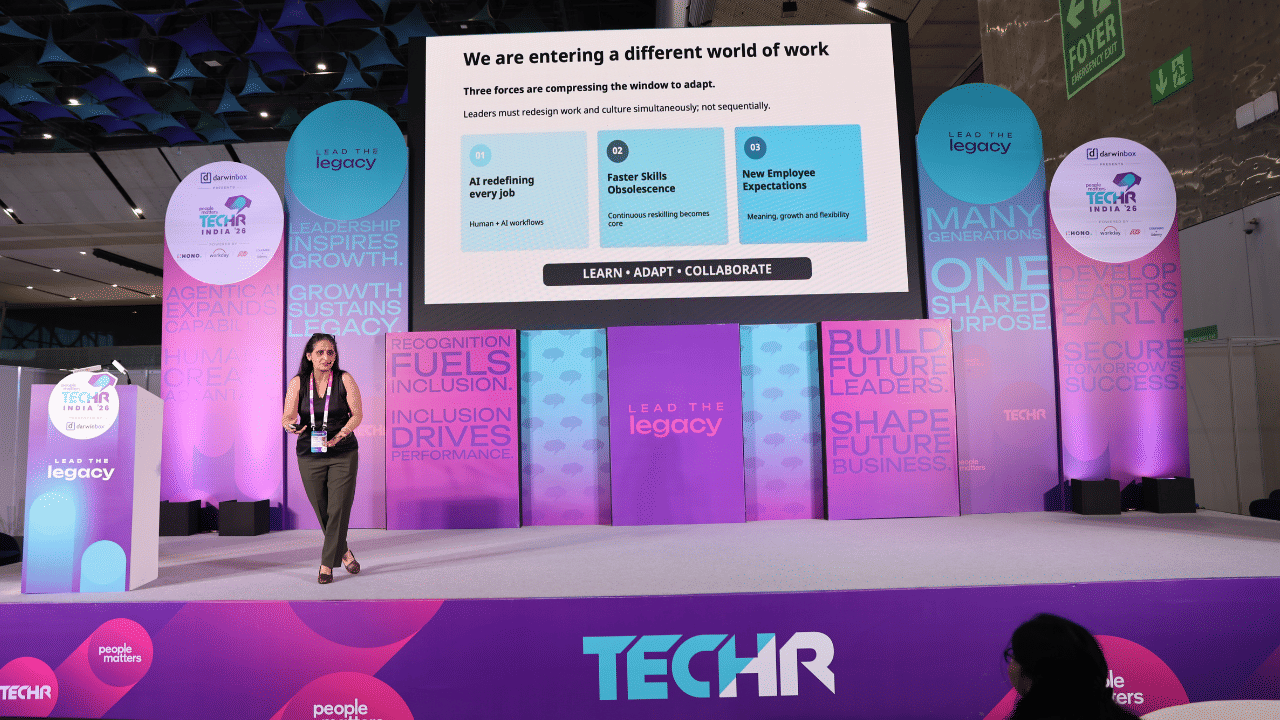
This was the central message of the masterclass, “Building Inclusive, High-Performing Teams by Leveraging Recognition,” where Candy Fernandez, Director – People & Great Work, IMEA, O.C. Tanner, and Kashish Kapoor, CHRO, Newgen, shared insights from O.C. Tanner’s 2026 Global Culture Report. The research draws on perspectives from more than 38,000 employees, leaders, HR practitioners and business leaders across 23 countries.
Recognition as a human need
Recognition is not merely an HR intervention. Fernandez described it as a “core psychological human need” and a spark that can fuel performance.
This becomes more relevant in a workplace that has changed dramatically in recent years. Hybrid work has reshaped how teams connect, economic uncertainty has reset priorities, and AI is redefining jobs and skills. Yet one expectation has remained constant, and that is performance.
“Performance mattered then, and it matters now,” Fernandez said.
Employees want to understand why their work matters and how it connects to something larger.
When purpose inspires performance
Purpose and values may be communicated clearly, but employees do not always see how they translate into their everyday work. The O.C. Tanner research found a gap between organisational purpose and the employee experience.
When that connection is missing, “purpose feels hollow,” Fernandez said.
She described inspiration as “a sudden insight or leap in understanding that produces new creative ideas or approaches to a problem.” Its strongest source, she added, is often other people: “The most powerful sources of inspiration at the workplace come from none other than us, people.”
Inspiration is built through everyday interactions with colleagues, managers and leaders, particularly when people feel safe to contribute, collaborate, experiment and learn.
Inclusion has to be experienced
The same principle applies to inclusion. Organisations have invested heavily in diversity and equity, but representation alone does not create belonging.
The research found that 30% of employees feel invisible at work, 65% feel unappreciated and 82% feel lonely.
“Inclusion today cannot be just a programme or a policy in your handbook. It has to be a daily practice,” Fernandez said.
She added that this practice is shaped by five everyday behaviours, which are: emotional intelligence, respect, goals and purpose, learning, and voice. Employees are 34 times more likely to practise inclusive behaviours when their leaders do the same.
Performance needs expectations and support
Sustaining performance requires organisations to balance what they ask of people with the support they provide.
Fernandez challenged the idea that wellbeing and productivity are competing priorities. “They aren't; they are partners,” she said.
The research frames healthy performance around two pillars: expectations and support. High expectations without adequate support can create an authoritarian environment, while high support with low expectations can become permissive. The strongest environment combines both.
Yet 34% of employees say they do not have enough support to match workplace expectations.
High expectations mean more than ambitious targets. They involve co-creating goals, involving employees in decisions, providing development opportunities and connecting work to purpose. Support also needs to be practical, from wellbeing check-ins and access to resources to flexibility around employees’ needs.
Fernandez pointed to a common gap: organisations may provide medical benefits without giving employees the time to use them. “Health waits for no one,” she said.
Recognition as a holistic practice
Recognition brings these elements into everyday work. Drawing on leadership author Doug Conant’s “abundance” mindset, Fernandez argued that organisations do not have to choose between people and performance.
Recognition, she said, should extend beyond outcomes. It can reinforce the efforts and behaviours that contribute to results, celebrate achievements, and acknowledge longer-term contributions and career journeys, including years of service recognition, employee service recognition, and significant career milestones.
Fernandez described recognition as operating at different levels of frequency and visibility, from everyday appreciation and peer recognition to rewards for significant results and celebrations of careers.
When organisations celebrate ideas and wins, “it just sparks. It takes it to another level.”
The business case is also measurable. Effective recognition is associated with a 15 times greater likelihood of having inclusive teams and an 18 times greater likelihood of having a healthy performance culture.
In an AI workplace, the human signal matters
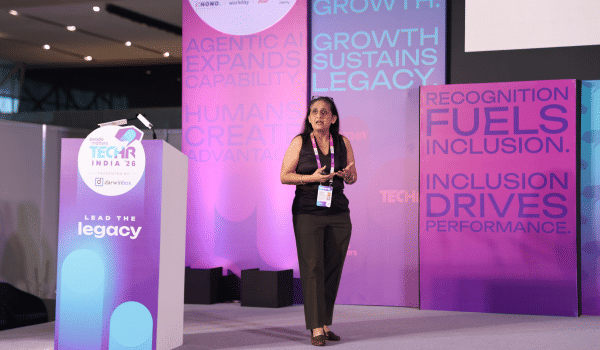
According to Kapoor, recognition has become even more important as AI reshapes work.
She recalled an employee early in her HR career who told her he was leaving. Kapoor asked whether it was compensation, the manager or the role. His answer was different:
“If I went tomorrow, nobody would even notice. It won't make a difference. I'm not visible here.”
The organisation had engagement activities, manager interactions and established HR processes. Yet the employee still felt invisible.
“We were ticking all boxes,” Kapoor reflected.
The story takes on new significance as AI changes jobs, skills and how people work. Technology can accelerate productivity, automation and efficiency, but it cannot replace the human act of appreciation.
“Your machine or your AI bot will never be able to turn around and say thank you to you,” Kapoor said.
Kapoor believes that the human element is brought by trust, empathy, hope and vulnerability, qualities that help bring organisational values to life.
From recognition to culture
Kapoor connected recognition to a broader shift in the role of HR, from primarily driving engagement towards becoming an architect of organisational capability.
But HR cannot build that culture alone. “HR alone cannot drive this. It is a very, very strong partnership,” she said, pointing to the role of leaders and the wider organisation in turning values into everyday behaviours.
At Newgen, long employee tenures and continuous learning are part of that culture. Employees have built careers spanning 15, 20 and 25 years, while the company’s CEO joined as a trainee and grew into the role over 33 years.
For Kapoor, culture becomes tangible when organisations pause to recognise the behaviours they want to see more of.
“We should stop, pause, recognise behaviour, and applaud and reward such moments and appreciate the behaviours and the traits, so that that becomes the culture that we want to create as an organisation.”
Trust, integrity and ethics are foundational to that culture. As Kapoor put it, “Integrity is a non-negotiable.”
She outlined five leadership practices to help make recognition part of everyday work: recognise behaviours, celebrate learning, appreciate immediately, encourage peer recognition and use AI for insight.
The connection between values and performance is also practical. When employees understand organisational values, connect them to their own purpose and link that purpose to business goals, behavioural competencies can be connected to KPIs. Culture then becomes part of how performance is achieved, rather than a separate conversation.
Fernandez closed the session with a reminder that culture cannot be left to chance:
“Culture cannot be left to default. It has to be by design, and all of us sitting in this room are in the centre of that design. You are key to that design.”
Recognition, then, is not simply about making employees feel good. It is a way of making purpose visible and reinforcing the behaviours organisations value. In a workplace being reshaped by AI and changing expectations, those human moments that build trust, belonging and meaning may be more important, not less.