








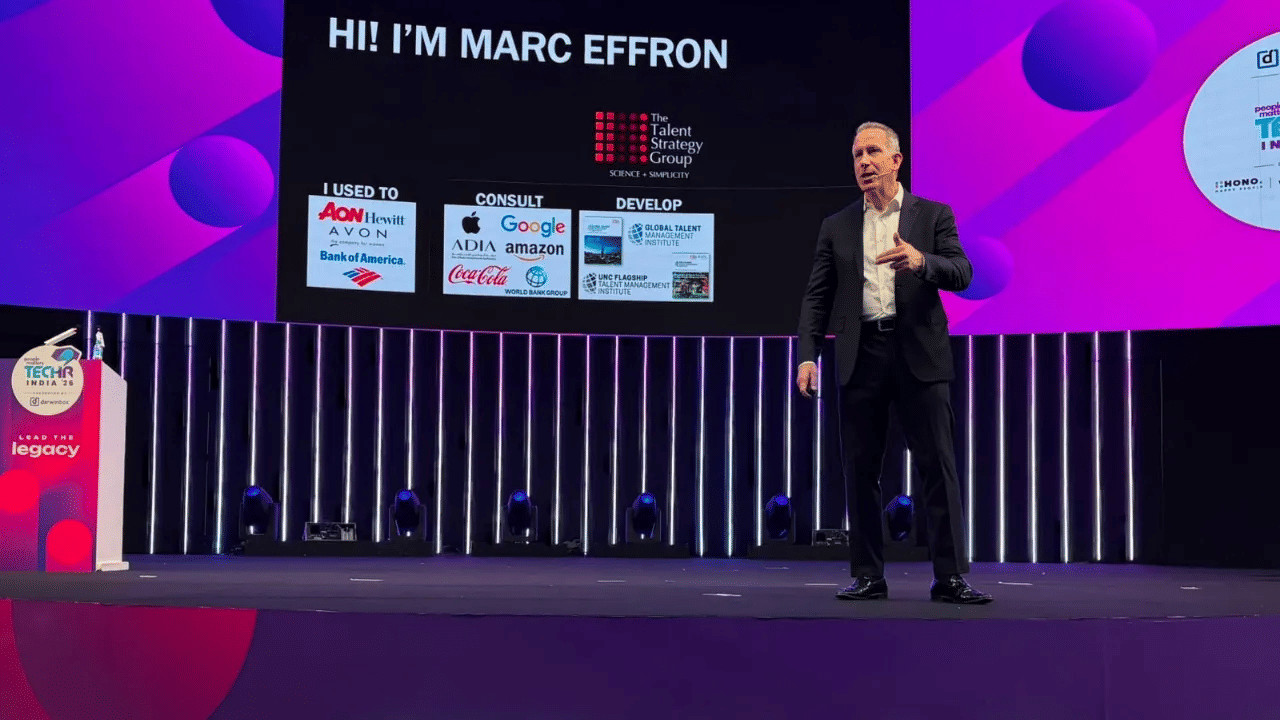
Every organisation claims that people are its greatest asset. But few can clearly articulate what they truly believe about talent. That, according to Marc Effron, President of The Talent Strategy Group, is the gap preventing organisations from consistently building high-performing workforces.
Speaking at TechHR India 2026, Effron argued that modern organisations don't suffer from a shortage of talent processes—they suffer from a lack of clarity. Before introducing another framework, capability model or leadership programme, organisations need something far more fundamental: a clearly defined talent philosophy.
"A talent philosophy is simply a clear statement of what you believe about people," he said. "Once you know what you're trying to build, then you can build practices on top of it. Without that foundation, it's very difficult to create consistency."
Drawing on his experience leading talent functions at Bank of America and Avon Products, and advising some of the world's largest organisations over the past 16 years, Effron challenged HR leaders to rethink how they approach talent management.
Start with difficult questions
Rather than introducing another HR initiative, Effron encouraged leaders to begin by confronting uncomfortable questions that many organisations avoid.
"How long is it okay to be a slightly underperforming employee?" he asked the audience.
For most companies, he observed, the answer varies dramatically depending on the manager, geography or business unit.
Similarly, organisations often lack consensus on questions such as:
How accountable are managers for developing their people?
How much should performance influence promotion decisions?
How transparent should employees be about where they stand?
The absence of shared answers, he argued, leads to inconsistent experiences across the organisation.
"If I'm sitting in Mumbai evaluating someone, would I make the same judgement as someone in Minneapolis or Belgium? Without a consistent talent philosophy, probably not."
Employees should never have to guess
One of Effron's strongest messages centred on transparency.
He argued that employees should never be left wondering where they stand or what success looks like. "Employees know where they stand," he said, adding that organisations often overcomplicate conversations that should be straightforward.
Rather than relying on lengthy competency documents or complicated frameworks, organisations should express their expectations in language employees immediately understand.
"There is no magical way of expressing a talent philosophy," he said. "It simply needs to speak about people."
Talent philosophy is strategy in action
Effron positioned talent philosophy as more than an HR exercise. Instead, he described it as the mechanism that translates business strategy into everyday management decisions.
"Your strategy should tell you what you need from your talent," he explained. "Your talent philosophy defines the consistent behaviours that help execute that strategy."
This becomes especially important during periods of transformation such as mergers, acquisitions, business spin-offs or strategic shifts.
"One of the best times to build or revisit your talent philosophy is when your strategy changes," he said. "A new strategy often requires a new way of thinking about talent."
Don't add more programmes, align the ones you have
Acknowledging that HR teams already juggle countless priorities, Effron anticipated the audience's biggest question: Where does this fit among everything else we're already doing?
He answered, "It belongs near the top."
Rather than creating another standalone initiative, organisations should first define their philosophy and then evaluate whether existing HR processes reinforce it.
"The first step is to compare everything you do in HR against your talent philosophy," he said. "There should be no disconnect between what the philosophy says and how people experience your organisation."
Recruitment, performance management, promotions, succession planning and leadership development should all reflect the same underlying beliefs about talent.
Culture changes through consistency
Creating a talent philosophy is only the beginning.
Effron stressed that organisations often fail not because the philosophy is flawed, but because they stop after writing it down.
Developing the document, he said, merely gets organisations "to the starting line."
The real work begins with consistent reinforcement. He urged leaders to communicate and demonstrate the philosophy continuously, not as a one-time launch, but as an ongoing management discipline.
"If people are being managed differently, that's culture change," he said. "Every month people need to do something that reinforces it."
According to Effron, organisations need to keep repeating the message until consistent behaviours become embedded in daily practice.
Why only a few organisations succeed
Drawing from his firm's experience working with organisations worldwide, Effron shared a sobering observation.
Only about 30% of companies fully realise the benefits of their talent philosophy. The difference isn't the quality of the philosophy itself.
Instead, successful organisations excel in two areas: aligning HR practices with the philosophy and ensuring senior leaders consistently model the desired behaviours.
"The organisations that succeed truly believe in being open and honest with people," he said. "They understand that managing talent consistently is what makes a talent philosophy work."
From philosophy to performance
Effron's keynote served as a reminder that high performance is rarely the outcome of sophisticated HR systems alone.
It begins with leaders agreeing on a simple but powerful question: What do we genuinely believe about talent?
Once those beliefs are clearly defined, and consistently reflected in every people decision. They become the foundation for stronger performance, better management and a more coherent employee experience.