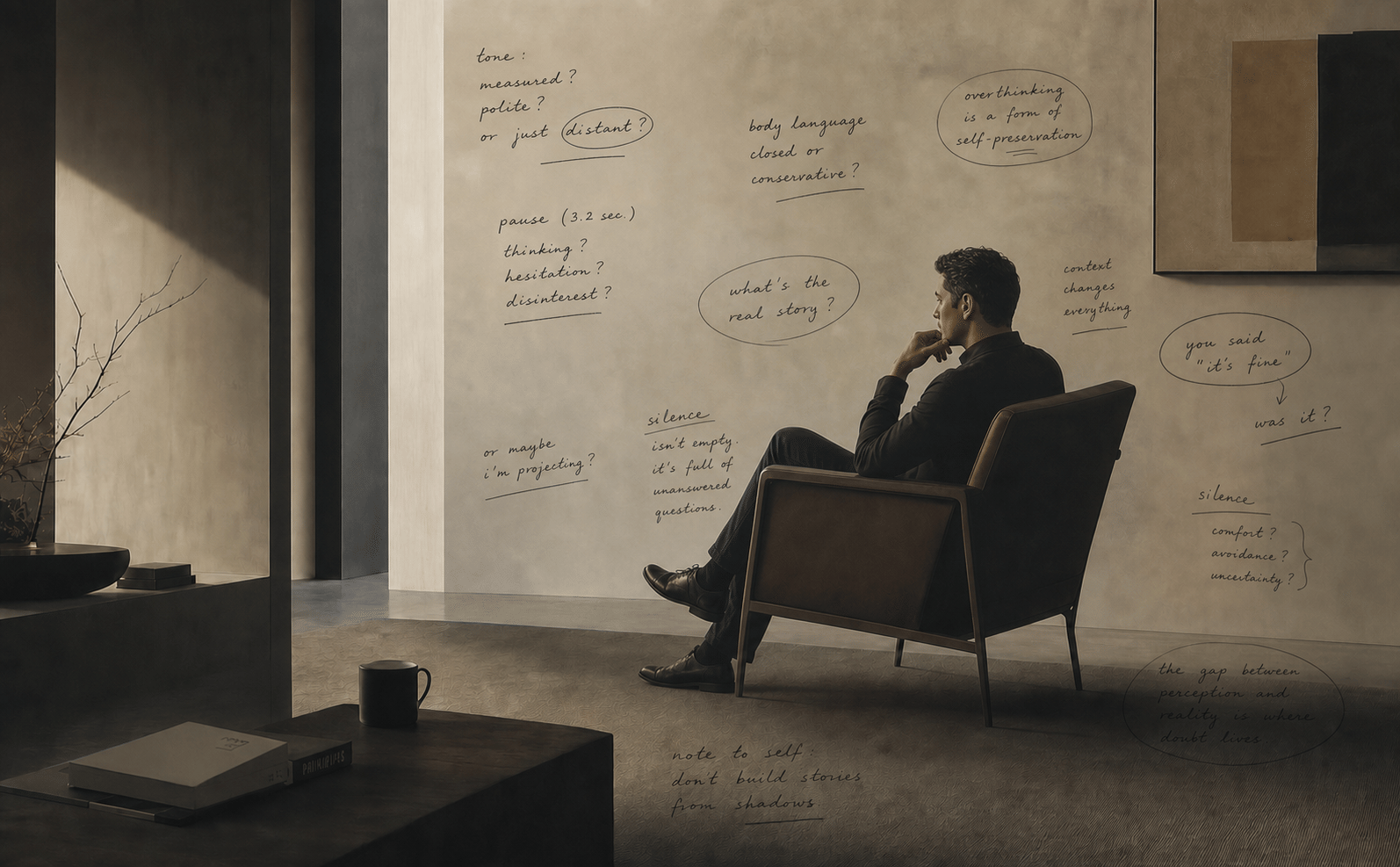
There is a particular kind of tiredness many people seem to carry now, though we do not always name it clearly. It comes from how much of modern life feels open to interpretation.
Not just the big moments. The smaller ones too. A delayed reply. A shorter message than usual. A shift in tone. A meeting that felt slightly off. A colleague who seemed warm last week and distant this week. A friend who said, “Let’s catch up soon,” and never followed up. A manager who gave less feedback than usual. A conversation that felt perfectly normal at the time, but somehow less normal when you replay it later.
At some point, many of us stopped simply living through these moments and started decoding them. We replay what was said. We think about pauses. We wonder what was meant, what changed, what was left unsaid, and what it might say about the relationship, the future, or our place in someone else’s mind.
Sometimes it is something as small as reading “Sure, no problem” and suddenly hearing three different tones inside the same sentence.
The strange part is how normal this has become. A lot of people spend an enormous amount of mental energy doing this without fully realising it. Some of it comes from a good place. People are more emotionally aware than they used to be. We notice the tone more. We pick up on power, exclusion, mood, and what is happening beneath the surface. In many ways, that is a more thoughtful way to move through the world.
But every strength has a point at which it can go too far. There is a point where awareness stops being useful and starts becoming a kind of vigilance. And that kind of vigilance can drain the life out of ordinary experience.
When Awareness Stops Helping
What makes constant interpretation so tiring is not just that we do it. It is that we do it all the time.
A late reply is no longer just a late reply. It may mean annoyance, distance, changed interest, subtle punishment, resentment. A disagreement at work is no longer only about the issue itself. It can start to feel like a comment on trust, loyalty, or standing.
It becomes harder to be spontaneous when you are always thinking about implications. Harder to be present when you are always searching for cues.
The problem is not interpretation itself. We all interpret. The problem is how much of it there is now. Technology has solved many communication problems, but it has also created new kinds of uncertainty that people are still learning to live with. We have more access to one another, but also more room to speculate. Silence is now visible. Delay is measurable. Small changes in behaviour are easier to notice than they used to be.
Social media makes this worse. We are not only exposed to what people say, but also to what they leave out, what they react to, what they ignore, how they present themselves, and how often they show up.
It is one thing to live among people who are reading you. It is another to start reading yourself in the same way. A lot of people now move through the world with a quiet running commentary in their head: Did that sound too eager? Too cold? Too vague? Did I say too much? Too little? Did that pause mean something? Am I imagining this shift?
A conversation ends, and then another conversation begins in your mind. In workplaces, this often shows up as second-guessing, hesitation, and a kind of emotional fatigue that leaders do not always see, but teams feel very deeply.
At work, this can be surprisingly small. A manager says, “Let’s revisit this next week,” in a tone that is hard to place. The meeting moves on, but the sentence does not. By evening, it has already acquired meanings it may never have contained: disappointment, loss of trust, reduced confidence, a subtle warning.
Why We Do It
Part of the reason, of course, is anxiety. Interpretation often rushes in where certainty is absent. A guessed meaning can feel easier to live with than no meaning at all. An unexplained silence is uncomfortable, but a story about that silence can feel strangely relieving, even when the story is wrong.
In that sense, interpretation can feel like control. The trouble is that the more we interpret without checking, the more we start living inside the meanings we have created ourselves. We begin responding not to what is happening, but to what we think is happening. Relationships get strained by assumptions that were never tested. Emotional energy gets spent on drafts of reality.
What makes this more complicated is that the people most likely to over-interpret are often not careless people, but thoughtful ones. They are perceptive and emotionally aware. They are good at reading rooms. They notice nuance. Which is precisely why this habit can feel less like overthinking and more like responsibility.
Most people who do this are not being irrational. If anything, they usually think they are being careful. And yet even attentiveness can become a trap when it never gets to rest. That, to me, is one of the quieter problems of modern adulthood: the line between emotional intelligence and emotional over-processing has become very thin.
The Peace of Leaving Some Things Alone
You can see this almost everywhere, but especially at work. Fast-growing organisations are often full of incomplete signals. Priorities shift without always being fully explained. Tone changes for reasons that may have little to do with the people receiving it. Feedback cycles can be partial. Decisions are sometimes shaped by conversations that never become visible to everyone else.
In that kind of environment, people learn to read between the lines because sometimes they have to. But reading between the lines all the time comes at a cost.
And to be fair, this instinct is not always misplaced. Most people can think of a manager whose tone changed before the feedback did, or a friendship that quietly drifted before anyone acknowledged it. The problem is not that we notice these things. The problem is that we sometimes start seeing them everywhere.
People begin spending too much energy decoding mood, sequence, access, and language, and not enough energy on the work itself. Someone notices they were not copied on a message chain they would usually have been on. Someone else gets a shorter response than usual from a leader already under pressure. Neither moment is necessarily meaningful on its own. But inside an atmosphere of partial signals, both can quickly start to feel like evidence.
The same thing happens in personal life too, though we often give it a better name and call it intuition.
And intuition does matter. But there is a difference between intuition and constant vigilance.
From the inside, the two can feel surprisingly similar. Both ask us to pay attention. The difference is that intuition usually settles after noticing something, while vigilance keeps returning to the same thought, trying to force certainty out of what may still be incomplete.
Because not every pause is loaded. Not every inconsistency is a message. Not every distance is rejection. Sometimes people are tired. Sometimes they are distracted. Sometimes they are carrying things that have nothing to do with you. Sometimes they are simply less consistent than the story your mind is building around them.
The exhaustion begins when we lose the ability to tell the difference and start confusing hypervigilance with insight. And the irony is that this habit often delays the very thing it promises: clarity.
Perhaps one of the most underrated forms of wisdom now is the ability to take a few things at face value. Not everything needs to be decoded in order to be understood. To ask when needed. To notice patterns when they persist. To trust intuition when it is clear. But also to leave room for incompleteness, inconsistency, and the possibility that not everything is about us.
That does not make a person naive. It may simply make them freer.
------
About the author: