








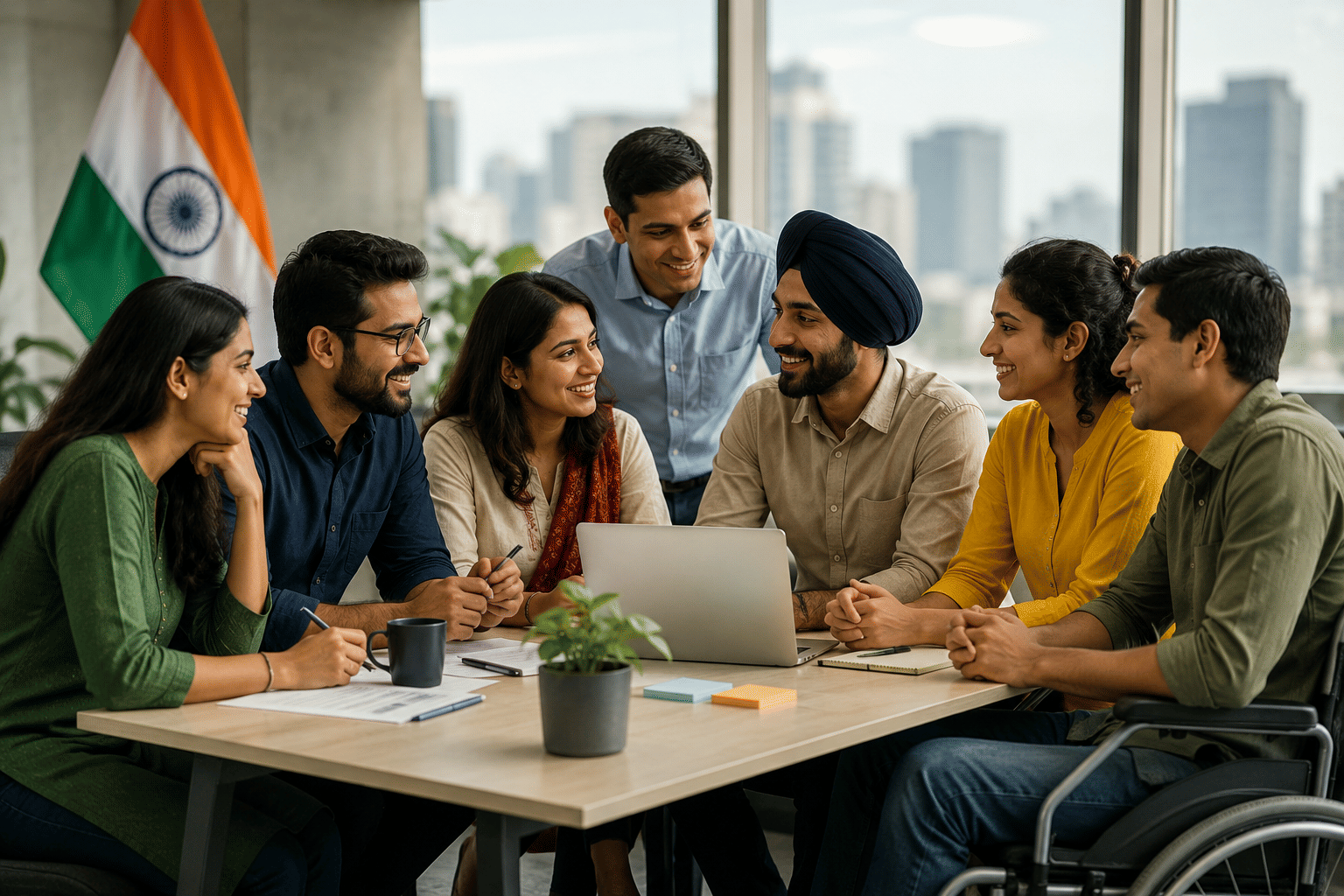
Walk into any large Indian office today and you will hear a familiar soundtrack.
A product manager switches between Hindi and English during a client call. Someone from Kochi explains Onam traditions over lunch. A colleague in Guwahati logs into a meeting with teammates from Pune, Chennai and Jaipur. Another joins remotely from a Tier-II town hundreds of kilometres away.
For decades, unity in diversity has been one of India's defining ideas. As the country celebrates its 80th Independence Day, many workplaces are turning that idea into a daily reality.
Not through speeches or slogans. Through people.
The modern Indian workplace is becoming one of the few places where multiple generations, languages, cultures, identities and life experiences come together with a common goal. Increasingly, leaders and HR teams are discovering that diversity is not just a social value. It is a business advantage.
The office cafeteria may be India's most underrated social experiment
India's diversity is often discussed through census numbers, election maps and cultural festivals.
Yet some of the most visible examples can be found inside offices.
A single team may include employees from several states. Workplace celebrations now routinely include everything from Pongal and Baisakhi to Eid, Christmas, Onam and Navratri. Hybrid work has further expanded the talent pool, allowing companies to recruit from cities and towns that were previously outside traditional corporate hiring networks.
As organisations cast a wider net for talent, teams are becoming more representative of the country's demographic complexity.
This shift is visible across sectors, from technology and financial services to manufacturing and retail.
Diversity has moved from hiring conversations to leadership agendas
There was a time when diversity discussions were largely confined to recruitment metrics.
Today, leaders are increasingly focused on belonging.
The challenge is no longer only about bringing different people into the organisation. It is about ensuring those people feel heard, valued and able to grow.
Research from Gallup and the National HRD Network (NHRDN) found that 45% of senior HR leaders identified diversity and inclusion as a cultural strength within their organisations. The report also noted that India's cultural and generational diversity makes inclusion an ongoing leadership priority.
For business leaders, this requires a different skill set.
Managing diverse teams means understanding multiple working styles, communication preferences and career expectations. Leadership today is increasingly measured not only by performance outcomes but also by the ability to create environments where different voices can contribute.
A workplace where four generations work together
India's workforce is experiencing another layer of diversity: age.
Many organisations now employ professionals from four generations simultaneously.
Fresh graduates entering the workforce bring digital fluency, different expectations around flexibility and a desire for faster career progression. Senior employees contribute institutional knowledge, industry expertise and leadership maturity.
This mix is changing how organisations think about learning.
Mentorship programmes remain important, but reverse mentoring is becoming equally valuable. Younger employees are increasingly helping senior leaders understand emerging technologies, workplace trends and changing employee expectations.
The learning relationship is no longer one-directional.
Inclusion is becoming broader and more visible
The definition of diversity in India is expanding.
Gender diversity remains a major focus area. Increasing attention is also being paid to employees with disabilities, professionals returning after career breaks, LGBTQIA+ talent and workers from underrepresented communities.
Industry assessments by Great Place to Work India increasingly evaluate organisations on how effectively they create opportunities for historically excluded groups, including women, persons with disabilities, career returnees, veterans and LGBTQIA+ employees.
Progress remains uneven.
A report cited by The Times of India noted that people with disabilities continue to account for less than 1% of the workforce in many companies, highlighting the distance still left to travel.
Yet the conversation has clearly evolved beyond compliance.
Many organisations are investing in accessibility, flexible work arrangements, employee resource groups and leadership development programmes designed to create more inclusive cultures.
Why business leaders are paying attention
Diversity is often discussed as a people issue.
Increasingly, it is being viewed as a business issue.
Leaders recognise that teams with varied perspectives are often better positioned to understand customers, challenge assumptions and solve complex problems.
India's economic growth is also changing talent dynamics. Companies are hiring across regions, time zones and markets. According to a recent Deel survey, 77% of Indian companies plan to increase overseas hiring over the next 12 to 18 months, making cross-cultural collaboration a core workplace capability.
As organisations become more geographically distributed, inclusion becomes less about location and more about culture.
India's next chapter of workplace inclusion
There is still work to do.
Age bias remains a concern for many professionals. Representation gaps persist across sectors. Recognition and belonging do not always keep pace with diversity initiatives.
But the broader direction is difficult to ignore.
The Indian workplace of 2026 looks very different from the workplace of a decade ago.
Teams are more diverse. Leaders are more conscious of inclusion. Employees are increasingly comfortable bringing their full identities to work.
On Independence Day, offices across the country will display flags, wear tricolour badges and sing the national anthem.
The more interesting story may be what happens on the remaining 364 days.
It is in those everyday conversations, collaborations and shared ambitions that India's workplaces continue to bring unity in diversity to life.