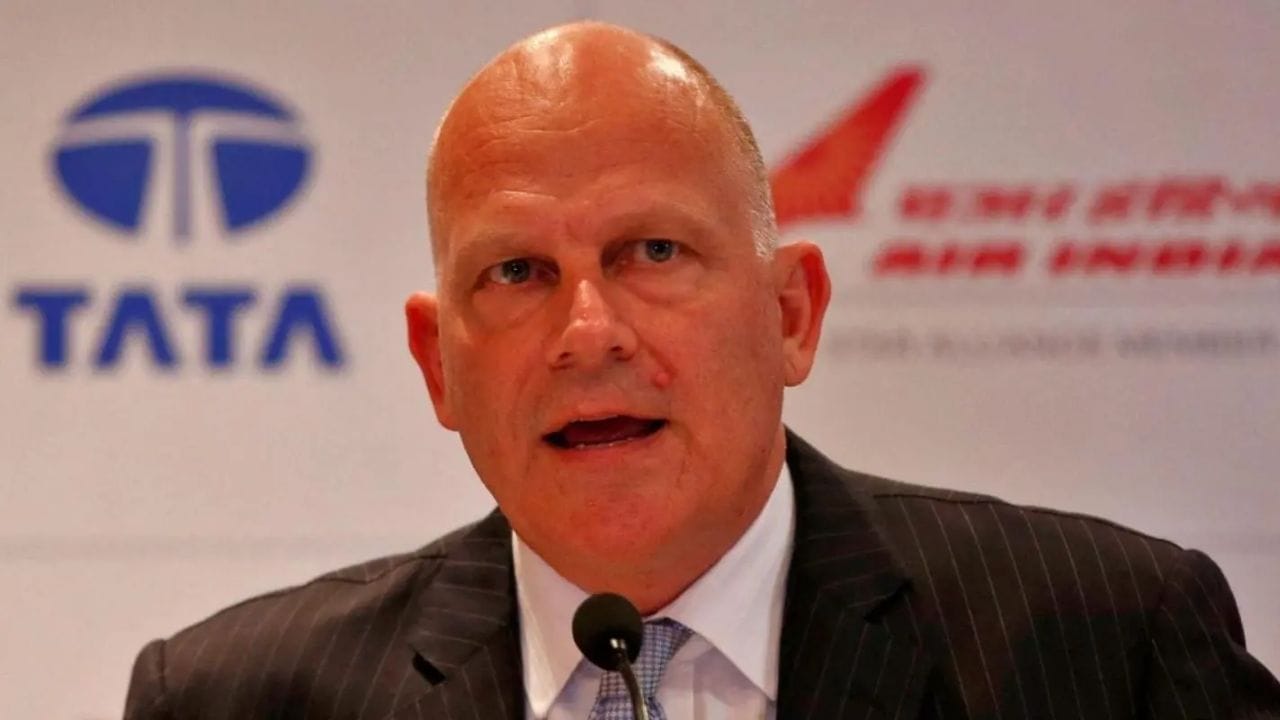
Air India chief executive Campbell Wilson has confirmed that he plans to step down within the next few months, saying the airline’s next leader will face major operational and financial challenges as geopolitical tensions continue to disrupt global aviation.
Speaking at a lunch event hosted by the Wings Club in New York on Thursday, Wilson said the carrier was grappling with rising fuel costs, prolonged airspace restrictions and the impact of the Iran conflict, according to Reuters.
“The next four years is going to be just as challenging as the past, albeit in a different way,” Wilson said. “And so the person that takes over will have their hands full.”
Wilson added that he would remain flexible during the transition process to ensure a smooth handover once a successor is appointed.
His comments come at a difficult moment for the Tata Group-owned airline, which is attempting an ambitious long-term turnaround while navigating mounting operational disruptions and continuing financial pressure.
Airspace restrictions strain international operations
One of the biggest challenges facing Air India has been the closure of key air routes following regional tensions involving Iran and restrictions on the use of Pakistani airspace.
According to Wilson, the disruptions have forced the airline to reroute several long-haul international services, increasing flight times and operating expenses.
“We now can't fly over many parts of the Gulf, so we have to take an even longer routing,” Wilson said, according to Reuters. He added that an eight-and-a-half-hour flight from Delhi to London was now taking around 12 hours because of rerouting requirements.
The operational impact has been significant. Key challenges highlighted by Wilson include:
• Extended flight durations on major international routes
• Rising fuel expenses linked to longer flying times
• Cancellation or scaling back of North American services
• Airspace restrictions linked to geopolitical tensions
• Pressure from a stronger US dollar on operating costs
Wilson said fuel costs had doubled from their earlier share of the airline’s cost base before the outbreak of the Iran conflict.
The airline has also reportedly cancelled thousands of flights in recent months due to airspace restrictions and route disruptions.
Leadership transition comes during difficult phase
Wilson said it had always been clear that his tenure at Air India would last four years.
“I’m going to be flexible for as long as it takes for them to find someone and make sure that we do a good transition,” he said.
According to earlier Reuters reporting, Vinod Kannan, currently associated with Singapore Airlines, and Air India commercial chief Nipun Aggarwal are among the leading contenders to succeed Wilson.
The leadership transition comes as the airline continues to pursue aggressive expansion plans in one of the world’s fastest-growing aviation markets.
Since returning to the Tata Group in 2022, Air India has sought to modernise operations, overhaul service standards and expand its fleet in a bid to compete more aggressively with global carriers.
However, the turnaround effort has also been overshadowed by operational setbacks and safety concerns.
The carrier faced intense scrutiny after a crash involving one of its Boeing 787 Dreamliner aircraft in June 2025 that killed hundreds of people. The airline has also dealt with criticism over delays, service issues and operational reliability during its restructuring process.
Growth ambitions remain intact
Despite the turbulence, Wilson indicated that the broader foundation for expansion had already been established.
“The platform has been laid, but obviously when you bring aircraft in, you're going to be operating in a much greater scale quite soon,” he told reporters after the event, according to Reuters.
Air India has placed major aircraft orders in recent years as part of its long-term fleet renewal strategy. The carrier is aiming to strengthen its international network and establish itself as a larger global aviation player.
Industry analysts say the incoming chief executive will need to balance growth ambitions with the immediate realities of volatile fuel prices, geopolitical instability and operational recovery.
The next phase for Air India is expected to test whether the airline can sustain its transformation plans while navigating one of the most challenging periods currently facing the global aviation sector.