








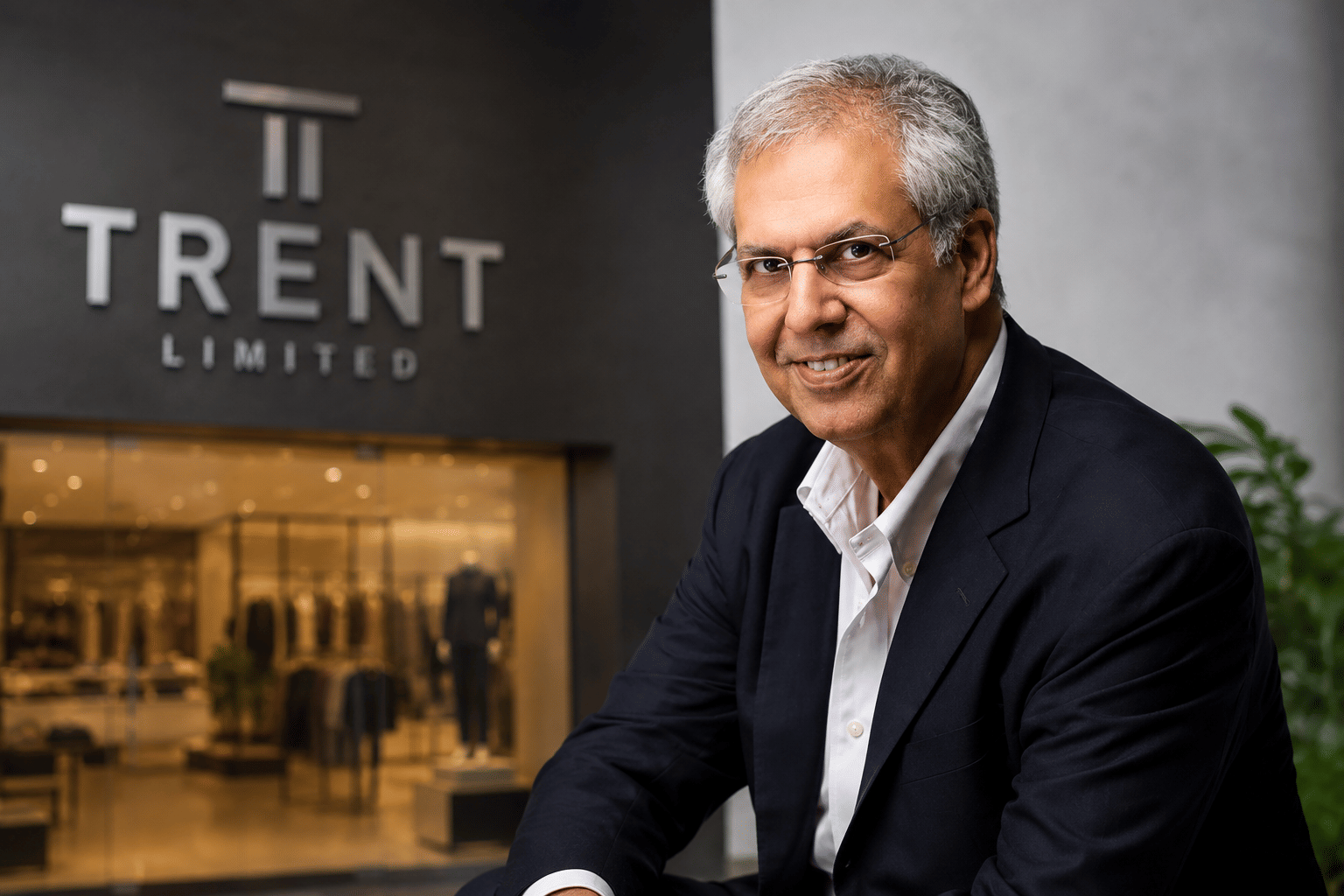
Noel Tata will step down as chairman of Trent later this year, drawing the curtain on a nearly three-decade association with the Tata Group retailer he helped shape into one of India's biggest consumer success stories.
The announcement came during Trent's 74th annual general meeting, where Tata informed shareholders of his decision in line with Tata Group governance norms requiring non-executive directors to retire at the age of 70. Tata turns 70 in November, making Trent the first Tata Group company where he has formally announced his exit as board chairman.
His departure marks the end of a leadership journey that saw Trent evolve from a fledgling retail business into a company with more than Rs 20,000 crore in annual revenue and a market capitalisation of nearly Rs 2 lakh crore.
A retail journey that began with Westside
Trent was established in 1998 following the divestment of the Lakme cosmetics business to Hindustan Unilever. Noel Tata joined the company's board in its founding year, when organised retail in India was still in its infancy.
One of Trent's earliest strategic moves was acquiring the Indian operations of UK retailer Littlewoods International. The business was later rebranded as Westside, laying the foundation for Trent's entry into organised fashion retail.
In June 1999, Tata became the company's first Managing Director, taking charge at a time when India's retail landscape remained dominated by neighbourhood stores and traditional family-run businesses.
Building a business through discipline, not disruption
Rather than pursuing rapid expansion, Tata focused on strengthening private labels, maintaining cost discipline and expanding stores steadily.
The strategy allowed Westside to build a distinctive position in India's fashion market while reducing dependence on third-party brands.
His biggest strategic bet, however, came much later through Zudio.
Long before value fashion became one of the country's fastest-growing retail segments, Trent invested in a low-price, fast-fashion model aimed at aspirational consumers. Zudio has since emerged as the company's primary growth engine, expanding rapidly across metropolitan cities as well as smaller towns.
Growth by the numbers
Trent's financial transformation accelerated during Tata's tenure as chairman, a position he assumed in March 2014 after succeeding F.K. Kavarana. Key milestones include:
- Revenue increased from Rs 2,333 crore in FY14 to Rs 20,074 crore in FY26
- Net profit improved from a loss of Rs 19 crore in FY14 to Rs 1,721 crore in FY26
- Market capitalisation expanded from around Rs 4,300 crore to nearly Rs 2 lakh crore
- Retail footprint grew to 1,286 stores across 321 cities
- Zudio expanded to 963 stores, including six outlets in the UAE
- Westside reached 300 stores
- Star Bazaar operates 84 food and grocery stores through Trent's partnership with Tesco
The numbers reflect how Trent has become one of the Tata Group's strongest value creators over the past decade.
A tougher road lies ahead
Despite its scale, Trent enters its next chapter amid growing competitive pressure.
Sales growth moderated to 17% in FY26, below the company's long-term target of 25%, as value retail becomes increasingly crowded.
Competition has intensified from established retailers, international brands and digital-first fashion businesses, while e-commerce and quick commerce continue reshaping consumer spending patterns.
Trent's online business also remains relatively small. Westside's e-commerce operations contribute about 6% of sales, or roughly Rs 300 crore, highlighting significant room for digital expansion.
The grocery business continues to face challenges as well. Trent Hypermarket, the joint venture with Tesco that operates Star Bazaar stores, reported a loss of Rs 129.47 crore in FY26, compared with Rs 71.46 crore in the previous financial year. The company has responded by increasing the share of private-label products and redesigning store formats to improve profitability.
Expansion remains central to Trent's strategy
Speaking at the AGM, Tata told shareholders the retailer still has considerable room to grow.
According to him, Trent currently serves only around 2% of India's addressable retail market, leaving significant opportunities across formats, categories and geographies.
He said the company would continue expanding its store network in a disciplined manner while deepening its presence in existing markets and entering new catchment areas where customer demand is strong.
The next phase of growth is also expected to include greater investment in technology, artificial intelligence and logistics. Trent's board has already approved a Rs 2,500 crore fundraising plan to strengthen technology infrastructure, AI capabilities and future store expansion.
End of an era, beginning of a new chapter
Noel Tata's exit closes one of the most significant leadership chapters in Indian retail.
Over nearly three decades, he helped transform Trent from a relatively small retail venture into one of India's most valuable listed retailers through disciplined expansion, private-label innovation and long-term strategic thinking.
As the company prepares for a leadership transition, it enters a more competitive retail landscape. Sustaining the momentum built under Tata's stewardship while adapting to changing consumer behaviour and digital disruption will shape Trent's next phase of growth.
New leaders, fresh capital, workforce shifts and unfiltered conversations — the story of work unfolds here.