








Artificial intelligence has moved beyond experimentation. The real challenge for organisations today is no longer whether to adopt AI, but how quickly they can transform their businesses to keep pace with it.
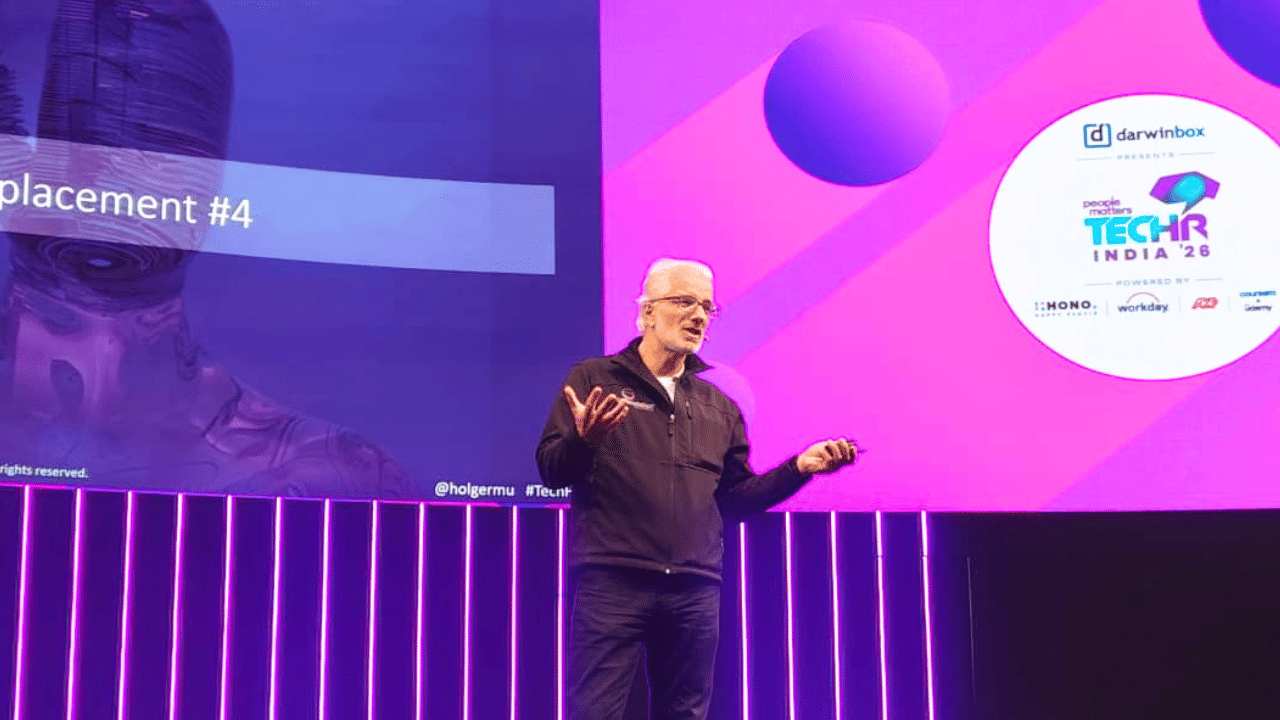
Speaking at People Matters' TechHR India 2026, Holger Mueller, VP & Principal Analyst at Constellation Research, argued that HR leaders have a pivotal role in helping organisations navigate what he described as the "second steam engine era" - a technological shift that is fundamentally reshaping how work gets done.
Mueller's simply emphasised that AI should not be mystified. "AI is nothing but software. It's different software, no question, but it's software. You already know how to buy software, deploy software and use software. Don't be afraid of what AI will do."
Think in two years, not five
Traditional strategic planning cycles are becoming obsolete, he said. Instead of asking where the business will be in five years, organisations should focus on what operating models will look like just two years from now.
"Looking five years ahead is almost impossible today. Thinking about how your enterprise will operate two years from now is challenging enough."
The pace of technological change has accelerated dramatically. While business practices have traditionally improved incrementally, technology has now raced ahead of organisational capabilities, creating a widening gap that AI has expanded even further.
According to Mueller, that gap represents both the biggest challenge and the biggest opportunity for enterprises willing to rethink how work is organised.
AI's real breakthrough is conversation
Rather than focussing on automation alone, Mueller believes the defining feature of generative AI is its ability to understand human intent.
"For the first time, software can have a conversation with you. It understands what you're trying to do. That conversational interface is the real revolution."
Everything else, from generating videos to writing code and automating workflows, builds on that foundation.
This shift is also making software development more accessible. Instead of relying exclusively on developers, business users can increasingly build their own automations through conversational interfaces.
"The people who know the business best are the ones who should be able to automate it."
Data will determine the winners
If there was one takeaway Mueller wanted every organisation to remember, it was this - "Data makes the quality of AI."
The sophistication of AI models matters far less than the quality of enterprise data feeding them. "If you don't have your data together, but your competitor does, they can use exactly the same AI and eat your breakfast."
He stressed that organisations need a strong, unified data foundation, what he described as an open data lakehouse that combines structured and unstructured information in one place.
Without it, even the most advanced AI initiatives will struggle to deliver meaningful business outcomes.
Don't buy AI without asking the same questions you've always asked
Despite the excitement around AI agents, Mueller urged leaders not to abandon the discipline they've always applied when purchasing enterprise software.
Every AI platform, he argued, should be evaluated on familiar parameters:
What version is it running?
What can it actually do?
What are its limitations?
What does the product roadmap look like?
How will it integrate with existing enterprise systems?
"Everyone says they have AI. But AI has a scope. It can't do everything. Ask for the scope."
He also encouraged organisations to align closely with their "gravitational vendor" - the technology provider already running the largest share of enterprise processes.
Moving too far away from core enterprise platforms, he warned, creates a constant "integration tax" that organisations continue paying through complexity and maintenance.
The biggest mistake? Waiting
Perhaps Mueller's strongest message was directed at organisations delaying AI adoption until governance, regulation or technology becomes more mature.
"Most people use governance as a reason not to do anything."
While governance remains essential, he warned that excessive caution risks leaving organisations behind competitors that are already learning and iterating.
Offering a refreshingly practical advice, Mueller said, "If you haven't built an AI agent this year, build one this month. Build two next month. They may not be perfect, but you have to start."
Leading organisations, he observed, are no longer debating whether to use AI. They are standardising agentic frameworks, strengthening data foundations and preparing for environments where multiple AI agents collaborate autonomously.
HR's role extends far beyond adoption
For HR leaders, the conversation is not simply about deploying new technology. It is about preparing organisations and people for continuous acceleration.
Over the next few years, Mueller expects AI to augment most knowledge work before gradually replacing certain document-heavy tasks. Jobs involving physical complexity and human interaction are likely to remain resilient for much longer.
He believes HR's responsibility is to ensure people evolve alongside technology rather than being left behind by it.
"Enterprise acceleration only happens through technology innovation while bringing people along the journey. You're the stewards of people in the enterprise."
Closing the session, Mueller said, "AI will continue evolving rapidly, but organisations cannot afford to wait for perfect conditions."
Those that build capabilities, strengthen data foundations and enable their people to work alongside AI today will be far better positioned for tomorrow.
As Mueller concluded, the question is no longer whether AI will transform work. The only question is how quickly organisations are prepared to transform with it.