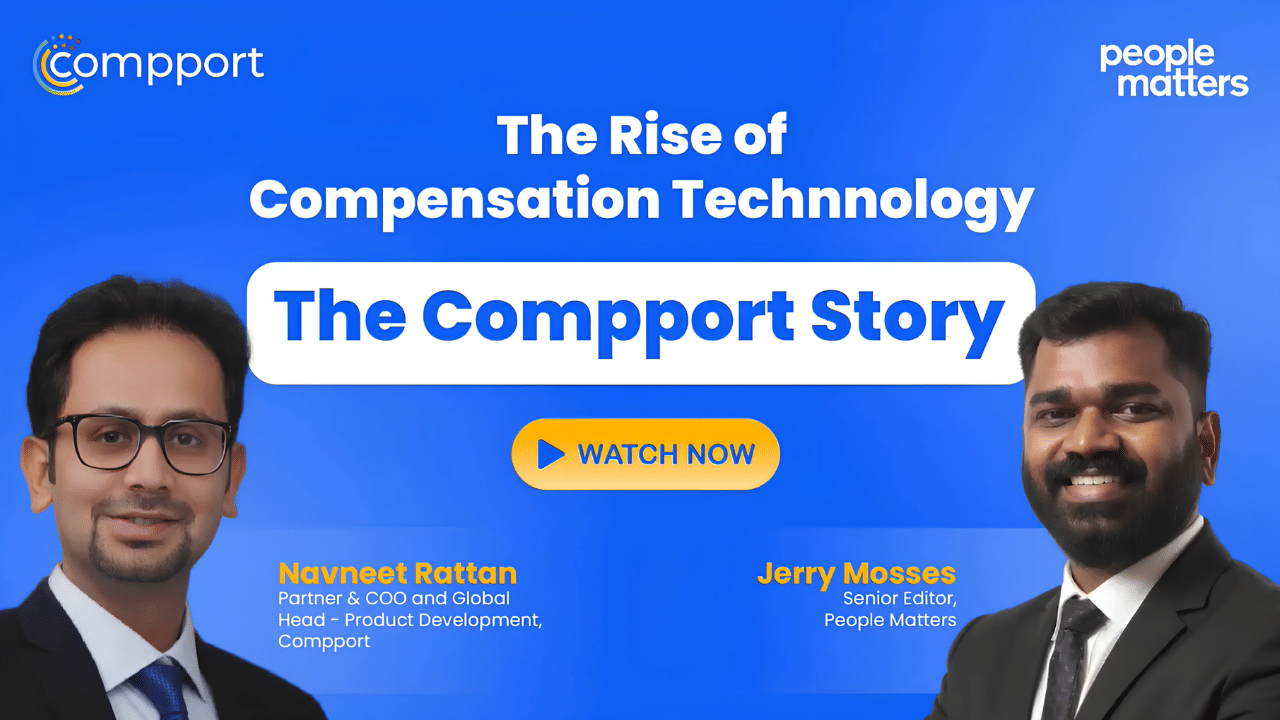
“Automation is table stakes today.” It is a striking assessment from Navneet Rattan, Partner and COO at Compport, particularly for a category that spent much of its early evolution trying to move organisations away from spreadsheets and manual compensation cycles.
Digitising an annual salary review was once a meaningful technology problem to solve. Today, organisations are navigating market corrections, retention interventions, promotions, variable pay, skill premiums and increasingly differentiated reward strategies, often across several employee populations at the same time. The challenge is no longer simply executing compensation accurately. It is deciding what action makes sense, for whom, at what moment, and against which context.
That shift sits at the heart of Compport’s view of where the category is heading: from compensation processing to compensation intelligence.
In an exclusive conversation with People Matters, Navneet Rattan, Partner and COO, Compport, reflected on what has fundamentally changed in the way organisations think about pay, why a single reward philosophy is becoming harder to sustain, and where AI can add meaningful value without removing human judgment from one of HR’s most consequential decisions.
The traditional annual compensation model is losing relevance.
For years, compensation architecture was built around a relatively predictable rhythm. Organisations planned an annual increment cycle, paid bonuses at defined points and made occasional exceptions where necessary.
The pandemic and its aftermath exposed how quickly that model could become inadequate.
During COVID-19, many businesses froze increments, bonuses, and other compensation measures in response to economic uncertainty. But when talent markets tightened after the initial disruption, the pressure reversed almost as quickly.
Navneet recalls conversations with HR leaders who found themselves responding to compensation pressures far more frequently than they had before.
“I've sat down with head of HRs who remember that period and have said that we were actually running not an annual, but a monthly compensation review cycle because every month some people or the other had to be given an increase.”
That period may have been exceptional, but it revealed something more permanent: compensation could no longer always wait for the compensation calendar.
Today, the annual review remains the main event for many organisations, but it increasingly coexists with quarterly variable pay, sales incentives, promotions, market corrections and targeted retention decisions.
As Navneet puts it: “It is not an annual process. It is actually an ongoing process, and it has become so over time. There are also times when companies, given business market and pressures, might not do the annual cycle at year-end but much later.”
The important shift is therefore not simply from one annual cycle to different cycle timings, but Compensation is moving from a scheduled HR process towards a more continuous response to business conditions and talent.
One reward strategy is becoming harder to defend
The economics of specialised skills are already making that differentiation visible. Results from leading survey houses on digital talent found that organisations in India are paying skill premiums of 10%–25% of base salary for sought-after digital capabilities. More than half of organisations surveyed across Asia Pacific also said differentiated reward programmes had become critical to sourcing digital talent.
That change becomes even more significant when viewed alongside another structural shift: organisations are no longer competing for talent only within the boundaries of their own industries.
Businesses across sectors now compete for digital, engineering, data, AI and other specialised capabilities. The consequence is that the traditional assumption that one compensation philosophy can be applied relatively uniformly across the organisation is becoming more difficult to sustain.
“One reward strategy doesn't work for companies,” Navneet said. “We've seen one company having multiple reward strategies at play, and that's given the business model and also the kind of talent that they're having to bring into the organisation given the business model.”
His argument is straightforward. When companies compete with different talent markets for different capabilities, simply superimposing an existing reward structure onto every employee group can become counterproductive.
“Today you are not just competing for talent with your industry peers, because the industry lines are getting blurred,” he said.
That is pushing organisations towards greater segmentation of rewards and, eventually, what Navneet describes as hyper-personalisation.
But personalisation creates a paradox for HR.
The more precisely an organisation tries to differentiate rewards according to talent segments, roles, skills or business priorities, the harder the compensation system becomes to administer consistently. More strategies mean more rules, more exceptions, more data and more opportunities for decisions to diverge.
“The more segmented the reward strategy, the more difficult it is to operate off a manual process because the complexity is very high,” Navneet explained.
Technology, in this context, is not simply making an existing process faster. It is becoming part of what makes a more differentiated reward strategy possible at scale.
Automation solves the process. It does not solve the judgment.
This is where the conversation around compensation technology starts to change.
Much of HR technology’s first wave focused on moving work from offline processes into systems: eliminating spreadsheets, standardising workflows, building approval structures and reducing administrative effort.
Those capabilities remain necessary. But Navneet believes they are no longer sufficient.
“Workflow automation is actually table stakes today,” he said. “I'll still call it business as usual.”
What lies beyond automation is a more difficult problem: giving the person making the compensation decision enough information to exercise sound judgment.
Navneet breaks that requirement into three layers.
First is data: complete and reliable information about compensation.
Second is context: understanding why the data looks the way it does for a particular role or person.
Third is the ability to analyse the two together and surface a recommendation.
A manager deciding whether to make a pay intervention does not simply need to know what an employee earns. The quality of the decision depends on the surrounding context: internal positioning, role requirements, skills, previous interventions, business priorities and the organisation's broader reward architecture.
The technology problem, therefore, shifts from recording a number to explaining a decision.
Navneet describes the desired outcome as “better, faster, consistent, and fair decisions” by managers, HR business partners and rewards teams.
That, rather than automation itself, is where compensation technology begins to become strategic.
From compensation analysis to compensation intelligence
This transition also changes how organisations should think about analytics.
Traditional compensation analytics largely helps HR understand what has already happened: where employees sit against ranges, how budgets have been distributed, how different populations compare and where anomalies may exist.
The emerging opportunity is more forward-looking.
Navneet describes it as moving “from compensation analysis to compensation intelligence.”
The difference is consequential.
Analysis surfaces information. Intelligence should help an organisation decide what to do with it.
The stakes around those decisions are also rising. Mercer’s 2025 Global Pay Transparency Survey, covering more than 1,600 multinational organisations, found that 77% are developing or have developed a pay-transparency strategy, but only 14% have fully implemented one across the enterprise. Employers in Asia and the Pacific were among those less prepared for growing transparency requirements.
That gap illustrates why compensation intelligence cannot stop at reporting. As employees, candidates and regulators increasingly ask organisations to explain how pay is determined, organisations need not only accurate compensation data but a defensible logic behind the decisions that data produces.
And that becomes particularly important as organisations encounter several emerging compensation challenges at once: pay equity, transparency, skills-based pay and increasingly personalised rewards.
These can easily be treated as separate programmes, each requiring its own solution. Navneet argues for looking at them differently.
Rather than treating each trend solely as a vertical problem, compensation intelligence can become a horizontal capability across them: connecting data, context and decision support irrespective of the specific compensation question being addressed.
It marks a broader evolution in the role of rewards technology. The system is no longer valuable simply because it houses compensation information or executes workflows. Its value increasingly lies in the quality of decisions it enables.
Navneet shares, “This is exactly why we have come up with the intelligence layer in our platform: CompportIQ - our Agentic AI module”.
CompportIQ helps organizations make better decisions—using AI to understand intent, model scenarios, identify risks and recommend actions, while governed compensation engines ensure every number is accurate, explainable and auditable. CompportIQ provides AI-powered Compensation Intelligence that helps Compensation leaders analyse, simulate and make smarter decisions across Job Architecture, Pay Ranges, Benchmarking, Merit, Incentives, Pay Equity, and Total Rewards.
The harder part of compensation technology is trust
There is another reason compensation technology differs from many enterprise software categories: the decisions it touches are unusually sensitive.
Organisations may be willing to experiment relatively quickly with technology in lower-risk workflows. Compensation requires confidence in the underlying data, logic and outcomes.
Navneet says Compport encountered that challenge directly during its early years.
“When we started off, we didn't really have a brand. Nobody knew Compport back then. But what we had was an awesome product,” he recalled.
Winning enterprise customers therefore required demonstrating depth rather than relying on the promise of digitisation: detailed product demonstrations, proof of concepts, testing and domain expertise.
“Our quick learning was that the clients had to be earned one by one, and not overnight. Today we are proud yet humbled to have 300+ customers across the globe,” he said.
That experience points to a larger lesson for the compensation technology category.
Implementation is only one part of adoption. Organisations also need HR teams, compensation specialists and managers to trust the information being surfaced and understand how to use it.
As Navneet observed, “The full journey is completed when you're able to drive adoption in a company.”
For a technology category increasingly seeking to shape decisions rather than merely execute them, that trust will become more important, not less.
What the conversation covers
Why compensation is moving beyond the traditional annual review cycle
How post-pandemic talent pressures changed the frequency of pay interventions
The shift from reward segmentation towards hyper-personalisation
Where AI can improve compensation decisions without replacing human judgment
Why trust and adoption matter as much as technology capability
What the next generation of compensation technology needs to enable