







AI & Emerging Tech
The efficiency paradox: Why AI makes work feel heavier, not smarter





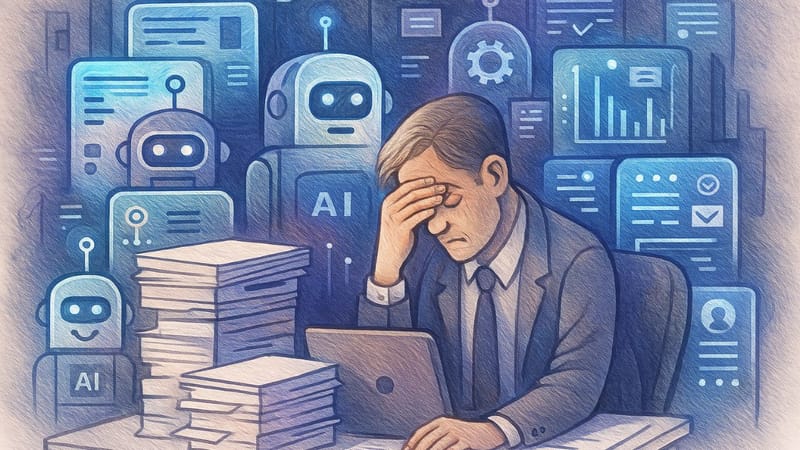
It is a strange feeling to grow weary of the future. For centuries, progress has been the great promise, faster, smarter, more powerful tools lifting the burden of human effort. But what if the very engines of progress begin to weigh on us?
Artificial intelligence has gone from buzzword to boardroom priority almost overnight. It writes reports, screens candidates, generates images, analyses customer data, and powers decision-making across industries. In just a few years, it has shifted from niche innovation to everyday reality. Every week seems to bring another launch, another update, another headline about how AI will change everything.
And yet, in the midst of all this energy, something quieter, but no less important, is happening. People are beginning to feel tired. Not tired in the sense of resisting progress or rejecting technology, but fatigued by the relentless pace, the hype cycle, and the pressure to adapt. Welcome to the age of AI fatigue.
The silent undercurrent of AI adoption
At first, AI fatigue might sound counterintuitive. After all, isn’t technology meant to make our lives easier? The reality is more complicated.
Employees today are not just using one AI tool. They are being asked to juggle multiple systems, all of which claim to streamline their work. A marketer might be using generative AI to draft content, an analytics tool to segment customers, and a chatbot to handle queries. A manager may be under pressure to ‘embed AI’ into strategy without really knowing what that means. Even consumers encounter AI at nearly every touchpoint, from recommendation engines to voice assistants.
The result is a kind of cognitive overload. Instead of feeling empowered, many people feel like they are on a treadmill that only speeds up. Harvard Business Review highlighted this tension in a 2024 study showing that employees who use AI intensively often report higher stress, loneliness, and even health issues such as insomnia. The paradox is stark: the very tools designed to save time can also drain energy.
Why it matters for leaders
For organisations, AI fatigue is more than an HR concern. It is a strategic risk.
Consider the investment stakes. Global spending on AI systems is projected to reach hundreds of billions in the next few years. But those investments mean little if employees disengage, resist adoption, or quietly revert to old ways of working. An EY survey found that even leaders are beginning to show signs of burnout from the pressure to constantly keep up with AI-driven change. What starts as excitement can quickly slide into skepticism, and skepticism is contagious.
In fact, fatigue erodes not just adoption but trust. When employees see tools rolled out with grand promises that fall short, they become wary of the next innovation. When leaders push AI initiatives without considering employee readiness, they risk creating an atmosphere of compliance rather than curiosity. In the long run, this slows down transformation more effectively than any technological barrier.
The anatomy of fatigue
So where does this fatigue come from? It is tempting to think of it purely in technical terms, but the roots are deeply human.
First, there is information overload. Every day brings a flood of new articles, webinars, and product updates. Employees don’t just need to do their jobs, they also feel they must stay current in a landscape that shifts weekly. It’s like drinking from a firehose.
Then there is adoption pressure. Many organisations have gone all-in on AI strategies, creating an implicit expectation that employees must use these tools to prove their relevance. Training is often insufficient, leaving workers caught between the fear of being left behind and the frustration of not knowing enough.
Layered on top is job insecurity. Even when leaders emphasize augmentation rather than replacement, the subtext of automation looms large. For some, AI doesn’t feel like a tool — it feels like a competitor.
And finally, leadership burnout cannot be overlooked. Executives themselves are not immune. A Wiley Workplace Intelligence Report in 2025 found growing ‘change fatigue’ across organisations, with AI cited as a major catalyst. Leaders may be tasked with getting AI right while simultaneously managing teams, customers, and shareholders. The burden is immense.
The irony of progress
There’s an irony at the heart of AI fatigue. The more fatigued people feel, the less likely they are to embrace the very technologies designed to help them. It becomes a vicious cycle: organisations push harder on adoption, employees resist more, and enthusiasm dwindles.
What makes this particularly dangerous is that fatigue is subtle. Unlike a major IT failure or a cybersecurity breach, it doesn’t announce itself with alarms. Instead, it creeps in quietly, in disengagement during training sessions, in tools that are technically available but rarely used, in leaders who avoid bold decisions because they feel too drained.
In many ways, AI fatigue is the canary in the coal mine of digital transformation. Ignore it, and the grandest strategies may collapse under the weight of human exhaustion.
Breaking the cycle
So, what can be done? The answer is not to slow down innovation, technology will continue to advance whether we like it or not. The answer is to humanize it.
That begins with pacing. Organisations must recognise that adoption is a journey, not a sprint. Rolling out multiple AI initiatives at once may look ambitious on paper, but it risks overwhelming the very people expected to deliver results. Small, phased experiments give employees room to adapt, learn, and build confidence.
Transparency is equally critical. Hype has a short half-life. Employees appreciate honesty about what AI can realistically achieve today, and where its limitations lie. When leaders admit that some systems are imperfect, it builds credibility rather than diminishing it.
And perhaps most importantly, framing matters. When AI is positioned as a co-pilot, a tool that augments human judgment rather than replacing it, the conversation shifts from fear to opportunity. Words are powerful. A phrase like ‘AI will replace repetitive tasks’ lands very differently from ‘AI will free up your time for more creative work.’
Of course, none of this is possible without capability building. Training must be role-specific, practical, and ongoing. Too often, employees are given generic AI workshops that feel disconnected from their actual responsibilities. What they need instead are hands-on examples: how AI helps a recruiter screen resumes, how it helps a finance analyst forecast trends, how it helps a manager summarise reports.
Finally, organisations must create feedback loops. Employees need safe spaces to express not only what’s working but also what isn’t. Fatigue often festers when people feel they have no voice in shaping the change that affects them.
Leadership for the long run
In the end, AI fatigue is not a technology problem, it is a leadership challenge. The companies that will succeed in the AI era are not those that adopt the most tools, but those that adopt them wisely.
That means acknowledging fatigue as real and valid, not as resistance to be bulldozed. It means designing change with empathy, not just efficiency. And it means remembering that technology may not tire, but humans do.
Leaders who take this seriously will not only sustain adoption but also cultivate trust, resilience, and genuine enthusiasm. Those who ignore it may find themselves with the best tools money can buy and a workforce too drained to use them.
The human side of innovation
AI is reshaping the world in profound ways. But as we race forward, we must ask: at what pace can people truly follow? Fatigue is a warning sign that the human side of innovation is being neglected.
The future of AI will not be decided solely by the sophistication of algorithms. It will be decided by whether people have the energy, trust, and will to embrace it. That is why tackling AI fatigue is not optional, it is central to ensuring progress that lasts.
The machines may not get tired. But if the humans do, the revolution stalls.
Topics
Author

Loading...