







AI & Emerging Tech
The new layoff may not look like a layoff: How AI is reshaping workforce stability






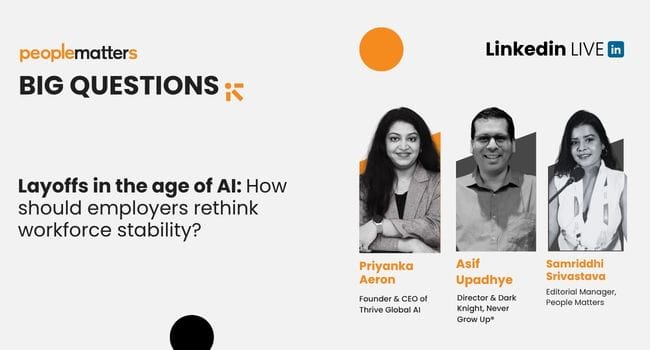
As AI changes how organisations operate, the bigger shift is not just job cuts. It is the quiet redesign of roles, workflows, expectations, and trust itself.
The layoffs dominating headlines today are only telling part of the story.
Inside organisations, a shift is underway. Teams are getting leaner. Roles are being merged. Repetitive work is disappearing into automated systems. Managers are being asked to do more with fewer people. And employees are increasingly unsure whether AI is being introduced to help them work better or simply make some of them unnecessary.
That tension sat at the centre of the latest People Matters Big Questions discussion featuring Priyanka Aeron, founder and CEO of Thrive Global AI, and Asif Upadhye, director at Never Grow Up.
The conversation was not framed around whether AI is “good” or “bad” for jobs. Instead, it focused on something more structural: what happens to workforce stability when organisations begin redesigning work itself around AI.

AI is compressing work faster than companies expected
One of the clearest themes from the discussion was that AI is changing operational timelines dramatically.
Aeron described how planning exercises in manufacturing and supply chain operations that once took weeks can now be completed in minutes using AI-led systems. Forecasting, inventory movement, and shutdown planning, she explained, are becoming faster and more data-driven.
For businesses, that creates obvious gains:
- Faster decisions
- Lower operational delays
- Better inventory control
- Higher efficiency
But it also changes workforce requirements.
When workflows that previously needed large teams become automated, organisations inevitably start questioning how many people are still required and which roles remain strategically important.
That is why the modern workforce debate is no longer only about layoffs. It is about redesign.
The bigger issue is how companies choose to use AI
Throughout the discussion, Upadhye repeatedly returned to one idea: intent matters more than technology.
According to him, organisations are approaching AI from two very different mindsets.
Some are using it to improve work quality, reduce repetitive tasks, and free employees to focus on more meaningful responsibilities. Others are approaching AI primarily as a cost-cutting tool.
That difference shapes how employees experience transformation.
If workers believe AI is being used mainly to reduce headcount, every automation initiative starts looking like a threat. If they believe it is helping them become more effective, adoption becomes easier.
“The intent should be, how can we do better?” Upadhye said during the discussion. The problem, however, is that employees are often not hearing that clearly enough.
Organisations are still struggling to communicate the transition
One of the strongest parts of the conversation centred on transparency.
Upadhye said that many organisations are not communicating AI-related workforce changes honestly or clearly enough. According to him, very few companies openly explain:
- Why certain roles are changing
- Which functions are becoming automated
- What reskilling pathways exist
- How AI adoption will affect long-term workforce structures
That silence creates uncertainty across organisations. Employees start wondering:
- Am I replaceable?
- Is my role shrinking?
- Is AI becoming my manager?
- Should I already be looking elsewhere?
The result is not just anxiety. It changes workplace behaviour itself.
During the session, the panel connected this uncertainty to broader workplace trends like quiet quitting, moonlighting, and declining trust between leadership and employees.
Fear-driven workplaces, Upadhye warned, eventually stop producing honest conversations and creative disagreement. Employees become more focused on survival than contribution.

Companies may be underestimating what humans still do best
The discussion also pushed back against the idea that AI can seamlessly replace human judgement.
Aeron pointed to customer-facing functions as one area where organisations often overestimate automation. Businesses may automate communication systems aggressively, but customers still trust people more than bots in high-stakes or emotionally sensitive interactions.
“People do business with people,” she said.
The same logic applies internally.
AI can generate reports quickly. It can identify trends faster than humans. But interpretation, context, judgement, and strategic thinking still depend heavily on people.
Upadhye warned that organisations trusting AI outputs blindly risk making bad decisions faster rather than better decisions smarter.
That becomes especially dangerous when companies start removing experienced employees who carry institutional knowledge that systems cannot easily replicate.
The definition of a “valuable employee” is changing
The panel also made it clear that employees can no longer rely on static job descriptions. AI is changing expectations across industries. Workers are now expected to:
- Learn continuously
- Use AI tools actively
- Work across functions
- Interpret data
- Think critically
- Communicate clearly
- Adapt quickly
Prompt engineering, dashboard interpretation, storytelling, and logical reasoning all emerged as increasingly important skills during the discussion.
But the panel also acknowledged that organisations themselves are sometimes creating unrealistic expectations.
Just because AI can generate outputs quickly does not mean employees can instantly transform how they work overnight. Adoption still requires learning time, experimentation, and managerial support.
That pressure gap is becoming another source of friction.

Leadership may be the biggest bottleneck
Interestingly, some of the sharpest criticism during the session was directed at leadership teams themselves.
Aeron argued that many leaders still want to review reports, dashboards, and operations using traditional systems even while demanding AI-led transformation from employees.
That inconsistency slows adoption.
Her argument was simple: organisations cannot become AI-first if leadership itself refuses to change how it operates.
Transformation, she suggested, only becomes credible when senior management visibly adopts new workflows and decision-making systems first.
Workforce stability is being redefined in real time
By the end of the discussion, one thing became clear: workforce instability in the AI era may not always arrive through dramatic layoff announcements.
Sometimes it will happen more quietly.
A role becomes smaller. A team shrinks gradually. Certain responsibilities disappear. Productivity expectations rise. AI absorbs more routine work. Human contribution becomes concentrated around judgement, creativity, and adaptability.
The organisations that navigate this shift successfully may not necessarily be the ones adopting AI the fastest.
They may be the ones that manage to answer a much harder question: How do you redesign work without making employees feel permanently disposable?
Because increasingly, the new layoff may not look like a layoff at all.
To learn more from leaders about some of the burning questions in today’s world of work, stay tuned to People Matters' Big Question series on LinkedIn.
Author
Loading...