







AI & Emerging Tech
The rate of AI adoption depends on manager behaviour and culture: Colleen Doherty






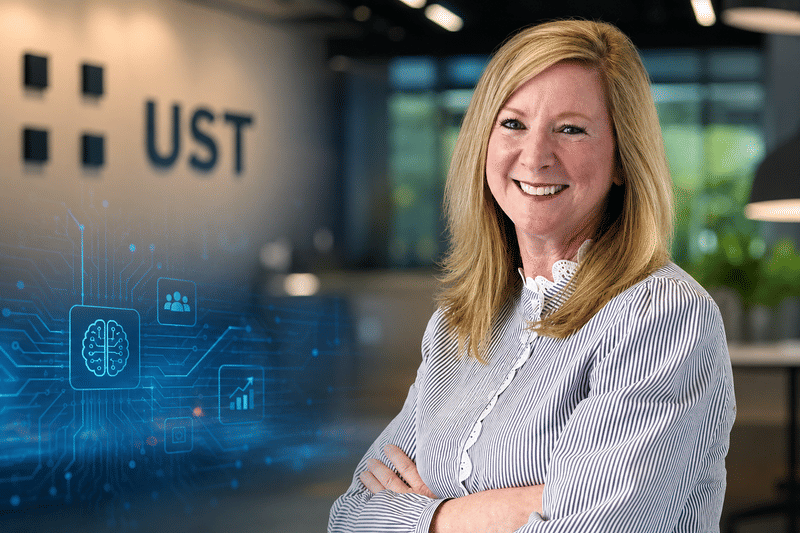
Employees may have access to AI tools and digital skills, but adoption stalls when managers fail to champion change. UST Chief People Officer Colleen Doherty explains why leadership behaviour, trust and organisational culture are becoming the biggest determinants of AI success.
For all the excitement surrounding artificial intelligence, many organisations are confronting a frustrating reality: employees have access to AI tools, training programmes are underway, and digital skills are improving, yet meaningful adoption remains uneven.
The assumption that digital fluency would naturally translate into AI fluency is proving flawed.
According to Colleen Doherty, Chief People Officer at UST, the organisations making real progress with AI are not necessarily the ones investing the most in technology. They are the ones creating cultures where managers actively encourage adoption, experimentation is supported, and employees understand how AI connects to business outcomes.
In a conversation with People Matters, Doherty offered a perspective that shifts the AI discussion away from technology and towards people. Her view is clear: the future of AI adoption will be determined less by access to tools and more by leadership behaviour, workforce confidence and organisational culture.
Digital skills are opening the door, but they are not driving adoption
Many organisations spent years building digitally capable workforces. Yet Doherty believes digital capability alone does not guarantee that employees will embrace AI in ways that create business value.
"Digital fluency alone is not enough to drive meaningful AI adoption," she says.
The distinction matters.
Being comfortable with digital tools and being willing to integrate AI into daily work are not the same thing. Employees need to see AI as a transformative capability rather than another technology platform competing for attention.
That shift, according to Doherty, rarely happens on its own.
Leadership endorsement plays a decisive role. Employees are far more likely to experiment with AI when they see senior leaders actively championing its use and reinforcing its importance across the organisation.
Equally important are practical examples. Employees need evidence that AI can deliver tangible business outcomes. Case studies, internal success stories and visible wins often become more influential than formal training programmes.
The lesson for employers is straightforward: adoption accelerates when employees understand why AI matters, not simply how it works.
The strongest AI adopters may not be who organisations expect
Conventional wisdom often suggests younger employees will lead AI adoption because they have grown up surrounded by technology.
Doherty sees a different trend emerging.
She points to mid-career professionals as some of the most committed AI adopters inside organisations.
The reason is rooted in experience.
Unlike employees encountering their first major technology shift, many mid-career professionals have already navigated multiple waves of disruption. They have seen technologies transform industries, change job requirements and reshape career trajectories.
That history creates urgency.
Having witnessed the consequences of failing to adapt, they often approach AI with a practical mindset rather than curiosity alone.
"They recognize that embracing new technologies is often essential for remaining relevant and competitive," Doherty explains.
Many have also experienced the benefits of being early adopters. Improved productivity, career progression and stronger business outcomes create powerful incentives to engage with new technologies.
As AI continues to reshape work, that awareness appears to be turning many experienced professionals into some of the workforce's strongest advocates for adoption.
The gap between using AI and creating value with AI
Not all AI adoption delivers equal value.
Many employees now use AI for drafting content, generating ideas or completing isolated tasks. Far fewer are integrating it into decision-making processes and broader business workflows.
Doherty believes the difference lies in how employees think about impact.
Those who successfully integrate AI into their work tend to look beyond individual tasks and focus on organisational outcomes.
Rather than asking how AI can help them complete a piece of work more quickly, they ask how it can contribute to larger business objectives.
According to Doherty, these employees share several characteristics:
- They understand the broader business impact of AI.
- They focus on organisational outcomes rather than isolated tasks.
- They anticipate how AI may reshape future ways of working.
- They identify opportunities to create long-term value.
- They establish a clear business case for AI adoption.
This ability to connect technology to business outcomes separates casual users from employees who generate meaningful value through AI.
Why trust remains the missing ingredient
If access to AI is increasing, why do many employees still rely heavily on instinct, peer validation and traditional judgement?
For Doherty, the answer comes down to trust.
Many employees continue to view AI-generated outputs as useful suggestions rather than reliable inputs for decision-making.
That hesitation becomes especially visible when decisions carry significant consequences.
The more accountability attached to a decision, the more likely employees are to fall back on established judgement and experience.
"There is also a concern around accountability, particularly in situations where the cost of making an incorrect decision is high," she says.
Organisational culture can reinforce this tendency.
Many workplaces still place greater value on experience-based decision-making than AI-assisted recommendations. As a result, employees often feel more comfortable relying on human judgement, even when AI tools are available.
Doherty expects trust to strengthen as AI technologies mature and governance frameworks become more robust.
Until then, adoption may continue to lag behind access.
The real barriers are organisational, not technological
One of the most striking observations from Doherty is that many organisations are focusing on the wrong problem.
"The biggest barriers to AI adoption are often organisational and psychological rather than technological," she says.
In many workplaces, employees are not resisting AI because the tools are inadequate. Instead, barriers often include:
- Limited exposure to AI technologies.
- Insufficient infrastructure and enablement.
- Lack of role-specific learning opportunities.
- Fear of making mistakes.
- Uncertainty about AI's relevance.
- Weak connections between AI adoption and career growth.
- Inconsistent manager sponsorship.
Without support, employees may view AI as unfamiliar or intimidating.
When adoption is not linked to role expectations, performance measures or career progression, motivation often declines further.
This is where managers become critical.
Employees frequently look to managers for guidance when navigating change. If leaders are disengaged or inconsistent, adoption slows. If leaders actively coach and encourage experimentation, adoption accelerates.
In Doherty's view, manager behaviour can be one of the strongest predictors of whether AI initiatives succeed or stall.
Why organisations need to rethink learning
Traditional training programmes remain important, but Doherty believes they are not enough on their own.
Organisations need to make AI part of everyday work.
"Organisations should focus on embedding AI into the flow of work rather than relying solely on traditional training programs," she says.
That means moving beyond one-size-fits-all learning approaches.
Instead, organisations should create role-specific pathways that reflect how different employee groups use AI in practice.
Doherty also advocates creating safe spaces for experimentation through:
- AI sandboxes
- Innovation labs
- Hackathons
- Practical workplace applications
- Manager-led coaching
Success should be measured through behavioural change and business outcomes rather than training completion rates alone.
The objective is not simply to educate employees about AI. It is to help them build confidence through regular use.
The future belongs to AI-native organisations
Looking ahead, Doherty believes a clear divide is emerging between organisations that integrate AI into the fabric of work and those that treat it as a standalone initiative.
The most successful organisations will redesign roles, workflows and career paths around AI.
They will link AI adoption to performance, rewards and career progression. They will measure outcomes such as productivity, quality, speed, business growth and long-term sustainability.
By contrast, organisations that focus primarily on tool deployment and training programmes risk fragmented adoption and limited impact.
Those companies may successfully introduce AI technology but fail to fundamentally change how work gets done.
The distinction could prove decisive.
As AI becomes more deeply embedded across industries, the organisations that thrive may not be those with the most advanced tools. They may be those that build cultures where employees feel confident using them.
That is why Doherty sees manager behaviour and organisational culture as increasingly important.
Technology may power the AI revolution. But whether employees embrace it remains, fundamentally, a people challenge.
Topics
Author
Loading...