







Business
Apple at 50: The founders, the fallout, and the leaders who built a trillion-dollar company






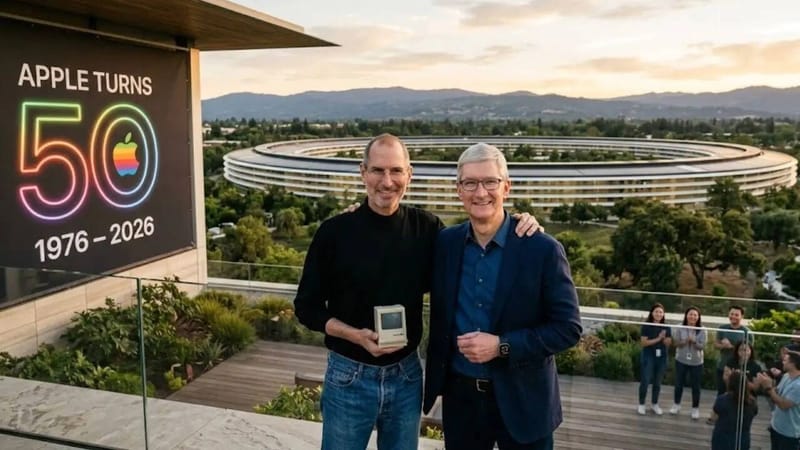
From a garage startup to a $trillion giant, Apple’s 50-year journey is a story of bold leaders, clashes, and reinvention.
Fifty years ago, Apple began not in a lab, but in a garage—with three men, a circuit board, and an idea that computers could be personal.
Today, it stands as one of the world’s most powerful companies. But Apple’s story is not just about products—it’s about people, personalities, power struggles, and pivots.
From Steve Jobs’ obsession with perfection to Tim Cook’s operational mastery, Apple’s leadership journey reads less like a corporate timeline and more like a long-running drama—with breakthroughs, exits, comebacks, and reinventions.
A VISIONARY, A BUILDER, AND THE MAN WHO LEFT
Apple’s origin story is almost mythical now.
Steve Jobs, the relentless visionary. Steve Wozniak, the brilliant engineer. And Ronald Wayne—the co-founder who got out early.
Wozniak built the machines. Jobs saw the future. Wayne handled early paperwork, even sketching Apple’s first logo, before selling his 10% stake within weeks.
It’s one of Silicon Valley’s most famous “what ifs”.
From there, things moved quickly. The Apple I was followed by the Apple II, and suddenly, this garage experiment looked like a real business.
MARKKULA AND THE FIRST RESET
Enter Mike Markkula—the investor who didn’t just bring money, but structure.
He invested early, helped professionalise the company, and brought in Michael Scott as Apple’s first CEO. That move marked Apple’s first big transition—from scrappy startup to serious company.
By 1980, Apple had gone public. Within a few years, it crossed $1 billion in annual sales, a staggering milestone for the time, according to Marketplace reporting.
But even as the business grew, tensions were building.
THE FALL AND RETURN OF STEVE JOBS
Apple’s most dramatic chapter? Jobs being pushed out of his own company.
In the early 1980s, Apple brought in John Sculley as CEO. What followed was a power struggle that ended with Jobs leaving in 1985. It should have been the end of the story. Instead, it became the middle.
Jobs went on to build NeXT and Pixar. Apple, meanwhile, drifted—cycling through leaders, products, and strategies without clear direction.
Then came 1997. Apple bought NeXT. Jobs came back. And everything changed.
JOBS REBUILDS APPLE
When Jobs returned, Apple was struggling. What followed was one of the most remarkable turnarounds in business history.
He simplified product lines. Killed distractions. Focused obsessively on design.
Then came the hits:
- iMac
- iPod
- iPhone
- iPad
Apple stopped being just a computer company. It became a lifestyle ecosystem.
Jobs didn’t just build products—he built desire. And a culture where details mattered, simplicity ruled, and “good enough” wasn’t acceptable.
TIM COOK: THE OPERATOR TAKES OVER
When Jobs stepped down in 2011, many wondered if Apple could survive without its icon.
Tim Cook, his successor, was a very different leader. No theatrics. No keynotes that felt like rock concerts.
Instead, Cook focused on what he knew best: scale, efficiency, and execution. Under him, Apple:
- Strengthened its global supply chain
- Expanded aggressively into services
- Became one of the first companies to cross the trillion-dollar mark
If Jobs built the rocket, Cook made sure it ran smoothly at scale.
APPLE TODAY: A TEAM, NOT A SINGLE HERO
Unlike its early years, Apple today isn’t defined by one personality.
It’s run by a deep leadership bench—from software and hardware to retail, marketing, and operations.
This shift reflects a broader evolution: from founder-led intensity to institutional leadership.
WHAT 50 YEARS OF APPLE REALLY SHOW
Apple’s story isn’t linear. It’s messy. Human. Full of contradictions. A founder who leaves and returns. A company that nearly fails—and then dominates. A culture built on both conflict and clarity.
At 50, Apple represents something bigger than technology. It shows that companies don’t just grow—they evolve through leadership. And sometimes, the difference between decline and dominance is not the product… but who’s in charge when it matters most.
Topics
Author
Loading...