







DEI Strategy
The Inclusion Value Chain: Turning inclusion into a competitive advantage






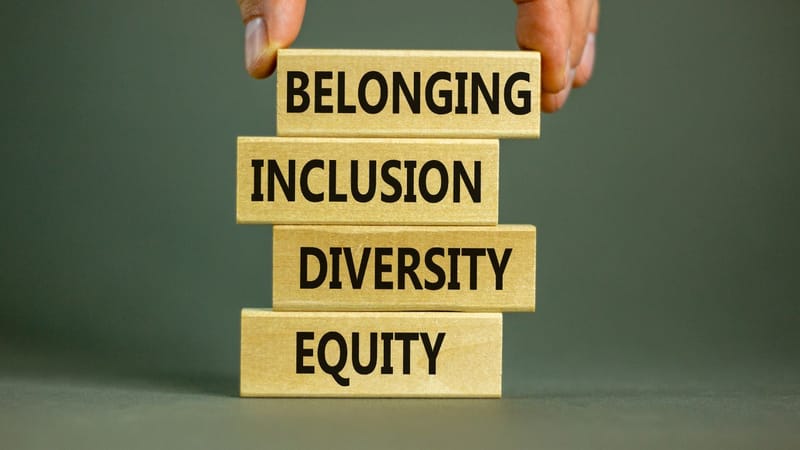
When inclusion becomes a business strategy, teams unlock their full potential. The Inclusion Value Chain maps the journey from aspiration to advantage.
Every organisation runs on invisible currents: trust, belonging, and the sense that every voice matters. When those currents are weak, even the most talented teams underperform; when they are strong, ordinary groups achieve extraordinary results. Inclusion is not an abstract principle but a performance multiplier, and the Inclusion Value Chain captures how intent can be translated into impact.
Unlike traditional DEI initiatives that treat inclusion as a separate workstream, the Inclusion Value Chain is a five-stage measure that integrates belonging into core business processes, creating sustainable change that drives both people and performance outcomes.
The Inclusion Value Chain spans five stages:
Stage 1 - Intelligence: Making inclusion visible
The strategic imperative: Organisations cannot manage what they cannot measure. The most successful companies treat inclusion as a business metric, not a cultural aspiration.
Leading organisations have moved beyond counting heads to understanding hearts and minds. They deploy sophisticated measurement systems that capture both behavioural indicators (policy utilisation rates, meeting participation patterns, promotion velocity) and experiential data (psychological safety scores, belonging indices, cultural penalty assessments). This dual-lens approach reveals the often-invisible barriers that prevent talent from fully contributing.
Global reports reflect that the business case is compelling: companies in the top quartile of ethnic and cultural diversity on executive teams outperformed those in the fourth quartile by 36% in profitability. Diverse and inclusive workforces demonstrate 1.12x more discretionary effort, 1.19x greater intent to stay, 1.42x greater team commitment, and 1.57x more collaboration among teams. They identify friction points before they become flight risks and spot emerging talent before competitors do.
Performance drivers:
Deploy real-time inclusion dashboards that track policy utilisation without cultural penalty
Implement sentiment analysis of internal communications to identify exclusionary language patterns
Create predictive models that flag teams at risk of talent attrition due to inclusion gaps
Stage 2 - Activation: Leadership as Inclusion Architects
The strategic imperative: Inclusion is not delegated; it is demonstrated. Leadership behaviour shapes culture more than any policy manual.
The most effective leaders operate as "inclusion architects", actively designing experiences that enable authentic contribution. They understand that inclusive leadership requires both emotional intelligence and tactical skill: interrupting bias in real-time, amplifying marginalised voices, and modelling vulnerability. These behaviours cannot be relegated to training modules; they must be embedded in performance expectations and compensation structures.
Organisations that integrate inclusion metrics into leadership compensation create cultures where inclusion becomes a measurable business outcome rather than an aspirational value. When leaders' financial incentives align with inclusion outcomes, behaviour shifts from compliance to commitment.
Performance drivers:
Embed inclusion impact scores in executive compensation formulas
Create "inclusion moments" in every leadership meeting where bias interruption is practised
Establish peer coaching circles where leaders hold each other accountable for inclusive behaviours
Stage 3 - Systemic Integration: Building Accountability Architecture
The strategic imperative: Sustainable inclusion requires systemic change, not individual heroics. Organisations must architect accountability into their operating model.
The accountability gap: where inclusive policies exist but exclusive practices persist, represents the greatest risk to DEI investment. Leading organisations close this gap by distributing inclusion ownership across all management levels, creating multiple feedback loops, and establishing consequences for both progress and stagnation.
Companies with robust accountability architectures create cultures where inclusion is everyone's responsibility, not just HR's mandate. They establish clear consequences for both progress and stagnation, ensuring that inclusion initiatives maintain momentum rather than losing energy over time.
Performance drivers:
Make inclusion outcomes a component of every manager's performance review
Establish cross-functional inclusion councils with budget authority and decision-making power
Create transparent reporting mechanisms with guaranteed response protocols
Stage 4 - Cultural Normalisation: Embedding Flexibility and Safety
The strategic imperative: Psychological safety and flexibility are not perks; they are performance enablers that unlock discretionary effort and innovation.
Google's Project Aristotle research identified psychological safety as the single most important factor in high-performing teams. The most innovative organisations understand that cognitive diversity requires psychological safety to flourish. They create environments where intellectual risk-taking is rewarded, where failure is treated as learning, and where diverse working styles are accommodated rather than penalised. This requires moving beyond policy creation to cultural transformation.
Teams with high psychological safety demonstrate greater willingness to speak up without fear of repercussion and to share ideas that advance innovation. When flexibility is truly normalised and not just tolerated, organisations unlock the full potential of their diverse talent.
Performance drivers:
Implement "flexibility-first" meeting protocols that accommodate different working styles and schedules
Create innovation challenges that explicitly reward diverse thinking approaches
Establish "failure celebration" rituals that normalise intellectual risk-taking
Stage 5 - Multiplication Effect: Leadership Pipeline as Culture Catalyst
The strategic imperative: Representation in leadership creates exponential cultural change. Every promoted woman becomes a signal that advancement is possible and diverse leadership styles are valued.
The multiplication effect occurs when underrepresented leaders not only succeed but also actively reshape the systems that enabled their success. They become both symbols of possibility and architects of inclusion, creating ripple effects that extend far beyond their immediate teams. This requires moving beyond mentorship to active sponsorship, leaders who use their influence to create opportunities, not just provide guidance.
Organisations with strong female leadership pipelines create exponential cultural change as these leaders reshape organisational systems from positions of influence. The return on investment in leadership development compounds over time, creating a sustainable competitive advantage.
Performance drivers:
Establish sponsorship requirements for senior leaders, measured by the advancement outcomes of their sponsees
Create accelerated leadership tracks with clear milestones and accountability measures
Implement reverse mentoring programs where diverse junior talent shapes senior leader perspectives
The synergy effect: Where intent meets impact
The Inclusion Value Chain creates compound returns when stages interconnect and reinforce each other. Organisations that implement this systematic approach transform DEI from a cost centre into a strategic capability, one that becomes increasingly valuable as markets become more diverse, talent becomes more mobile, and competitive advantage increasingly depends on the ability to harness collective intelligence.
Inclusion is not a destination but a capability, one that becomes increasingly valuable as markets become more diverse, talent becomes more mobile, and competitive advantage increasingly depends on the ability to harness collective intelligence. Organisations that master this capability don't just become more inclusive; they become more intelligent, adaptive, and ultimately, more successful.
The goal is to build for the long term and create a structure where inclusion is second nature, not an obligation — Tracy Williams, Chief People and Culture Officer at New Relic

Loading...