







Employee Engagement
Inclusivity, Rewards and Well-being as AI propels HR Initiatives to Attract and Retain Talent





Attracting, engaging and retaining the right talent is essential and is now more enabled with AI intervention. Rewards and well-being are undoubtedly strategic initiatives which are now made possible with technology-enabled inclusivity, personalization, and flexibility.
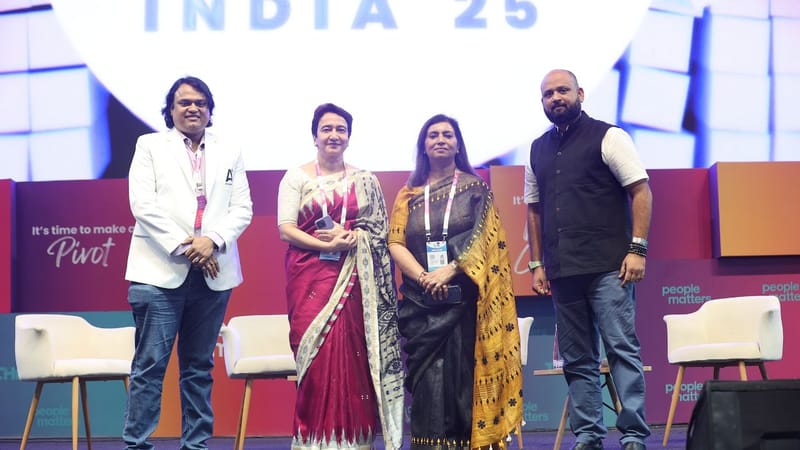
Tech-powered HR is redefining how companies now hire employees or decide recognition strategies for their well-being. To discuss the same, a high-powered panel discussion titled ‘Tech-Powered Culture: Redefining Recognition & Well-being’ discussed how technology merged code and culture into a homogenous association that redefined business outcomes for many organisations.
The panel gathered leaders from diverse organisations to discuss how automation, AI, and hybrid work are redefining employee engagement, recognition, and well-being. Girish Menon (Head HR, Swiggy), Sourabh Deorah (Co-founder & CEO, AdvantageClub.ai), Anupama Kaul (Director – HR, Cummins India), and Simin Askari (President – Corporate HR & Business Excellence, Dharampal Satyapal) shared their insights on this transformation.
While newspapers and news websites are screaming headlines about potential job losses with the threat of AI looming largely over many employees’ work profiles, the panelists shared major concerns about attracting quality talent and retaining it for fear of losing out some of their best employees to their competitors. With retaining talent being the real pain point for today’s HR, the focus is on making recognition and wellness central to competitiveness.
Rewards and Well-being: From Perks to Strategic Necessity
Creating the right talent pool is essential but then retaining talent can be equally tough. Realising the seriousness involved in hiring and the tenacity needed to retain employees, Sourabh Deorah posed a very significant question, “How do you reimagine rewards and well-being programs in the today’s AI era, how it’s going to change in the near future, and what’s the impact it can bring?”
Anupama Kaul, willing to answer the question in the right perspective responded, “As of today, reward and recognition and well-being are no longer aspirational initiatives or nice to have. I think they have become a part of organisational DNA. The organisation has to really focus on how we are recognising our people and how we are driving the well-being initiative. At the same time, it needs to reach employees the masses, away from the time when we could really have the sales wise implementation. Technology and AI plays a very critical role for organisations to be very efficient, effective, deliver these initiatives and actions at the same time across that’s amazing, and that’s very true.”
Programs must be inclusive, reaching all employees, not just select groups, and should extend beyond professional achievements to include mental, physical, and financial well-being as well as personal milestones. Recognition, when aligned with cultural values, drives both performance and belonging.
Easier Said than Done
Taking Anupama’s views forward, Simin Askari added, “To make people stick around, you need to have very specific strategies around rewards and recognitions.” There are hurdles that must be overcome while ensuring a holistic kind of approach in carving out essential employee-retention strategies:
Defining the purpose of recognition: Being clear about what to recognise and describe explicitly employees’ achievements, well-being, or life events.
Digital fatigue: There is a major challenge in introducing new work platforms in today’s workplace. Prolonged screen time, recurring online meetings, persistent notifications and the compulsion to be always present across various applications and platforms can cause employee burn-out. The stress, be it physical or mental, is real. Though the idea of introducing new platforms cannot be ignored outrightly, companies must focus on a human-centred approach while strategically ensuring that new platforms integrate smoothly.
Are the initiatives relevant: Companies must avoid copying others’ initiatives and ensure programs that create cultural and business impact. Most importantly, the initiatives must be measured against their effect to see the real impact. While adoption rates and participation matter, true success lies in fostering a “culture of appreciation.” Beyond retention, metrics such as survey feedback, health trends, and employee engagement levels reveal the broader benefits of well-being initiatives.
Trust Your Employees
Policy innovations fail where there is a genuine lack of trust towards employees. Companies today must allow a certain level of flexibility to avoid employees adopting an unwanted rigid mindset. Progressive practices must be planned and implemented. For example, Swiggy allows moonlighting policies to its employees that allow them to pursue external work, provided there is no conflict of interest, thus, reflecting the must-needed trust and autonomy.
Girish Menon added, “Contrast of policies that you can build which makes it relevant to the end user. Similar lines. We run flex wallet for a lot of organisations during covid, a lot of organisations, like with the work from home, flex wallet have very interesting requests.”
Offering allowances for courses, fitness, or personal growth underscored personalisation, though with necessary guardrails. Flexibility emerged as a recurring principle, tailored to roles and business needs, from hybrid work to temporary four-day weeks during Covid.
Setting Clear Priorities
AI and digital tools enable scale, speed, and personalisation in engagement programs. From real-time mood tracking to individualized recognition, technology ensures inclusivity and timeliness. Panelists predicted that by 2026, AI will be deeply embedded across HR functions, shaping hyper-personalised employee experiences.
Simin added, “I think the way the world is moving a lot of organisation, including ours, is actually looking at how to continue embedding AI and, you know, into more and more processes, how to ensure that employee experiences become more hyper personalised than it is to do with the way they are recognised, or it is to do with the way they are developed and how the talent is managed.”
Attracting Gen Z Talent
Gen Z demands purpose-driven organizations, transparency, and digital-first experiences. Beyond pay, they value sustainability, societal contributions, and flexible career paths. They expect self-service, app-based HR tools and judge employers on alignment with personal values, making employer branding critical.
There is one thing that panelists could not agree more about. It is that rewards and well-being are no longer optional perks but strategic imperatives. Effective programs must be inclusive, personalised, and technologically enabled, with flexibility and purpose at their core. The ultimate ROI is not just reduced attrition but the cultivation of a sustainable culture of appreciation and well-being that drives long-term engagement and organisational success.
Loading...