







Employee Skilling
Reinventing workforce: How companies are rethinking skills, AI, and talent readiness





Discover how HCL GUVI CEO Arun Prakash M shares insights on future-ready skills, AI-led learning, and the evolving strategies shaping tomorrow’s workforce.
In boardrooms across the world, a quiet anxiety is rising. Companies know that the era of incremental improvement is over; efficiency alone won’t secure their future. Innovation, fast, fearless, and continuous, is now the currency of competitiveness. Yet as industries race toward AI-enabled transformation, many organisations are confronting an uncomfortable truth: their people aren’t fully prepared for the future that’s already here.
Few understand this challenge better than Arun Prakash M, Founder & CEO of HCL GUVI, who has spent years working at the frontlines of digital skilling. From multinational giants to ambitious startups, he has seen how capability gaps can either stall innovation or accelerate it. In this conversation, Arun offers a candid look at what holds companies back, what truly moves the needle, and how learning strategies must evolve if organisations want to thrive in a rapidly shifting world.
The capability gap: Why traditional learning models are no longer enough
According to Arun, one of the biggest barriers to innovation is the persistence of outdated learning approaches that were built for slower, more predictable business cycles. While technology and customer expectations have leapt forward, many organisations still rely on learning frameworks that haven’t evolved at the same pace.
Employees today often lack exposure to emerging technologies, and the disconnect between business and technology teams continues to widen. Managers may understand AI in theory yet struggle to apply it effectively, and new hires frequently enter the workforce without being job-ready. These gaps slow down transformation and hinder companies from unlocking innovation.
Arun notes that the shift must be toward application-driven, business-aligned learning, the kind that turns concepts into real problem-solving skills. HCL GUVI, he says, has been instrumental in helping companies bridge that gap by bringing practical, hands-on learning experiences into workforce development.
Personalised learning at scale: The new corporate expectation
Personalisation is no longer a premium, it’s the baseline. But delivering customised learning pathways for thousands of employees across diverse roles is far from simple. Arun observes that organisations are increasingly embracing personalised learning journeys designed around role specificity, maturity levels, and functional contexts. What used to be a challenge, scaling tailored content has now become attainable through integrated platforms that combine diagnostics, learning pathways, and immersive labs. Employees no longer want generic content. They want learning that speaks directly to their role, their goals, and the technologies shaping their work.
Redefining onboarding: Why day-one productivity matters more than ever
A new hire’s first few months significantly impact their long-term success, and companies are feeling the pressure to accelerate speed-to-productivity. Arun explains that organisations today are reinventing onboarding with pre-joining learning modules, job-ready finishing schools, and hands-on simulations that mirror real workplace scenarios. Gone are the days of passive induction programs. Instead, continuous assessments and real-time feedback loops ensure that employees transition into their roles with greater confidence and capability. The result is a workforce that doesn’t just enter the company, it contributes meaningfully from the start.
The GenAI imperative: Building AI fluency across the organisation
Perhaps the most dramatic shift in talent development comes from the rise of Generative AI. Arun points out that AI fluency is no longer reserved for data scientists or engineers. Every function from marketing and HR to finance and operations is exploring how AI can help them work smarter and innovate faster.
Companies are now embedding AI learning into development roadmaps through manager-focused AI programs, functional awareness tracks, and deep-dive technical labs. Internal AI champions are emerging to drive experimentation and adoption. As Arun puts it, the goal is no longer to understand what AI is, but to recognise what AI can do for every role.
Cracking the engagement code: Making learning social, practical, and outcome-driven
Even the most well-designed programs fail if learners don’t engage. Arun highlights that meaningful participation rises sharply when learning is practical, interactive, and tied to outcomes employees care about. Cohort-based learning builds community and momentum, while vernacular content in specific use cases widens access. Mentor-led sessions bring depth and accountability, and real-world challenges such as hackathons and project showcases give employees the satisfaction of applying what they learn. When learning feels relevant to the job and aligned with growth, engagement becomes organic.
Learning for good: How CSR-led skilling is transforming communities
Beyond corporate walls, a powerful movement is gaining ground around inclusion-led and CSR-based skilling. For Arun, these initiatives represent more than social responsibility, they’re catalysts for economic mobility.
Women returning to the workforce are using tech skilling programs to rebuild their careers. Youth in underserved regions are gaining employability through structured digital learning. And vernacular skilling is breaking language as a barrier, allowing more people to benefit from digital opportunities.
A defining milestone in this movement was HCL GUVI’s South Asian Women in Tech (SAWiT) initiative, which earned a Guinness World Record for the most users taking an AI lesson in 24 hours. Over 46,000 women completed an AI and Python lesson in a single day, showcasing the transformative power of accessible learning at scale.
The road ahead: Learning as the engine of organisational transformation
As the interview draws to a close, Arun reflects on what will define the workplaces of the future. Companies that invest in people, not just platforms, will be the ones that innovate, adapt, and lead. AI will accelerate work, but human capability will determine how far organisations can go.
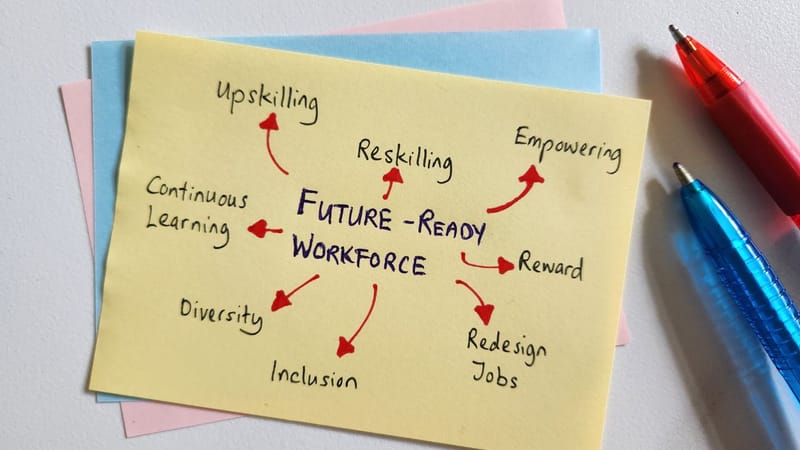
A future-ready workforce, Arun believes, is one that embraces continuous learning, experiments boldly with technology, and thrives in environments that reward creativity and curiosity. In a world where change is constant, learning is not just an HR initiative, it is the most powerful strategy for resilience.
Topics
Author

Loading...