







HR Technology
“Autonomy is not a button. It is a dial”: Chaitanya Peddi on the future of AI at work


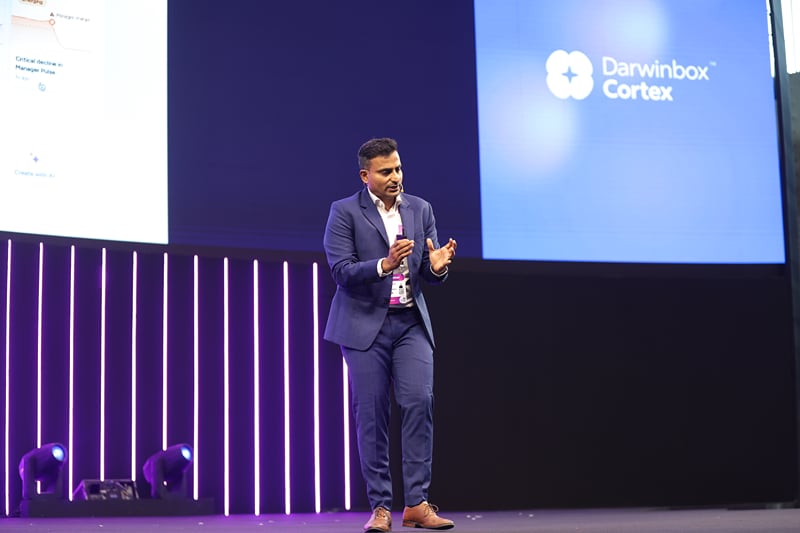
At TechHR 2026, Darwinbox Co-founder Chaitanya Peddi outlined why AI-native HR requires a fundamental redesign of enterprise systems, moving beyond workflows and modules towards signals, context and adaptive execution.
For years, HR technology has been organised around modules. Recruitment, learning, performance, payroll and rewards each sat within their own structured systems. According to Chaitanya Peddi, Co-founder of Darwinbox, that model is increasingly misaligned with how work unfolds in an AI-driven world.
Speaking at People Matters TechHR 2026 in New Delhi, Peddi stated that the next phase of HR technology will not be defined by more workflows or more AI features layered onto existing platforms. Instead, it will depend on systems that can identify emerging workforce signals, connect context in real time and help organisations act before problems become costly.
"For every workforce problem, it is actually visible before it becomes expensive. But the thing is we are able to connect the dots only in hindsight. That is how systems are designed," he said.
His keynote, titled From Modules To Moments: Giving HR The Reflexes For The AI-Native Era, explored what it means for enterprise platforms to become genuinely AI-native and why many current approaches fall short.
Why being AI-native is harder than it sounds
Peddi began by reflecting on a question that had occupied him over the past year: what does it truly mean for an enterprise platform to be AI-native?
Despite significant investments in AI, he said the answer was not straightforward.
"A year back, I asked myself the same question. With all the investment that we have done in AI, are we AI native? And the honest answer was no."
He described a period of experimentation, learning and rebuilding that challenged many assumptions about how AI should be integrated into enterprise software.
One of the first lessons was that simply connecting existing tools to large language models does not create an AI-native platform.
According to Peddi, organisations initially assumed they could expose enterprise tools to AI models and allow the models to orchestrate work. In practice, that approach struggled to scale.
"Beyond 20 tools, the model starts hallucinating like there is no tomorrow. It fails. It didn't work."
The industry then shifted towards agents. Yet Peddi questioned whether many so-called AI agents represented meaningful innovation.
"That is where a lot of agent washing happened."
He added that many offerings marketed as agents were little more than existing workflows wrapped in AI interfaces.
"Many of them are nothing but workflows wrapped in AI skin."
The conclusion, he said, was that organisations needed to rethink systems from first principles rather than layering AI onto existing architectures.
From employee journeys to workforce signals
A central theme of the session was the need to move away from viewing HR through isolated modules.
Historically, organisations have mapped employee experiences across separate systems such as applicant tracking, onboarding, core HR, performance management and time management. Peddi described this as siloed thinking.
Instead, he proposed seeing the workforce as a continuous stream of signals generated across the employee lifecycle.
These signals may appear insignificant in isolation but can become meaningful when connected.
As an example, he described a supervisor whose resignation appears surprising only after the event. In reality, the warning signs often exist well beforehand.
Signals may include:
Changes in leave patterns
Declining engagement levels
Compensation gaps compared with peers
Reduced manager sentiment
Sustained periods of overwork
When connected, these signals can reveal emerging workforce risks.
Peddi referred to these patterns as "moments" that evolve over time. Some moments are still forming, while others become fully crystallised and require intervention.
Using an example of employee flight risk, he explained how multiple concurrent signals can create a high-confidence prediction.
"All these things happening concurrently at the same time cannot be a coincidence."
The goal is not simply to identify the risk but to help managers respond appropriately.
Once a moment is identified, managers can explore contributing factors, understand why the issue emerged and generate a tailored action plan.
Importantly, Peddi stressed that interventions cannot be standardised.
"You cannot have a templatised playbook. You need to have a very personalised playbook."
The same workforce outcome may stem from very different underlying causes, making context critical.
The role of context in enterprise decision-making
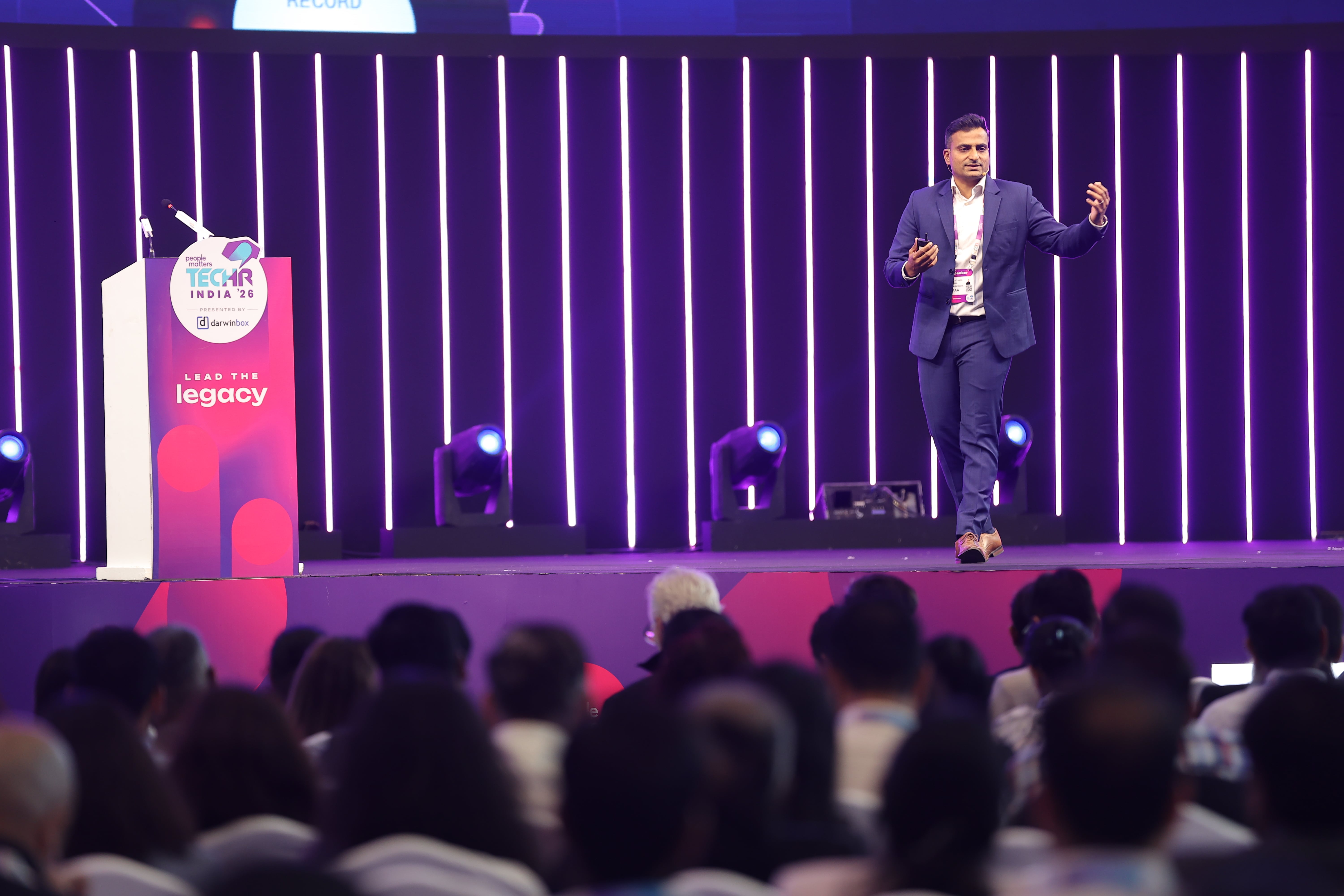
Another challenge Peddi highlighted was the difficulty of building and executing HR solutions inside complex enterprise systems.
Traditionally, creating workflows or solving workforce problems requires expertise across three dimensions:
Understanding the HR platform itself
Understanding the organisation's specific configuration and history
Understanding HR practices and domain knowledge
Few people possess all three.
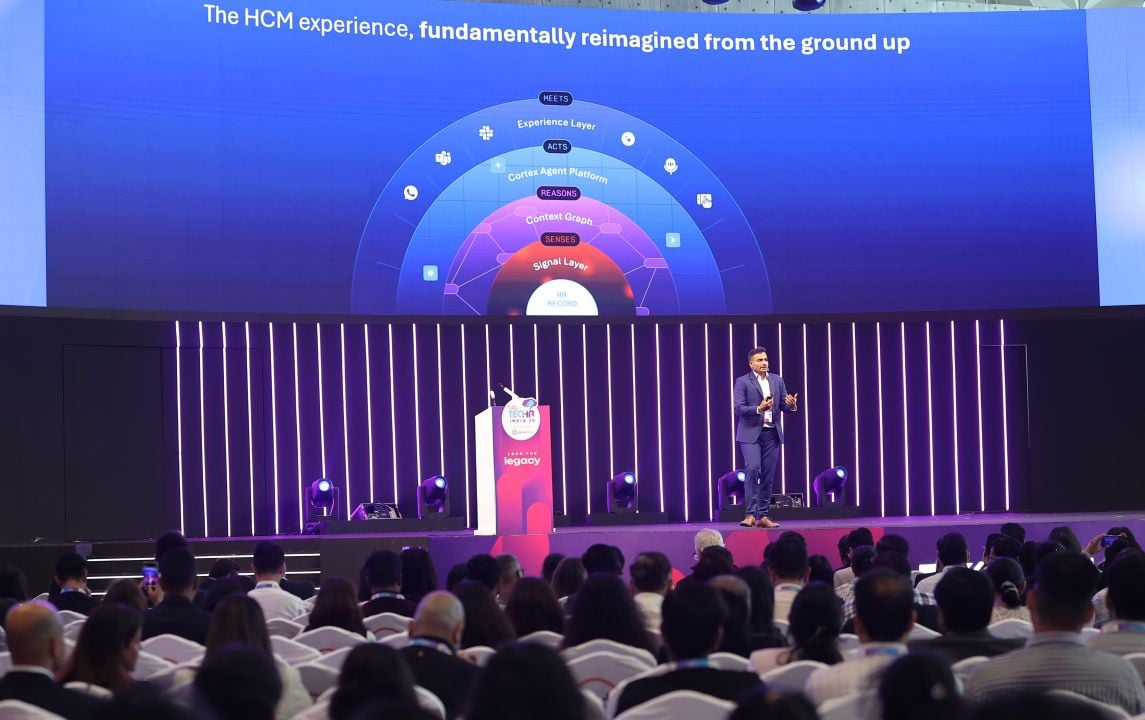
To address this challenge, Peddi described the concept of a "context graph", which encodes platform knowledge, organisational realities and HR expertise into a shared intelligence layer.
He described this as one of the most significant investments undertaken by Darwinbox during its AI transformation journey.
The practical implication is that systems can assist organisations in analysing and executing highly complex tasks that previously required extensive manual effort.
Peddi illustrated this through examples such as:
Wage code compliance analysis
Compensation restructuring
Impact assessments on employee pay
Post-merger workforce integration planning
Role harmonisation
Grade and compensation alignment
Rather than simply providing answers, the system analyses data, highlights decision points and presents recommendations while keeping humans in control of final decisions.
"At any point, you can approve all the recommendations, or you can approve certain recommendations partially, and you can always have a conversation and override as well."
Why execution matters as much as intelligence
Peddi also argued that the next evolution of enterprise software requires moving beyond AI-assisted analysis.
Many AI systems today excel at answering questions, summarising information or generating recommendations. The harder challenge is execution.
"Many of the agents end there. All these are good query-answering agents. But who will do actual execution?"
Traditional enterprise platforms rely on workflow engines to manage execution. However, Peddi suggested that workflow engines alone will be insufficient in the AI era.
Instead, organisations will need systems capable of orchestrating work dynamically across humans and AI agents.
He described scenarios where managers can create complex processes through conversation rather than manually configuring workflows.
These processes can then evolve, adapt to changing circumstances and gradually become reusable templates.
The result is a shift from static workflows to adaptive execution models that learn over time.
Why autonomy should be earned
As organisations explore agentic AI, questions around automated decision-making continue to grow. Peddi argued against treating autonomy as an all-or-nothing concept.
"Autonomy is not a button. It is a dial. You have to earn it."
He illustrated this through an expense approval example.
If a manager consistently approves certain types of exceptions under specific conditions, the system can recognise the pattern and suggest automation. The manager can then choose whether to delegate those decisions.
The principle is that trust should develop progressively rather than being assumed from the outset.
Instead of immediately handing over control, organisations should allow AI systems to demonstrate reliability before increasing levels of autonomy.
Towards interface-agnostic HR
Peddi also challenged the assumption that employees should always interact with HR systems through dedicated applications.
In his view, AI-native systems should be capable of delivering experiences through whichever interface employees already use, whether that is collaboration tools, messaging platforms or other workplace environments.
More importantly, these experiences should not simply redirect users back to traditional HR systems.
"That is not truly what headless or interface agnosticity means."
The objective, he said, is to allow work, decisions and employee experiences to occur naturally within the flow of work rather than forcing employees to navigate multiple systems.
A shift from workflows to workplace reflexes
Peddi's keynote ultimately focused less on AI features and more on organisational responsiveness.
His argument was that workforce issues rarely emerge without warning. The challenge lies in identifying weak signals early, understanding context and acting quickly enough to influence outcomes.
To achieve that, HR systems must evolve beyond static modules and predefined workflows.
Instead, they need to combine signal detection, contextual understanding, adaptive execution and progressive autonomy.
As organisations continue to explore AI's role in the workplace, Peddi's message was clear: becoming AI-native is not about adding intelligence on top of existing systems. It requires rethinking how enterprise platforms observe, reason and respond to work itself.
Topics
Author
Loading...