







Leadership
15 Indian-origin CEOs leading the world's biggest companies in 2026





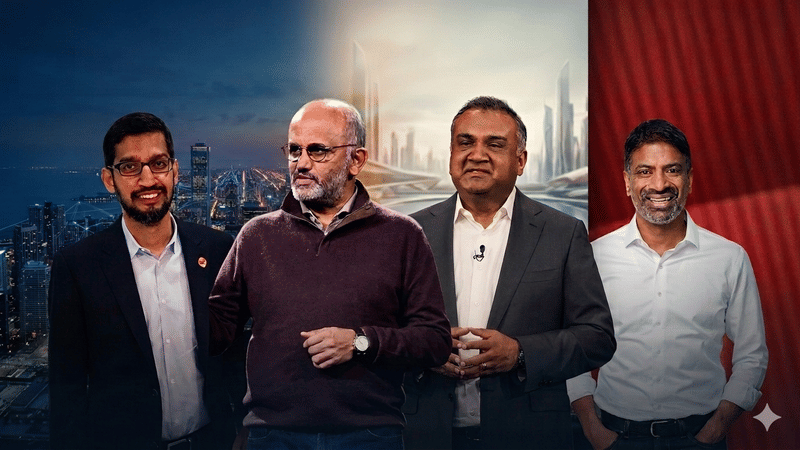
From AI and cloud computing to luxury fashion and semiconductors, these Indian-origin CEOs are shaping the future of global business, one boardroom at a time.
Not too long ago, seeing an Indian-origin executive at the helm of a global company was the exception. In 2026, it has become a defining feature of international business.
These leaders oversee organisations collectively worth trillions of dollars, influence products and services used by billions of people, and make decisions that shape industries ranging from artificial intelligence and cloud computing to banking, pharmaceuticals, consumer goods and luxury fashion.
Some are steering century-old corporations through reinvention. Others are building the infrastructure powering the AI revolution. Together, they represent one of the strongest examples of Indian leadership on the global stage.
Here's a look at 15 Indian-origin CEOs leading some of the world's biggest organisations.
1. Sundar Pichai
Organisation: Google & Alphabet
Role: Chief Executive Officer

If Google Search is the internet's front door, Sundar Pichai holds the keys.
An IIT Kharagpur graduate, Pichai joined Google in 2004 and rose through the ranks after leading products including Chrome and ChromeOS. He became Google's CEO in 2015 before taking charge of parent company Alphabet in 2019.
Today, his biggest assignment is steering Google's AI ambitions through products such as Gemini, while balancing regulation, competition and innovation across one of the world's largest technology companies.
2. Satya Nadella
Organisation: Microsoft
Role: Chairman and Chief Executive Officer

Few CEOs have reinvented a company quite like Satya Nadella.
After taking over Microsoft in 2014, the Hyderabad-born executive transformed the Windows giant into a cloud and AI powerhouse. Azure became a cornerstone of Microsoft's business, while strategic bets on LinkedIn, GitHub, Activision Blizzard, OpenAI and Copilot have reshaped the company's future.
More than a decade later, Microsoft remains one of the world's most valuable companies.
3. Shantanu Narayen
Organisation: Adobe
Role: Chair and Chief Executive Officer
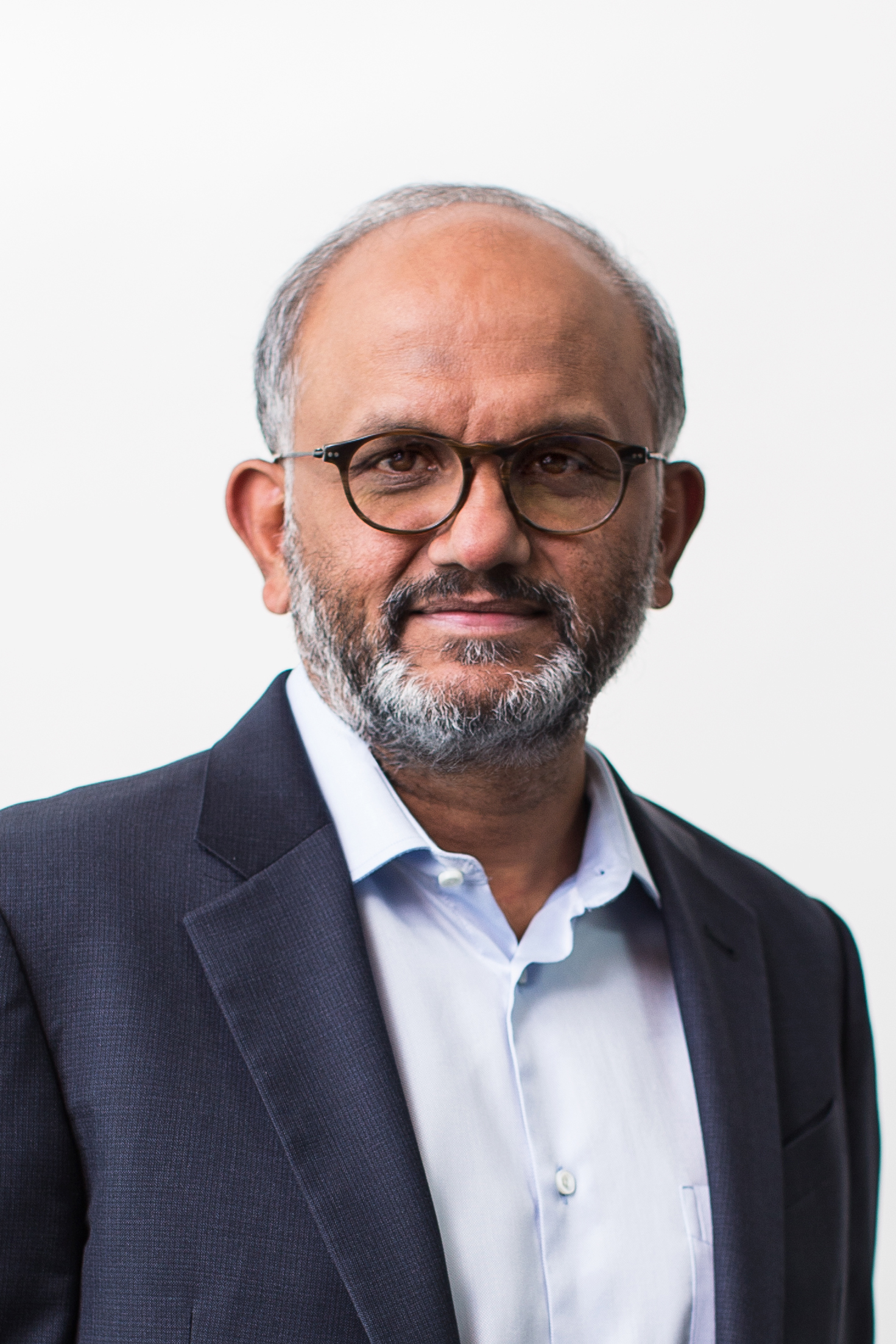
Creative professionals may know Adobe for Photoshop, but Shantanu Narayen has spent nearly two decades turning the company into much more.
Since becoming CEO in 2007, Narayen has led Adobe's transition to cloud subscriptions, expanded its digital experience business and positioned the company as an AI leader across creativity, productivity and enterprise software.
His leadership has helped Adobe evolve from a software company into one of the industry's most influential technology platforms.
4. Arvind Krishna
Organisation: IBM
Role: Chairman and Chief Executive Officer
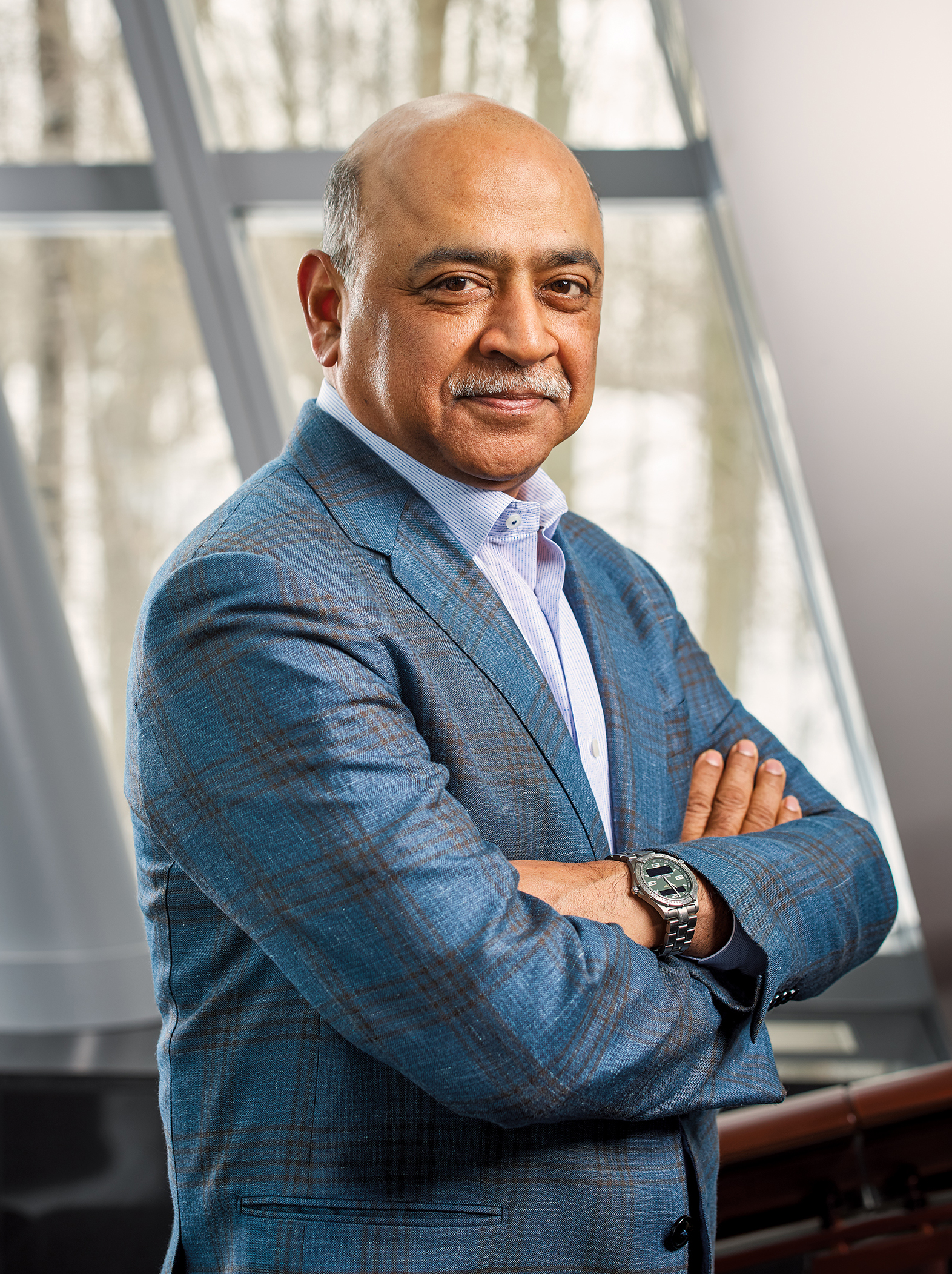
When Arvind Krishna became IBM CEO in 2020, he inherited one of technology's oldest companies.
His response was simple: focus.
IBM doubled down on hybrid cloud, enterprise AI and quantum computing, completed the spin-off of Kyndryl and accelerated investments around platforms including watsonx.
Krishna's strategy reflects IBM's shift from legacy infrastructure towards AI-powered enterprise software and consulting.
5. Neal Mohan
Organisation: YouTube
Role: Chief Executive Officer

Every minute, hundreds of hours of video are uploaded to YouTube.
Making sure the world's biggest video platform keeps growing is the job of Neal Mohan.
A long-time Google executive, Mohan became YouTube CEO in 2023 after serving as Chief Product Officer. He has helped build products including YouTube Shorts, YouTube Premium, YouTube Music and YouTube TV, while expanding AI tools for creators.
6. Ajay Banga
Organisation: The World Bank
Role: President

Not every global leader comes from Silicon Valley.
Former Mastercard CEO Ajay Banga became President of the World Bank in 2023, becoming the first Indian-American to lead the institution.
His focus has been on accelerating development finance, strengthening private sector partnerships and modernising the bank's operations to address evolving global challenges.
7. Vasant Narasimhan
Organisation: Novartis
Role: Chief Executive Officer

A physician by training, Dr Vasant Narasimhan brings a clinician's perspective to one of the world's largest pharmaceutical companies.
Since becoming CEO in 2018, he has streamlined Novartis around innovative medicines while expanding investments in advanced therapies, digital technologies and AI-enabled drug discovery.
8. C. S. Venkatakrishnan
Organisation: Barclays
Role: Group Chief Executive

Known simply as Venkat, C. S. Venkatakrishnan leads one of Britain's biggest banking institutions.
Having spent decades in investment banking and risk management, he now oversees Barclays' global operations while steering the bank through digital transformation, AI adoption and evolving financial regulation.
9. Shailesh Jejurikar
Organisation: Procter & Gamble
Role: President and Chief Executive Officer
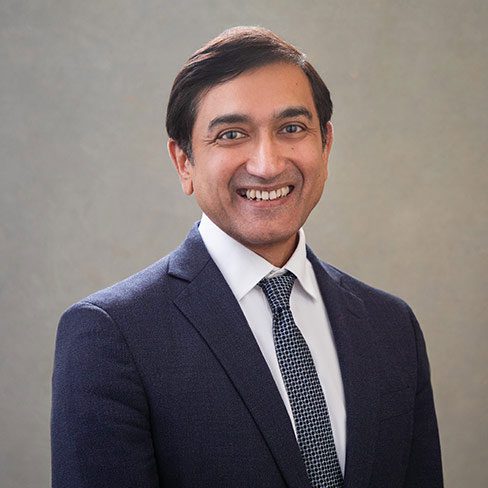
From detergents and shampoos to baby care products, Procter & Gamble touches billions of consumers every day.
Leading the consumer goods giant is Shailesh Jejurikar, who became CEO in 2026 after more than three decades with the company.
His leadership focuses on innovation, operational excellence and sustainable long-term growth across P&G's global portfolio.
10. Sanjay Mehrotra
Organisation: Micron Technology
Role: Chairman, President and Chief Executive Officer

The AI boom has created unprecedented demand for memory chips.
At the centre of that market sits Sanjay Mehrotra, who has led Micron since 2017 after co-founding SanDisk.
Under his leadership, Micron has expanded its focus on advanced memory technologies powering AI infrastructure, cloud computing and next-generation data centres.
11. Jayshree Ullal
Organisation: Arista Networks
Role: Chairperson and Chief Executive Officer

Behind every AI model sits an enormous network.
Jayshree Ullal has spent years building exactly that.
She joined Arista Networks when it was still a young startup. Today, the company is one of the world's leading providers of cloud networking infrastructure serving hyperscale technology companies and AI data centres.
12. Leena Nair
Organisation: Chanel
Role: Global Chief Executive Officer

Luxury and technology rarely appear in the same conversation.
Leena Nair has changed that.
After serving as Chief Human Resources Officer at Unilever, she became Global CEO of Chanel in 2022. Today, she leads one of the world's most iconic luxury brands while balancing craftsmanship, sustainability and digital transformation.
13. Nikesh Arora
Organisation: Palo Alto Networks
Role: Chairman and Chief Executive Officer

Cybersecurity has become one of the fastest-growing industries in the AI era.
Leading one of its biggest players is Nikesh Arora.
The former Google and SoftBank executive has expanded Palo Alto Networks into a broad cybersecurity platform serving enterprises worldwide, with growing investments in AI-powered security.
14. Revathi Advaithi
Organisation: Flex
Role: Chief Executive Officer

Global supply chains have become as important as product innovation.
Revathi Advaithi has spent the past several years transforming Flex into a leader in advanced manufacturing, supply chain solutions and engineering services across industries including healthcare, automotive and industrial technology.
More than a trend
The rise of Indian-origin CEOs is no longer a headline. It is part of the global corporate landscape.
From Google's AI roadmap and Microsoft's cloud strategy to Chanel's luxury business and the World Bank's development agenda, these leaders influence decisions that affect businesses, governments and billions of people worldwide.
Different industries. Different leadership styles. One common thread.
The boardrooms may be spread across California, London, Paris and New York, but many of the people making the biggest decisions have roots in India.
Topics
Author
Loading...