







Leadership
High Performance Beyond the Dashboard: Jonty Rhodes and Dr Marcus Ranney on what keeps people at their best






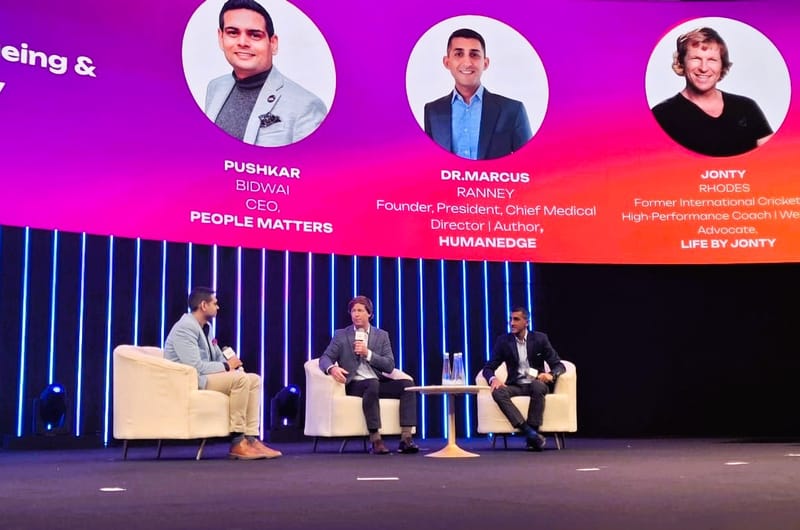
At TechHR India 2026, Jonty Rhodes and Dr Marcus Ranney unpacked the less visible drivers of high performance—from smarter practice and recovery to recognition, human connection, judgement and a culture people genuinely believe in.
A high-performance culture cannot be created by putting values on a wall. Data cannot make every decision. And simply asking people to work harder does not prepare them to perform when the pressure is highest.
For Jonty Rhodes, what separates good performance from sustained high performance lies much deeper—in how people practise, how much ownership they have, whether they feel recognised, how they recover and whether the belief within a team is genuinely reflected in everyday behaviour.
At Field Notes: Performance, Aging & the Data in Between at People Matters TechHR India 2026, Rhodes and physician and human-performance expert Dr Marcus Ranney brought together experience from elite sport and performance science to examine what helps people consistently operate at their best.
Look beyond the scoreboard
Rhodes' own career offers perhaps the clearest starting point.
When South Africa entered the 1992 Cricket World Cup with limited international experience, the team knew it needed to find an advantage elsewhere. It chose fitness and fielding.
“We had to find areas that nobody else was even looking at,” Rhodes recalled. If the team could save 25 to 30 runs in the field, it could compensate for gaps elsewhere.
It fundamentally altered his understanding of performance.
“Every run saved was as important as every run scored.”
That principle becomes particularly relevant to organisations attempting to rethink performance. The most valuable contribution is not always the most visible one.
Rhodes described how IPL teams can have international stars sitting on the bench while younger players take the field. The senior player's contribution may instead come from spending time with that youngster, sharing experience or helping them prepare.
Those contributions need to be seen too.
“People really love appreciation. They really love recognition,” Rhodes said.
For organisations, the question is therefore not only who delivered the visible result, but who helped make that result possible.
Human connection cannot be coached out of performance
When asked whether playing or coaching was harder, Rhodes had little hesitation: coaching.
As a player, his focus was largely his own performance. Coaching meant understanding every player as an individual.
When he began coaching fielding, Rhodes realised that trying to replicate what had worked for him would be ineffective. A tall fast bowler, for example, could not be expected to move or dive like Rhodes.
“My role in the team was to take the player and make them the best fielder that they could be,” he said.
That distinction matters for people leaders too. Development cannot be about reproducing the leader in everybody else.
Rhodes also recalled asking young Indian players whether they understood his instructions. They would say, “Yes, coach”, while their body language sometimes suggested precisely the opposite.
That is why, he said, “human connection” is critical in coaching.
Creating psychological safety and a “freedom to fail” allows people to ask questions, contribute and ultimately take greater ownership of their performance.
‘Perfect practice makes perfect’
High performance becomes most visible when decisions have to be made under pressure.
Rhodes described cricket as a game in which almost every ball demands a decision. The real question for coaches, therefore, is whether players are prepared to make “good choices, good decisions in the heat of the battle.”
His philosophy of practice reflects that objective.
“Perfect practice makes perfect. It's not hours of intensive training,” Rhodes said. The emphasis, he added, should be on practising harder, practising smarter and practising as though it were a match situation.
That shifts the conversation from training volume to training quality.
For organisations investing heavily in skilling and upskilling, there is an important parallel: counting learning hours or programme completions says little about whether somebody can apply that capability when a difficult decision actually arrives.
The better measure is whether practice has changed performance.
Mental space is a performance requirement
Preparation is only one part of the equation. Recovery increasingly determines whether someone can sustain that performance.
Rhodes pointed to the intensity of modern cricket, where international commitments and franchise tournaments leave players with far less downtime.
“High performance, consistently high performance, is not about motivation,” he said.
A player arriving at a high-stakes match is already motivated. The harder question is whether they are physically, and importantly, mentally—in a state to perform at their peak.
Ranney framed this through three elements of what he calls the corporate athlete: preparation, performance and recovery.
Professional sports teams increasingly use sleep, activity and other physiological data to inform decisions about when an athlete can be pushed and when recovery is needed.
But the larger lesson is not the dashboard itself. It is recognising that recovery is part of performance, rather than time taken away from it.
Data can inform the call. It cannot own it
For all the information now available to coaches, Rhodes placed a clear limit on its authority.
“We use the data to start a conversation. We don't use the data to make the final decision.”
Analytics may indicate Plan A. But when circumstances change, players still need to interpret what is happening, trust their judgement and decide whether and when to pivot.
For leaders working with increasingly AI-enabled decision systems, that distinction is becoming critical.
The value of better data is not that leaders can stop exercising judgement. It is that they can exercise better-informed judgement while remaining accountable for the call.
Can high performance actually be measured?
An audience question took the discussion one step further: is there something innate that separates consistently winning performers and teams from everyone else?
Ranney said he has spent years looking for what he called a possible “performance gene”, across sport and other extreme performance environments.
He has not found it.
“There is a unique quality which is sort of the stardust, the secret sauce that some people have,” he said, suggesting that deep desire appears to play a role even though he has not been able to quantify it through a biomarker.
Rhodes approached the question through Australian cricket.
He argued that Australia's historic strength was not simply the quality of individual players but the belief teammates placed in one another. If one player failed, they genuinely believed someone else could step forward and win the game.
And that led to perhaps his sharpest observation for organisational leaders:
“We can all talk about this team culture we have... but do you genuinely believe it, or is it just something you say?”
A culture that is a hashtag or appears on a billboard, Rhodes argued, “doesn't mean a great deal”.
What distinguished those teams was behaviour. “Every single day, they didn't just say it, they behaved in that manner.”
That is where the different threads of the session ultimately meet.
High performance is not one metric, one technology or one extraordinary performer. It is built through smarter practice, sufficient recovery, recognition of less visible contributions, coaches who understand individuals, data that informs rather than dictates, and teams whose belief in one another survives the pressure of the moment.
Or, as Ranney put it, results can come from the “incremental 1%s which compound over time.”
The scoreboard records the outcome. The culture, preparation and human judgement behind it determine how often you can repeat it.
Also Read: ‘Lead with failure’: Ranveer Brar on growth and reinvention at TechHR India 2026
Topics
Author
Loading...