







Leadership
Human-first leadership can unlock India's potential: Dr Tharoor at TechHR’25






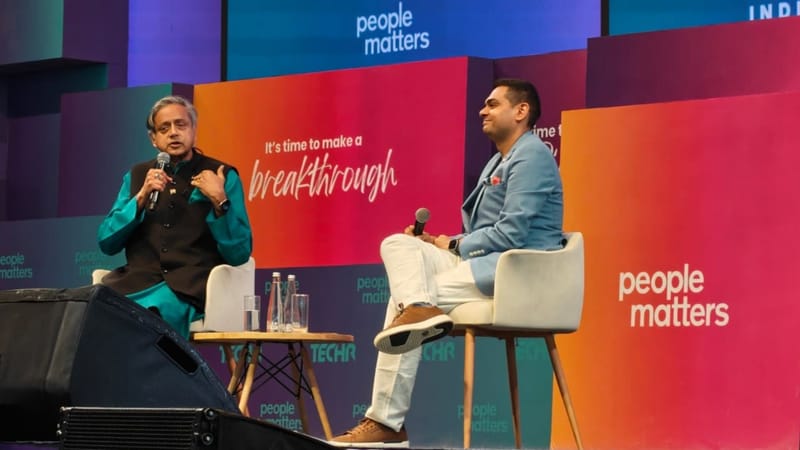
At TECHHR’25, Dr Shashi Tharoor calls for collaborative leadership and investment in human capital to drive India's AI-led future.
In a stirring keynote address at People Matters TECHHR’25, Dr Shashi Tharoor—Member of Parliament, diplomat, and celebrated author—articulated a powerful call for a new kind of leadership in India. Speaking to an audience of corporate decision-makers, tech pioneers, and HR leaders at Yashobhoomi Convention Centre, Tharoor challenged India's over-reliance on "heroic" leaders and urged a transition towards collaborative, human-first leadership that can unleash the country’s untapped potential—especially in the era of AI and digital innovation.
"India needs a leader who is less demanding—someone who listens, collaborates, and uplifts,” Dr Tharoor said. “We are the biggest users of AI in the world. Imagine what more we could achieve with the right kind of leadership.”
Listening Over Commanding
Dr Tharoor’s views on leadership were strikingly unconventional, especially in a political and corporate landscape often fixated on charisma and centralised authority.
“The best kind of leader,” he argued, “is not the one who demands admiration but the one who makes everyone feel included—who creates a sense of collective achievement.”
Tharoor cited Ajinkya Rahane’s understated leadership during India’s 2021 Test cricket tour of Australia as an ideal metaphor. Soft-spoken and composed, Rahane steered the Indian team through adversity without grandstanding—and when victory came, he handed the trophy to the youngest team member. “That,” Tharoor said, “is a model of leadership India should learn from.”
In contrast, the dominant Indian leadership style, he noted, often revolves around one towering figure—“the man on the white stallion,” as he put it—who is seen as the sole solution to all national problems. From Indira Gandhi to Narendra Modi, Indian politics has been shaped by such figures.
But Tharoor believes this adulation comes at a cost. “We still demand the heroic leader. It’s deeply ingrained, perhaps a flaw in our national character. But this model is not future-fit.”
The Case for Collaborative Leadership
Tharoor’s remarks are not just a critique—they offer a roadmap. He advocated for a form of leadership more aligned with 21st-century needs: “collegial, open, less demanding of personal adulation.”
He pointed to past Prime Ministers Atal Bihari Vajpayee and Manmohan Singh as examples of this alternative leadership style. “Both were collaborative and deeply thoughtful,” Tharoor said. “But they struggled to garner the same passionate following as more charismatic figures.”
In the workplace, this leadership shift is just as urgent. "Your employees are your audience," Tharoor reminded HR leaders. "A leader must listen—and listening is where feedback lives."
The Skilling Crisis No One Owns
From leadership, the conversation turned to India’s biggest unlock—its people. Tharoor was blunt in identifying a critical weakness: India’s failure to skill its vast workforce for a modern economy.
“We have 10 million people entering the job market every year,” he said. “And we’re not ready.”
Tharoor reflected on his time as Minister of State for Human Resource Development, lamenting the country’s inadequate skilling ecosystem. “We had a nationwide shortage of certified plumbers and masons. Everyone trained went to the Gulf. In India, people learn on the job, if at all. That’s neither scalable nor fair.”
He proposed a bold solution: every company above a certain size should be legally mandated to run a skilling centre, training high school dropouts and rural youth. “They could hire the best, and others would leave with a diploma that opens up real opportunity.”
But who owns the responsibility? “All three—government, corporate India, and the individual,” Tharoor said. “The government must incentivise and invest. Companies must train. Individuals must commit to learning.”
Beyond GDP: Redefining Brand India
Tharoor’s optimism about India’s global image was tempered by realism. “We’ve done a great job with the hardware—airports, convention centres, tech stacks—but we need to fix the software: education, sanitation, drinking water, poverty.”
Still, he sees promise in India’s evolving brand. “From snake charmers and elephants, we’re now being noticed for UPI, for digital innovation,” he said, recalling how India’s digital payments system is gaining traction globally, with 19 countries signed on.
“Imagine if UPI became as globally recognisable as Coca-Cola,” he suggested. “That’s the power of brand India—when we blend tradition with innovation, Ayurveda with AI, yoga with UPI.”
But visibility is not enough. "Soft power without hard power is weakness," he warned. "And hard power without soft power is bullying. India must develop smart power—investing in its people and projecting its values."
Reimagining Human Capital
For Tharoor, the future of India doesn’t rest solely on artificial intelligence, but on actual intelligence—developing human capital that can keep pace with rapid change. “If we get our act together—on basic education, public health, skilling, inclusion—then our tech and talent will take us far.”
He acknowledged that AI is transforming global labour markets, but India’s scale offers a unique edge. “We’re the biggest users of AI. But are we training our youth to be creators, not just consumers?”
Tharoor cautioned against letting inequality deepen in the name of progress. “We can’t have a society where a few fly rockets while millions can’t fix a leaky tap. Every Indian must have a stake in the future.”
A New Leadership Mandate
In the final moments of his address, Tharoor returned to the idea that technology alone won’t transform India—it needs a human-first mindset.
“Leadership in India must become less about control and more about enablement,” he said. “Our challenge isn’t just infrastructure or AI or branding—it’s making sure the people building this country feel seen, heard, and skilled.”
Tharoor’s message to India’s corporate and political elite was clear: the leader India needs now is not the loudest or most commanding, but the one who enables 1.4 billion people to thrive.
Topics
Author
Loading...