







Leadership
Lead with a human edge: Why empathy is the new strategy




In the race to automate everything, our greatest advantage may lie in what machines can’t replicate, our humanity.
In every era of disruption, there comes a moment when leaders must stop asking, “What can technology do?” and start asking, “What should we, as humans, become?”
That moment is now.
Artificial intelligence has rewritten the rules of work faster than any revolution before it. Algorithms can predict, process, and perform with astonishing precision. Yet, amid this surge of digital intelligence, the defining question of leadership has quietly shifted. The future won’t belong to those who build faster systems but to those who build deeper connections.
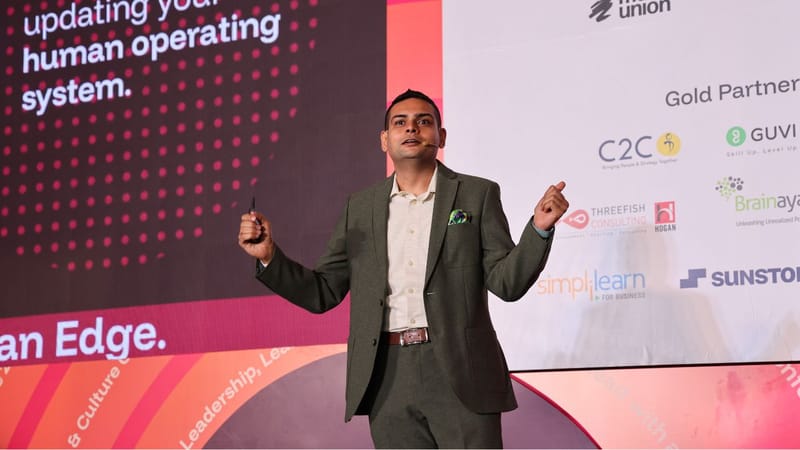
Pushkar Bidwai, CEO of People Matters, captured this truth in his keynote address on “Lead With A Human Edge: Architecting Growth Through Collective Potential,” at the People Matters Leadership, Learning and Culture Conference 2025 held in Mumbai today. His message was not defensive, but visionary. “Empathy, creativity, and connection are our greatest differentiators.”
In a world chasing speed, Pushkar argued that our advantage lies not in acceleration but in awareness not in efficiency, but in empathy.
The Human Edge: From Soft Skill to Strategic Power
For too long, leadership conversations have treated empathy and culture as the ‘soft’ side of business. But the most transformative organisations of our time, from Microsoft to Haier, have shown that these so-called soft skills are, in fact, the hardest to replicate and the most powerful to scale. When Satya Nadella took over a fragmented Microsoft in 2014, he didn’t begin with code or cost-cutting. He began with listening. “He did not start with boardrooms or town halls,” Pushkar recalled. “He took his leadership team into the redwoods, where there was empathy, listening, and collaboration.”
In that quiet act of reflection, Nadella reframed what it meant to lead in the modern era. The “C” in CEO, he said, stood for Culture, a radical notion for a company once defined by internal rivalry.
The results were staggering. Under Nadella, Microsoft’s market value multiplied nearly tenfold. But the true transformation wasn’t numerical, it was cultural. A company that had once prided itself on being ‘know-it-all’ learned to become ‘learn-it-all.’ Pushkar called this one of the biggest leadership risks ever taken and one of the most human. Because at its heart, the shift was not about software; it was about soulware.
Organisations Are Living Organisms
Traditional management was built on control: plans, processes, and hierarchies designed to tame complexity. But as Pushkar noted, ‘organisations are living organisms. They evolve, sense, and respond. Trying to manage them like machines is an illusion. The leaders of tomorrow will not be engineers of systems — they will be gardeners of cultures.’
“Planting a tree is very easy,” Bidwai said. “The real game is how you nurture, how you create an environment, how you enable the culture.”
Nurturing, not directing, is the leadership mindset for an era of interdependence. It’s what turns learning into growth and growth into resilience. The challenge, of course, is that nurturing takes time and time is the one currency the modern world seems unwilling to spend. Yet, if leadership and learning are the roots of progress, then culture is the soil. Without it, nothing thrives, he added.
Ownership as the New Hierarchy
As Microsoft reimagined its core identity, a parallel revolution was unfolding in China—Haier, the home appliance titan, radically restructured its 50,000-strong workforce into 4,000 micro-enterprises, each operating with the agility and autonomy of a start-up within a vast ecosystem. Each of these nodes operated like individual companies, some with eight people, some with eighty, but all working in harmony,” Pushkar said.
Haier’s radical principle, known as Rendanheyi, turned employees into entrepreneurs and managers into mentors. “Many times we want ownership, but we don’t want to share wealth,” he reflected. “This whole piece of picking up things voluntarily can only be driven from a culture that thrives on ownership.”
The result was extraordinary agility, zero distance between customer and creator. It proved that when every individual acts like a CEO of their own sphere, innovation no longer depends on hierarchy.
He posed a provocative question to leaders everywhere: What if every person in your organisation thought, felt, and acted like an owner? It’s a question not of empowerment, but of trust. Because to lead with a human edge is to believe deeply and deliberately that people, when trusted, will rise.
The Age of AI and the Return of Empathy
If the last decade was about digitisation, the next will be about humanisation. As Pushkar reminded the audience, “By 2030, we could have cognitive AI coming into play.”
Machines will think faster, predict better, and act smarter, but they will never care.
That word ‘care’ is quickly becoming the new frontier of leadership. Because as technology automates tasks, what remains deeply human are the capabilities that cannot be coded: curiosity, ethics, empathy, and intuition. These are not side skills; they are strategic assets.
And yet, according to People Matters’ SHRPA research, the very function tasked with developing these capabilities, HR, feels the least prepared to do so. Leaders across Asia listed ‘creating great leaders’ as their number one challenge, while admitting their teams lack readiness to deliver on it. That insight should unsettle us. We are building smarter tools, but not necessarily wiser teams.
The fix, Pushkar suggested, begins not with new programs but with a new posture, humility.
“While we are architecting so much for organisations to thrive, how much of that capability are we building ourselves?”
Beyond Titles, Beyond Ego
Perhaps the most striking moment of Pushkar’s talk was not analytical but symbolic. He invited participants to discard their corporate titles just for a moment and invent new ones that reflected their purpose, not their position. “Sometimes titles define how we operate. Can we look beyond titles?” His own? In People Matters, Pushkar stated that he visualises his creative title as Plumber. “Wherever anything needs fixing, I will go and fix things.”
The metaphor landed. Leadership, stripped of status, is about service. To lead with a human edge is to roll up your sleeves, listen, and fix what’s broken, in systems, in relationships, in ourselves.
The New Architecture of Leadership
Pushkar's provocation was simple, yet transformative: “Can every single person in our organisation act like a CEO?” That question reframes leadership not as a role but as a responsibility. In this view, culture is not designed; it is architected. And the architects are everyone from the C-suite to the shop floor.
“Our job does not stop at creating programs or implementing strategies; we need to architect the culture.” The culture we architect today, one grounded in trust, curiosity, and connection will determine whether our organisations can thrive amid AI, automation, and ambiguity.
The Future Is Not Artificial, It’s Deeply Human
What Pushkar calls ‘the human edge’ is not a nostalgic pushback against technology. It is a pragmatic blueprint for sustainable growth. The leaders who will define the next decade will be those who use AI to augment human potential, not replace it those who recognise that data drives decisions, but empathy drives destiny.
Because the future of leadership isn’t about knowing more, it’s about feeling deeper. It isn’t about speed, it’s about making sense . And it isn’t about managing people, it’s about believing in them.
As Pushkar put it, this is the moment to lead with heart: “If there’s one community that can lead and enable this, it is ours. That’s the promise I want from all of you.” In an age where technology races ahead, perhaps the bravest thing a leader can do is pause and listen.
Author
Loading...