If you walk into one of Godrej Properties’ ‘silent sites’, you’ll notice something different. Maybe it’s the inclusive signage that greets you. Or the seamless way hearing-impaired employees move through their workday, supported by sign interpreters and peers who treat inclusion not as a checkbox, but as muscle memory. The design isn’t just about ramps or braille or representation — it’s systemic.
And that’s a recurring theme in Megha Goel’s approach to HR leadership: transform from the inside out, or don’t bother at all.
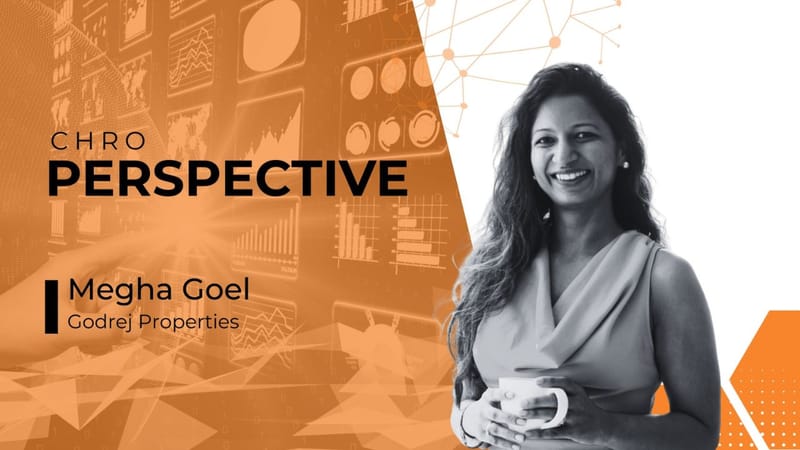
A chemical engineer turned people strategist, Megha has led with quiet force — pivoting Godrej Properties through 3X growth, embedding AI and tech into workforce practices, and rewriting the rules of talent betting with a fierce focus on internal capability. What makes her perspective different isn’t just the systems she’s built — it’s how deeply they are interwoven with trust, data credibility, and inclusion that doesn't wait for perfection before action.
In this edition of CHRO Perspective, we spoke with Megha about the real mechanics of HR transformation — and why she believes you can't AI your way to impact without data discipline, human judgment, and respect for potential.
Q. You’re one of the few CHROs who began in hardcore engineering. What did you carry forward from that world?
I’m a chemical engineer by education, and a gold medallist at that — but I realised early on that just being good at something isn’t enough. I worked at AkzoNobel Coatings in a highly technical role, and while I did well, I couldn’t bring myself to go back to the books, to dive deeper. It didn’t spark me.
What did spark something was seeing a radically different kind of workplace culture — I remember watching the CEO and a factory worker share lunch at the same table. That egalitarian moment stayed with me. Later, during an internship at Britannia, I worked on a factory operations project that turned a struggling unit profitable. It wasn’t labelled as “HR,” but it combined human understanding with process design. That’s when I knew this was my path: building solutions that serve people and business together.
Q. What does building from the inside really look like at your scale?
When we say we’ve grown from 1,800 to 4,500 employees in two years — that’s not just a hiring story. That’s culture, infrastructure, readiness, and internal mobility all moving at once. And it required me to unlearn a lot. I’d come from diverse industries, strong in my opinions, confident in structure. But here’s the thing: when your company is multiplying at this pace, your legacy approaches will get questioned. Mine were.
At one point, I was told — very directly — “If you’re just going to quote policy, why do we need you?” That stung. But it also reset my approach. I realised HR isn’t about holding the line — it’s about knowing when to serve and when to protect. That duality is the real work.
Q. Let’s talk AI. Everyone’s talking about it. What are you actually doing?
We’ve always had a tech backbone — we were among the first in India to adopt SAP SuccessFactors. But AI? That’s where the shift is accelerating now.
We’ve started small, with use cases like bots for policy queries, AI-led recruitment processes, and nudges in our continuous listening tools. But here’s the caveat: AI is only as good as your data foundation.
I don’t believe in glamorising AI until our data is consistently reliable. Today, if I want a three-level deep incentive analysis, I still have to toggle between systems, sometimes go back to Excel. The dashboards look slick, yes, but what’s under the hood? That’s the harder discipline.
So our focus now is twofold: getting the integration right, and cleaning the data with rigour. Because you can’t automate judgment. You need to earn that trust first.
Q. Where do you see AI playing a genuine role in HR?
Anything that’s repetitive, transactional — bring it on. But when it comes to people decisions, especially in moments of care, context, or ambiguity, AI has a long way to go.
For instance, imagine an employee is struggling with burnout but doesn’t use that word. A human HR partner, trained and trusted, will pick up on the cues. A bot might flag a wellness policy — but that’s not care.
That’s also why our recruitment team includes people from the very communities we want to represent — LGBTQIA+, persons with disabilities — because the sensitivity required in those interactions can’t be scripted. Especially when a candidate says, “I’m closeted. Can I trust this place?” That’s not an API call. That’s a human moment.
Q. You’ve made bold internal talent bets — even for senior leadership. What drives that?
Two things. One, we realised we were judging our internal talent far more harshly than external candidates. Someone performs well for a year, but we still hesitate. Meanwhile, we meet an outsider twice and are ready to roll. That’s bias.
Two, internal success rates are simply better. The person knows your culture, your expectations, your systems. They may be 70% ready, but they’ll close that gap fast with the right support. Whereas an external hire might take six months just to align.
Today, even our CEO sends back recommendations if there’s an internal candidate who’s ready. Recently, we had three top management roles open — two were filled internally. Those created four more openings at the next level, and all of those too were filled from within. It’s a domino effect of growth, if you trust potential.
Q. But not all roles can be built internally, right?
Of course. There are always roles where we need specific experience — especially in digital, tech, or where a leadership reset is needed. We also use external hiring as a succession planning tool — to fast-track readiness for future transitions.
But here’s our philosophy: default to internal. Defend the exception.
Q. What’s your blueprint for preparing internal leaders?
We start with clarity: what are our critical roles? Then, who could potentially fill them in the next 0–2, 3–5 years? We use both hard performance data and our Godrej Capability Factors (GCFs) — core leadership behaviours mapped across levels.
Each potential successor has a personalised growth plan — could be about influence, strategy, team-building, or decision-making. Managers own this journey with them. And we run this process rigorously — annual reviews, in-depth talent discussions, live tracking.
It’s not perfect, but it’s intentional. That’s what matters.
Q. Inclusion isn’t just a policy for you — it seems embedded. How?
We believe in doing what’s right, not what ticks a box. When we realised there wasn’t enough experienced talent from the LGBTQIA+ or PWD communities, we didn’t push quotas. We built a nine-month internship programme that allowed mutual discovery.
Every intern is assigned a buddy, given real goals, reviewed every quarter. Some convert in six months, others take longer. We’ve had a 50% conversion rate — and that’s the point. We hire on potential, with purpose — never out of sympathy.
We also built model sites: 50% men, 40% women, 10% LGBTQIA+ or PWD — with full infrastructure, from accessible washrooms to sign language interpreters. We call them ‘silent sites’ because of the inclusivity of our speech-impaired workforce — and they’re outperforming benchmarks.
And then there’s the Equality Café — run entirely by diverse teams. It’s a quiet but powerful symbol: that inclusion serves, and delivers.
Q. One last thing — what’s the one shift HR leaders need to make now?
Stop seeing technology as a shortcut. AI is not your saviour if your data is broken, your culture brittle, or your processes exclusionary.
Be thoughtful. Be human. And never forget — the most transformative systems are still built on trust.
As organisations chase the next big thing in AI or talent strategy, perhaps it's time to pause and ask: Are we building systems that remember the human at the centre? Or are we just coding our past biases into new tools?
Either way, leaders like Goel remind us — transformation begins with trust and is sustained by humanity.
This story is part of CHRO Perspective. A People Matters series featuring bold ideas and real-world insights from India’s top CHROs. Stay with us for more perspectives that power the future of work.










 ||
||