







Leadership
Tatas, Birlas, Ambani: The OG leaders who shaped India’s economy after 1947





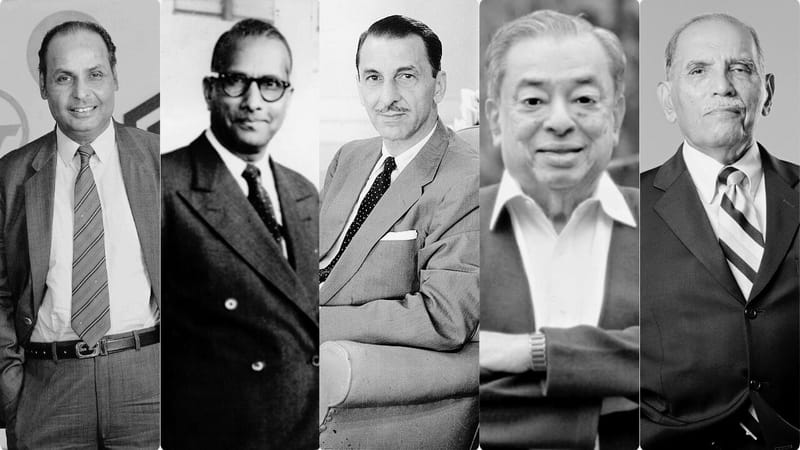
From J.R.D. Tata to Narayana Murthy, meet the foundational business leaders who built India's economic story after independence.
When India gained independence in 1947, the country was faced with a monumental challenge: to build its economy from the ground up. Partition had left industries divided and the economy in disarray. But amid this uncertainty, a generation of visionaries rose—not just to run companies, but to build institutions, create jobs, invest in innovation, and help define what independent India could achieve.
These are the OG business leaders who shaped the trajectory of India’s economy. They laid the groundwork for what would become Asia’s third-largest economy, and their legacy continues to influence Indian business and policy even today.
1. J.R.D. Tata – The Architect of Modern Indian Industry
Organisation: Tata Group
Legacy: Air India, Tata Steel, TCS, Indian Hotels Company
J.R.D. Tata was much more than a business magnate. He was a pioneering industrialist who redefined corporate India. Under his leadership, Tata Group expanded into new sectors including software, aviation, chemicals, and hospitality.
He founded Tata Airlines (later Air India) in 1932 and later served as its chairman when the airline was nationalised. J.R.D. Tata received India's highest civilian honour, the Bharat Ratna, in 1992 for his contributions to Indian industry and philanthropy. He was also a strong advocate for workers’ rights and responsible capitalism, setting up some of the earliest employee welfare schemes in India.
2. G.D. Birla – The Industrialist Who Supported the Freedom Struggle
Organisation: Birla Group
Legacy: Hindustan Motors, Birla Cement, education & philanthropy
Ghanshyam Das Birla was both a business leader and a close associate of Mahatma Gandhi. He expanded his family’s business into textiles, cement, and automobiles, becoming a key figure in India's early industrialisation. He established Hindustan Motors in 1942, which later became one of India’s leading automobile manufacturers. G.D. Birla also played a critical role in founding key institutions like BITS Pilani, and was deeply involved in nation-building efforts through philanthropy.
3. Dhirubhai Ambani – The Disruptor Who Democratised Capital
Organisation: Reliance Industries
Legacy: Petrochemicals, retail, telecom, equity culture in India
Dhirubhai Ambani redefined entrepreneurship in India. Starting out as a yarn trader, he built Reliance Industries into India’s most valuable company. His groundbreaking IPO in 1977 brought equity investing to the Indian middle class, creating a culture of retail shareholders. His approach was disruptive: vertical integration, aggressive scaling, and a direct connection with consumers and shareholders. His legacy is now carried forward by Mukesh Ambani, who expanded Reliance into retail and telecom.
4. Verghese Kurien – Father of the White Revolution
Organisation: Amul, National Dairy Development Board (NDDB)
Legacy: Made India self-sufficient in milk production
Verghese Kurien built a cooperative model that transformed rural India. As the founding chairman of Amul and NDDB, he helped make India the world's largest milk producer. According to official records from NDDB, Kurien's efforts led to Operation Flood, which doubled India's milk output between 1970 and 1996. His model empowered millions of farmers and is studied globally as a case of grassroots-driven development.
5. F.C. Kohli – The Father of Indian IT
Organisation: Tata Consultancy Services (TCS)
Legacy: Built the foundation for India’s software services industry
Fakir Chand Kohli co-founded TCS and played a crucial role in shaping India’s global IT identity. Joining Tata Electric in 1951 and later leading TCS, he introduced quality and process rigour long before they became industry norms. Kohli championed skills development and was instrumental in TCS becoming India’s first billion-dollar IT firm. His work inspired the creation of industry bodies like NASSCOM.
6. Narayana Murthy – Redefining Ethics and Governance in Business
Organisation: Infosys
Legacy: Corporate governance, India’s IT services exports
In 1981, Narayana Murthy co-founded Infosys with ₹10,000 borrowed from his wife. The company became a global leader in IT services, known for transparent governance, listing on NASDAQ in 1999. Infosys was among the first Indian companies to offer stock options to employees and prioritise disclosures to shareholders. Murthy's leadership laid the moral foundation for India's IT industry.
7. Ratan Tata – Going Global with Indian Values
Organisation: Tata Group
Legacy: Acquisitions of JLR, Tetley; Nano; Tata Trusts
Ratan Tata succeeded J.R.D. and led the Tata Group through global expansion. Under his leadership, Tata acquired international brands like Jaguar Land Rover and Tetley Tea. Tata also drove innovation with the Tata Nano, positioned as the world’s cheapest car. His focus on ethics and philanthropy through Tata Trusts continues to shape India’s corporate social responsibility landscape.
8. Azim Premji – India’s Most Generous Entrepreneur
Organisation: Wipro
Legacy: IT expansion, large-scale philanthropy
Azim Premji transformed Wipro from a vegetable oil business into a tech powerhouse. More importantly, he gave away a significant portion of his wealth to social causes. Premji has donated over $21 billion to the Azim Premji Foundation, focusing on education and social justice.
9. Dr. Prathap C. Reddy – Pioneer of Private Healthcare in India
Organisation: Apollo Hospitals
Legacy: Established the first corporate hospital chain in India
Dr. Reddy founded Apollo Hospitals in 1983, bringing global standards to Indian healthcare. Apollo was the first in India to receive international healthcare accreditation. His model inspired a wave of private hospitals and raised the quality bar in medical infrastructure.
10. Kiran Mazumdar-Shaw – India’s Biotech Pioneer
Organisation: Biocon
Legacy: Biopharma, affordable insulin, women in STEM
Starting Biocon in a garage in 1978, Kiran Mazumdar-Shaw overcame gender bias and regulatory hurdles to build a global biopharmaceutical company. Biocon is a leading producer of biosimilars and affordable insulin, helping improve access to healthcare globally.
Honourable Mentions
Nandan Nilekani – Infosys Co-founder and Aadhaar Architect
After Infosys, Nilekani headed the UIDAI and led Aadhaar, the world’s largest biometric ID programme. As reported by The Indian Express, Aadhaar now covers over 1.3 billion people.
Nusli Wadia – Defending Legacy and Modernising Industry
Chairman of the Wadia Group, Nusli Wadia preserved legacy brands like Britannia and Bombay Dyeing. His legal and business battles shaped India’s corporate governance culture.
K.K. Birla – Diversifying the Birla Empire
Krishna Kumar Birla played a critical role in expanding the Birla Group into new verticals and was also a Parliamentarian and patron of education.
These leaders were not merely businessmen; they were builders of modern India. They navigated the Licence Raj, globalisation, and the digital age. They created industries, wrote the playbook for ethical leadership, and invested in human capital before it became fashionable.
In an era where startups and unicorns dominate headlines, it is important to remember the foundational figures who laid the bricks for India's rise. Their stories are a reminder that nation-building and business-building are often two sides of the same coin.
Topics
Author
Loading...