







Leadership
TechHR India 2026: Meet the leaders who navigated disruption before you had to


 ||
||

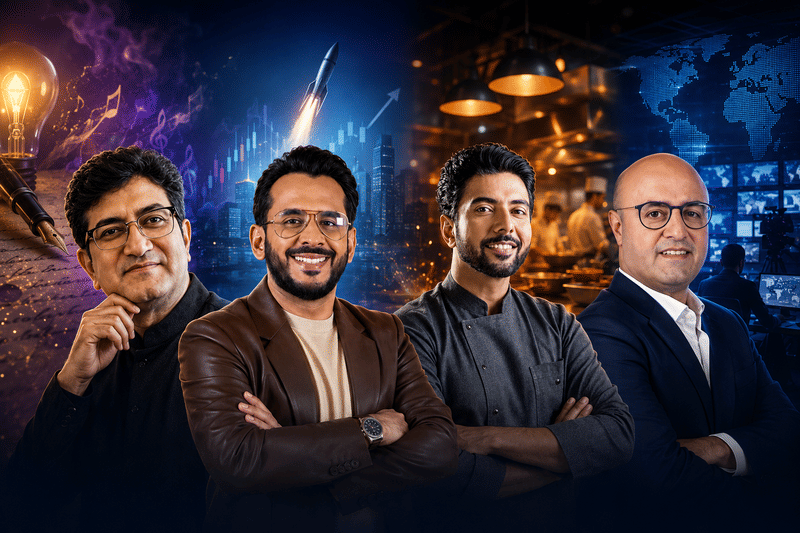
Four extraordinary careers. Four different industries. One common lesson. The leaders who stay ahead are the ones who learn to embrace disruption long before it becomes everyone else's reality.
Disruption does not arrive with a warning.
It slips into boardrooms as a new technology. Into businesses as a changing customer. Into newsrooms as a global crisis. Into creative industries as a blank page that suddenly demands a new language.
The leaders who succeed are rarely those who react fastest. They are the ones who have learnt to live with uncertainty long before everyone else begins talking about it.
This year, People Matters TechHR India 2026 brings together an exceptional line-up of leaders. Their worlds could not be more different. One writes stories that shape culture. One built one of India's most recognisable consumer brands. One transformed culinary excellence into a global personal brand. One reports from the frontlines of geopolitical change.
Together, Prasoon Joshi, Aman Gupta, Ranveer Brar and Aditya Kaul represent a broader leadership truth. No matter the profession, disruption rewards those willing to rethink, relearn and reinvent.
As organisations prepare for an AI-driven future, their experiences offer lessons that extend far beyond their respective industries.
Prasoon Joshi: Why creativity remains a leader's greatest competitive advantage

For more than three decades, Prasoon Joshi has worked where commerce meets creativity.
As a lyricist, screenwriter and advertising leader who served as CEO of McCann Worldgroup India and Chairman of McCann APAC, he has helped shape campaigns, films and ideas that have remained culturally relevant across changing generations.
His career has unfolded through multiple waves of disruption. The rise of digital media. The explosion of social platforms. The transformation of consumer behaviour. Now, the rapid emergence of generative AI.
Each wave has raised the same question. Can technology replace creativity?
Joshi's body of work suggests a different perspective. Technology changes how ideas are delivered. Creativity determines whether they matter.
For business and HR leaders, this distinction has become increasingly relevant. Organisations may automate workflows and accelerate decision-making, but culture, purpose and trust still depend on human imagination.
At TechHR India 2026, Joshi brings a perspective forged at the intersection of leadership, communication and culture, reminding organisations why originality remains difficult to automate.
Aman Gupta: Building a business by challenging convention

Markets rarely wait for leaders to catch up.
Few understand this better than Aman Gupta, Co-founder of boAt and founder of OFF/BEAT.
When boAt entered India's consumer electronics market, it faced established global competitors with significantly larger resources. Yet the company carved its own space by understanding changing consumer expectations and responding with speed, accessibility and brand relevance.
Gupta's entrepreneurial journey has since evolved beyond building a business. As an investor and mentor, he has become one of the country's most visible advocates for entrepreneurship, innovation and calculated risk-taking.
His leadership journey reflects a simple reality facing organisations today.
Transformation is rarely driven by those protecting existing models. It comes from leaders willing to question assumptions before circumstances force them to.
As businesses navigate AI adoption, evolving workforce expectations and new growth models, Gupta's experiences offer valuable insight into building organisations that stay agile without losing their identity.
Start with the stories, arrive for the experience
Restaurants offer very little room for complacency.
Every service is a performance. Every customer expects consistency. Every menu must evolve without losing its soul.
Over nearly three decades, Ranveer Brar has transformed himself from a professional chef into a restaurateur, author, television personality and entrepreneur, building influence far beyond the kitchen.
His success has never been built on recipes alone.
It has been built on curiosity.
From preserving regional culinary traditions to embracing new formats across television, digital media and hospitality, Brar has continuously reinvented himself while remaining rooted in authenticity.
This balance has become equally important for modern organisations.
Companies often pursue innovation while struggling to preserve the values that made them successful in the first place.
Brar's journey demonstrates that reinvention does not require abandoning fundamentals. Instead, it demands continuously refining them to remain meaningful in a changing world.
For leaders responsible for building resilient teams, the lesson is both practical and timely. Excellence is not created through occasional breakthroughs. It is sustained through everyday discipline.
Aditya Kaul: Leading when certainty doesn't exist

Few professions operate under greater pressure than journalism.
Decisions are made in real time. Information changes by the minute. Credibility depends on separating fact from speculation.
As Senior Executive Editor at NDTV, Aditya Kaul has spent years reporting on geopolitics, national security and strategic affairs, covering conflicts, diplomatic developments and international events where clarity is often difficult to find.
His career illustrates another dimension of leadership in an age of disruption.
The ability to remain calm when circumstances become uncertain.
Businesses increasingly face similar conditions. Geopolitical tensions influence supply chains. Regulatory changes reshape industries. Artificial intelligence alters competitive landscapes almost overnight.
Leaders cannot always control uncertainty.
They can control how they respond to it.
Kaul's experience offers a valuable perspective on judgement, resilience and informed decision-making in environments where every decision carries consequences.
Where leadership conversations become leadership practice
These four leaders come from different worlds, but their journeys intersect on one powerful idea.
Leadership is no longer defined by expertise alone.
It is defined by adaptability.
This philosophy sits at the heart of People Matters TechHR India 2026, organised around the theme "Orchestrating Growth With A Human Edge." The conference explores how organisations can combine technological advancement with human capability to build sustainable growth.
Across 100+ learning hours, attendees will explore four major agenda tracks:
The New HR Operating System Edge
The Leadership Edge
The Human+Tech Experience Edge
The Sustainable Innovation Edge
The event also features immersive formats including C-Suite Huddles, People Matters Think Tank, TechHR Lighthouse Talks, People Matters Big Questions, Talent Snack sessions and interactive Live Q&A discussions, creating opportunities for deeper learning beyond traditional keynote sessions.
Also Read: TechHR India 2026: Meet the leaders who have mastered challenges you are preparing for
Joining the programme are global thought leaders including Marc Effron, President of The Talent Strategy Group, and Holger Mueller, Vice President and Principal Analyst at Constellation Research, alongside more than 175 speakers, 150+ HR and Work Tech partners, and over 5,000 HR leaders, CEOs, CHROs and work tech professionals.
The conversations leaders cannot afford to miss
The future rarely belongs to organisations with the biggest budgets or the most sophisticated technology.
It belongs to those who recognise change early and prepare people to navigate it confidently.
Whether through creativity, entrepreneurship, craftsmanship or journalism, Prasoon Joshi, Aman Gupta, Ranveer Brar and Aditya Kaul have each spent their careers responding to disruption before it became everyone else's challenge.
Their experiences are different.
Their leadership lessons are universal.
As businesses continue to redefine work in the age of AI, these are conversations that extend well beyond inspiration. They offer practical ways of thinking about resilience, innovation and human-centred leadership.
People Matters TechHR India 2026 will take place on 6 and 7 August 2026 at the Yashobhoomi Convention Centre, Delhi.
Register now
Join Asia's largest HR and Work Tech conference and be part of two days of bold ideas, practical learning and meaningful conversations with 5,000+ attendees, 175+ speakers, 150+ HR and Work Tech partners, and more than 100 learning hours. If the future of work demands a new kind of leadership, TechHR India 2026 is where those conversations begin.
Topics
Loading...