







Leadership
The Human Edge in the Age of AI: Andrew Bryant on Leadership, Synergy, and Self-Ownership





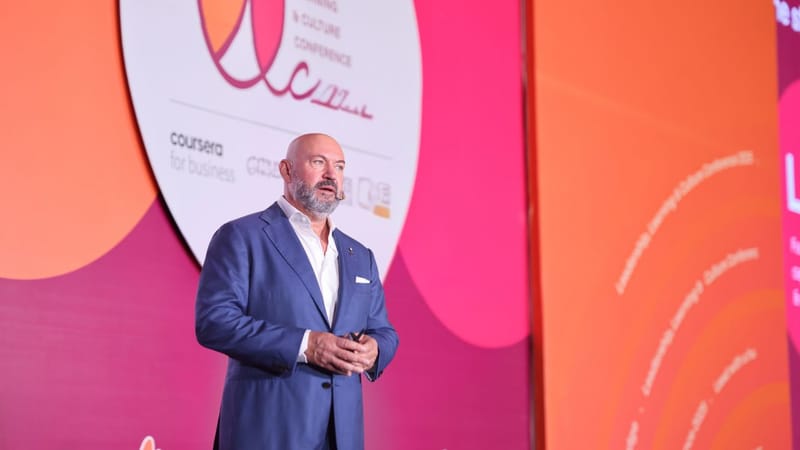
Andrew Bryant calls on leaders to move beyond fear and harness AI–human synergy, using technology to amplify, not replace, our shared humanity.
When artificial intelligence is rewriting the rules of business, leadership, and even creativity itself, one question keeps executives awake at night: What does it mean to be human in the age of machines? Standing before a packed hall at the People Matters conference in India, global leadership expert Andrew Bryant didn’t just offer an answer, he offered a challenge. “Leaders everywhere are asking the same thing,” he began. “Do I embrace AI and replace people with bots, or do I resist it and preserve the human connection?” He paused, then smiled. “There’s a third option: bringing AI and humans together in a way that uses AI to amplify our humanity. That’s the real opportunity.”
With that one line, Bryant set the tone for a keynote that was part philosophy, part provocation, and all leadership. Blending humour, stories, and decades of experience coaching executives around the world, he painted a vivid picture of what the future demands: a world where self-leadership and human synergy define success more than systems, structures, or speed.
The Leadership Dilemma: AI or Humanity?
Bryant pointed out that too many leaders are confusing efficiency with effectiveness. “AI can be incredibly efficient; it can admit a hospital patient in seconds,” he said. “But effectiveness is a different thing. When your elderly mother comes to the hospital confused, an AI might see her stable vitals and mark her case as non-urgent. A human nurse, however, might notice subtle changes and realise it’s early-onset sepsis, which is life-threatening. That’s effectiveness. That’s humanity.”
The Cautionary Tale of Going ‘All In’ on AI
Bryant cited the now-famous case of Kang, a Swedish software company that replaced its 700 human agents with AI bots. “The board loved it, stock prices went up,” he said. “But customer satisfaction fell through the floor. Within a year, they had to start hiring humans back. I actually congratulated the CEO for admitting his mistake publicly, because that’s rare leadership humility. They realised they’d gone too fast, trading loyalty and innovation for short-term gain.”
His takeaway? “You cannot remove the human element. The challenge is to create AI–human synergy.” And in a playful nod to his theme, he added: “The irony? The human in the image on my slide was AI-generated.”
Cultural, Not Just Technical: The Real AI Challenge
Quoting Steve Cadigan, LinkedIn’s first Chief HR Officer, Bryant highlighted that “the challenge with AI is more cultural than technical.” Cadigan told him, “We have to confront our own insecurities. People fear AI because they think it’ll take their jobs, but every major technological shift has ultimately created new kinds of work.”
Bryant warned that fear can lead to a “leadership vacuum.” “When people are afraid, they cling to control,” he said. “But fear is inversely proportional to control the less control we feel, the more fearful we become. And AI, with its opaque algorithms, makes many feel like they’re losing control.”
That’s precisely when leadership matters most. “When catastrophe strikes, leadership is stepping up,” he said, recalling a story from Mumbai’s 2008 attacks. “When the bomb went off at the Taj, the entire Unilever leadership team was there. And who led them to safety? Not the executives but an assistant manager from the Taj who said, ‘It’s my responsibility to get you out.’ That’s leadership.”
Self-Leadership: Being the Driver, Not the Passenger
Bryant’s concept of self-leadership, the idea that every individual must take ownership of their own thinking, feeling, and action, is at the core of his philosophy. “Self-leadership,” he said, “is the practice of influencing your thinking, feeling, and actions toward your objectives, not your company’s objectives, your objectives. When individual goals align with organisational goals, that’s when the magic happens.”
He illustrated this with a metaphor: “Leadership is being the driver of your car, not the passenger. When you’re in the passenger seat, you just get taken wherever it’s going. But when you’re the driver, you choose the route.” He chuckled as he recounted learning to drive in Portugal after moving there during the pandemic. “I’d always driven on the left in the UK, Australia, Singapore, and suddenly I was driving on the right, with a stick shift on the wrong side. I realised I was ignorant of my own ignorance! But that’s the essence of learning. If it doesn’t feel awkward, you’re not learning enough.”
Don’t Do It for Them: The HR Trap
Bryant’s message to HR professionals was both warm and challenging: “Stop doing it for people.” He shared a personal story about playing Minecraft with his teenage daughter during lockdown. When he asked her to upgrade his armour, she replied, “I could, but then you wouldn’t learn anything.”
“She understood ownership,” he said proudly. “And HR professionals need to remember that. You have the biggest hearts, but if you keep rescuing people, they won’t learn. Nobody’s coming on a white horse to save them. Help people take responsibility for their own growth.”
Responsibility vs. Accountability: A Leadership Lesson
One of the most striking distinctions Bryant drew was between being responsible for and being accountable to. “I’m responsible for myself,” he said. “I made sure I got to sleep, got ready, and showed up here today. But I’m accountable to you, my audience, for delivering value. I can’t learn for you. You have to be responsible for your own learning.”
He used humour to drive home the point: “People often ask why I say ‘my Brazilian wife.’ It sounds like I have more than one! But when you’re married to a Brazilian, you know you’re alive, because death is so close,” he laughed. “Am I responsible for my wife? No. She’s smart and capable. But I’m accountable to her. And that’s how organisations should work, responsibility for oneself, accountability to each other.”
From Fear to Potential: The Next Leadership Frontier
As Bryant explained, too many managers are stuck in “firefighting mode”, busy but not leading. “If you’re always reacting, you’re not reflecting,” he said. “You move from fear to burnout, and there’s no space for strategy or growth.”
That insight became the foundation for his upcoming book, Potentialized. “Many of my executive coaching clients told me their biggest fear was not living up to their potential,” he said. “So I asked: how do we measure potential? How do we expand what ‘best’ means?”
The result was a framework for integrating potential into leadership practice: “The art of performing at your best while continuously expanding what ‘best’ means.”
From Yakutsk to the Universe: Stories of Possibility
Bryant shared the story of Arsen Tomsky, founder of ride-sharing platform inDrive, who turned a local injustice into a global innovation. “He noticed during Yakutsk’s freezing winters that taxi drivers raised prices. So people started posting, ‘I’m driving from A to B, does anyone want to share fuel?’ That human ingenuity became an app and a billion-dollar company.
Bryant’s voice softened as he reflected: “He told me, to reach the highest level, an entrepreneur needs either one-in-a-million luck or a personal spiritual voice. And we’re in India, the birthplace of spiritual voice.”
Proprioception: Knowing Your Place in the System
Drawing on his physiotherapy background, Bryant introduced proprioception, the body’s ability to sense its position in space, as a metaphor for modern leadership. “In a world where leaders are juggling people, technology, and now AI, proprioception means knowing where you stand in your purpose, your relationships, your body, your learning.”
He invited the audience to test it by balancing on one leg, eyes closed, hand on ear, prompting laughter across the room. “If you managed that, you have proprioception,” he quipped. “But in leadership, it’s about understanding your environment and adapting to it.”
The Human Wonder That AI Can’t Replicate
Bryant closed with a powerful reminder: “AI can analyse everything, but it cannot wonder. Humans wonder what’s possible, and that’s where potential lives.”
He believes the biggest barrier to AI’s success isn’t technology or employee readiness, it’s leadership. “Leadership,” he concluded, “is the process of influencing others in a way that enhances their contribution. But more than that, it’s about developing yourself so you can positively influence others.”
His call to action was clear and memorable: “Embrace the shift. Take ownership. Be the driver. Develop your proprioception. Be an authentic leader. Because the future isn’t AI or human, it’s AI and human, together.”
Author
Loading...