







Leadership
The leadership edge you can’t outsource: Richard Lobo on building resilient culture amid restructuring





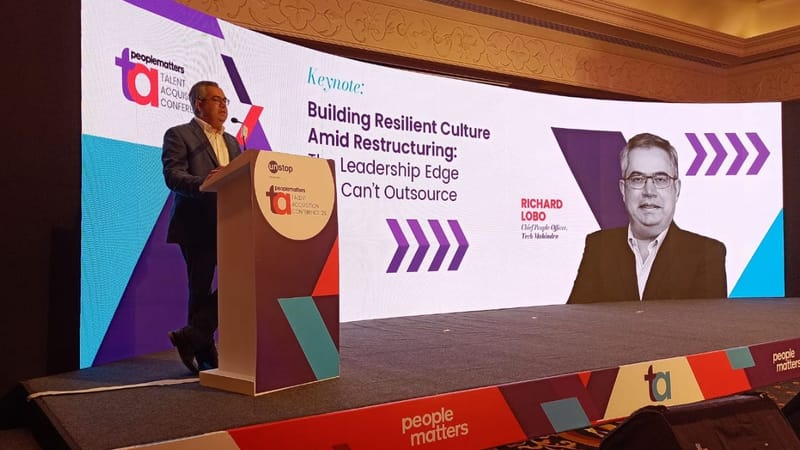
At People Matters TA Conference 2025, Tech Mahindra’s Richard Lobo said culture, not tech or structure, is the edge firms can’t neglect in times of disruption.
Restructuring is one of the most unsettling words in corporate life. It evokes images of redundancies, shifting reporting lines, and endless PowerPoint decks. Yet for Richard Lobo, Chief People Officer at Tech Mahindra, restructuring is not simply a technical exercise in organisational design. It is about something far more enduring, culture. Delivering a keynote today at People Matters Talent Acquisition Conference 2025 in Bengaluru, Lobo’s message was clear and uncompromising: you cannot outsource culture, and in moments of upheaval, it is the only sustainable advantage an organisation possesses.
“What holds companies together is culture, often misused as a buzzword, but ultimately the truest competitive edge.”
Lobo began by situating today’s workplace within its wider context. Technology, he observed, tends to dominate the headlines, particularly artificial intelligence. But to focus solely on AI is to miss the bigger picture. “There are many more things happening beyond AI,” he said, pointing to business model disruption and geopolitical turbulence as equally powerful forces. Electric vehicles replacing petrol and diesel cars. Streaming services overtaking traditional media. Digital wallets displacing cash. Shifting alliances and conflicts reshaping supply chains. “This is the kind of change each of us is dealing with,” Lobo reminded the audience. Disruption is no longer episodic; it is constant. And in such an environment, processes and charts are poor anchors. The true ballast, he argued, is culture.
The say–do gap: Holding a mirror up to leaders
Tech Mahindra, like many organisations, found itself needing to recalibrate. Lobo spoke with striking candour about a period when performance lagged behind that of peers, prompting the leadership team to pause and reflect. Rather than rushing to prescribe solutions, they chose first to listen. An external agency was brought in to capture unfiltered employee perspectives, a deliberate move to ensure honesty beyond the politeness of internal surveys.
The results were revealing. While employees affirmed the organisation’s core values, they also voiced clear frustrations: processes that were unnecessarily complex, recognition systems that failed to consistently reward high performance, and a hunger for greater space to innovate. It was, in Lobo’s words, a mirror held up to leadership. The gap between what organisations claim and what employees experience, the say–do gap, is often wider than leaders imagine.
“Organisations say certain things, but they don’t necessarily follow through. The only way to know is to ask your people. And listen deeply.”
This exercise became a turning point. Rather than launching new slogans or campaigns, the company focused on closing the gap through tangible actions, the kind employees could see, feel, and trust in their everyday work.
Culture: A collective endeavour
Lobo also dismantled the assumption that culture is shaped by leaders alone. Leadership may set the tone, but culture is co-created every day by everyone in the organisation. “It is what attracts people, keeps them engaged, and defines how you deal with clients, suppliers, and society at large,” he said. Apple, he noted, is a striking case in point. Long after Steve Jobs, the company’s culture of innovation remains intact, giving its products a premium appeal rooted not just in design but in cultural DNA. In this sense, culture is not an HR initiative, nor something that exists only within an organisation’s four walls. It extends to every relationship, every stakeholder interaction, and every decision.
The human-centric deficit
One of the most resonant moments of the keynote came when Lobo addressed a distinctly modern failing: distracted leadership. “I find it difficult to get leaders who can have conversations with people without looking at their phones,” he admitted, prompting laughter and knowing nods. Beneath the humour lay a serious point. In an age of digital overload, leaders who cannot give undivided attention erode trust and weaken psychological safety. For Lobo, human-centred leadership is not a soft ideal. It is a competitive necessity, one that builds trust, reinforces culture, and provides differentiation no technology can replicate.
Mid-level leaders: The overlooked core
Restructuring often places middle managers in the firing line, blamed for inertia or resistance. Lobo challenged this narrative, describing them instead as the glue that holds organisations together during times of flux. But he was pragmatic too: “Invest in those who are open to learning and adapting. For the others, they must either move with the times or move on.” In today’s unforgiving business climate, organisations cannot afford to carry those unwilling to evolve. Middle leaders who embrace learning can amplify culture; those who refuse risk holding back the entire enterprise.
Learning as a lifelong discipline
Threaded throughout Lobo’s address was a single truth: learning is no longer optional or episodic. In the past, careers were often built upon accumulated years of service. Today, expertise has a shelf-life. “Learning is going to be lifelong,” he insisted. “What matters is not how many years you’ve worked, but what you can do and deliver now.” This requires both individual commitment and organisational support. Resilient companies will be those that embed learning into the everyday, encouraging curiosity, experimentation and reinvention.
Engagement is not a metric alone
Lobo also offered a sharp critique of the over-reliance on engagement surveys. “People generally say they’re engaged. But when you sit down and talk, you uncover frustrations and the real opportunities for change.” The insight is clear: culture is not measured through scores alone. It is revealed in lived experience and open conversation. Numbers provide a surface-level pulse; dialogue uncovers the truth.
As he concluded, Lobo reframed restructuring not as a setback but as an opportunity. When organisations reinforce their values, empower agile decision-making and make innovation habitual, restructuring becomes a springboard for renewal. “Culture doesn’t change because leaders declare it. It changes when people experience it every day, when they see the difference, and they want to come back to work because of it.”
The People Matters TA Conference 2025 took place at The Leela Palace, Bengaluru on the theme "REWIRE or RETIRE: Talent Readiness in the Modern Workplace” challenging leaders to rethink how they attract, engage, and grow talent in a workplace transformed by AI, agility, and shifting expectations.
Author
Loading...