







Leadership
What’s next for BFSI talent? Be part of the answer at BFSI Talent & Tech Summit 2026



 ||
||

With 8.5 million workers and rising AI demand, BFSI faces a widening capability gap.
For a sector built on precision, BFSI is entering a phase where the variables are no longer fully controllable.
Technology is moving faster than regulation can fully anticipate. Customer expectations are shifting faster than institutions can redesign journeys. And perhaps most critically, roles are evolving faster than organisations can build people for them.
And the mismatch is beginning to show. India’s BFSI sector employs over 8.5 million people across more than 20,000 institutions — one of the largest workforce bases in the country. But scale is no longer the advantage it once was.
According to the Deloitte–NASSCOM (2025) report, 83% of BFSI firms prioritise digital transformation, yet most acknowledge their workforce is not ready to deliver it. At the same time, over 60% of financial CEOs expect AI to maintain or increase headcount, not reduce it.
The problem isn’t hiring. It’s translation
Across BFSI, hiring continues. Headcount hasn’t stalled. But what organisations are increasingly struggling with is translation — converting talent into capability, and capability into outcomes.
A credit decision today is no longer just a credit decision. It draws from data models, regulatory frameworks, customer experience metrics and algorithmic outputs. The human role hasn’t disappeared — it has become more complex.
So organisations are seeing familiar patterns:
- Teams that are staffed but not fully effective
- Roles that are filled but slow to ramp up
- Specialists who are hired but difficult to retain
At the same time, the industry itself is being restructured — not incrementally, but fundamentally. Distribution is moving away from physical networks towards platform-led and embedded ecosystems. Wealth management is emerging as the long-term anchor of customer relationships, demanding a blend of advisory capability and digital fluency.
Fintechs and Big Tech players are not constrained by legacy systems or operating models. They compete on speed, integration and user experience — setting new benchmarks that traditional institutions must now match.
AI, meanwhile, is no longer a layer of efficiency. It is embedded in fraud detection, underwriting, portfolio decisions and customer engagement.
And all this changes something fundamental: decision-making is becoming shared between human judgement and machine logic — but accountability remains human.

India’s role is expanding — and so is the pressure
India is not just participating in this shift. It is central to it. The country’s BFSI GCC ecosystem, currently valued at $40 billion, is expected to grow to $135 billion by 2032, with over 90 enterprises and 185 centres operating at scale.
These are running core functions — AI, cloud, cybersecurity and risk operations — for global institutions, further sharpening the talent challenge. At the same time, demand is rising for highly specialised roles. Supply is not keeping pace. And within organisations, generational expectations, attrition pressures and skill gaps are converging.
The result is a system under strain — not because it lacks people, but because it lacks aligned capability at scale.
In response, organisations are beginning to move beyond conventional hiring strategies. One approach gaining traction is the idea of building capability through structured systems — often referred to as a “talent factory” model. Instead of treating recruitment, onboarding and training as separate functions, these are integrated into a continuous pipeline designed to produce job-ready capability.
Therefore, leaders are increasingly expected to operate at the intersection of risk, governance, capability building and transformation execution. Questions that were once addressed by finance or risk functions are now central to HR:
- Does the organisation have the capability to manage AI-led decision systems?
- Is governance embedded into workflows, not just compliance frameworks?
- Can leadership pipelines sustain transformation under regulatory scrutiny?
- Are organisations building capability in areas such as climate risk, ethical AI and cyber resilience?
Where the BFSI Talent & Tech Summit fits in
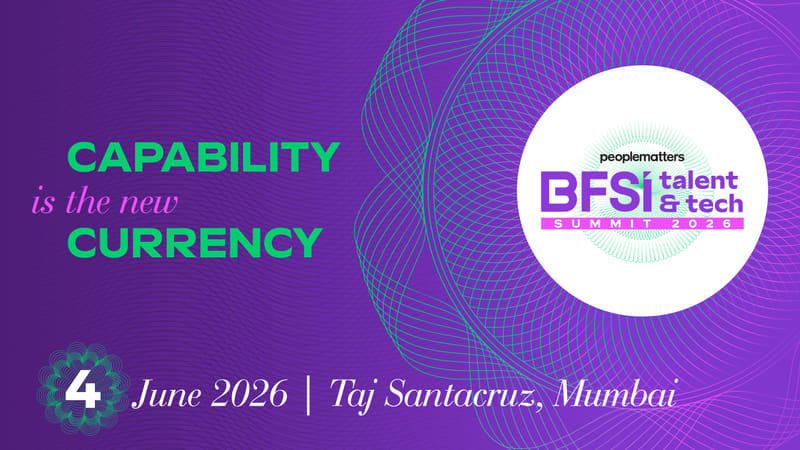
The BFSI Talent & Tech Summit 2026 is built around the questions the industry is already dealing with. Happening on 4 June at Taj Santacruz, Mumbai, the focus is simple: what’s actually working when it comes to talent, and what clearly isn’t.
The conversations will cut across things leaders are actively figuring out — how to build skills in an AI-led setup, what happens when roles change faster than org structures, how leadership needs to evolve when decisions are partly machine-driven, and how to keep trust intact in all of this.
With 170+ delegates, 20+ speakers and 15+ partners, this isn’t a room of observers. It’s people in the middle of the shift — trying, testing, fixing. If you’re leading talent, tech or business in BFSI, you already know this isn’t theoretical anymore. It’s showing up in hiring, in teams, in decision-making speed.
The idea is to get into that honestly — what’s working, what’s not, where AI actually helps (and where it doesn’t), and how people are scaling talent without breaking systems or teams. If that sounds like the conversations you’re already having internally, you’ll probably want to be in this one too.
Topics
Author
Loading...