







Leadership
Why keeping people issues alive is a boardroom survival skill





CHROs must translate talent strategy into business outcomes, quantify risk and hold the line on culture — even when numbers dominate the boardroom.
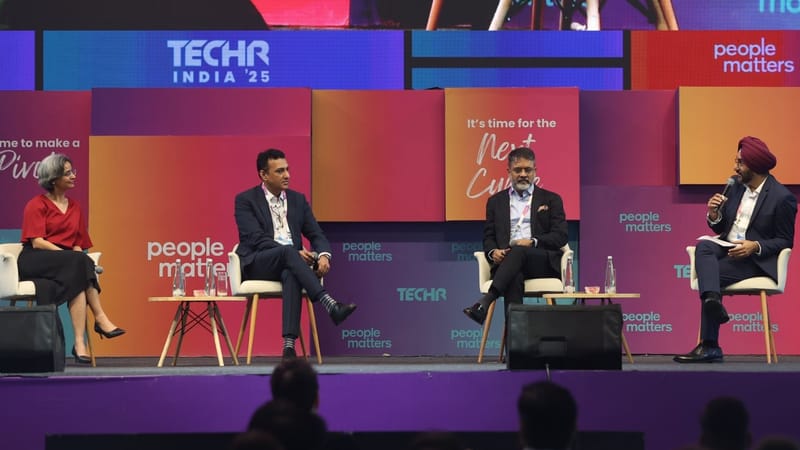
The air at TechHR 2025 crackled with urgency. On stage, three of India’s most influential HR leaders — Yuvaraj Srivastava of MakeMyTrip, Vibhash Naik of HDFC Life, and Manmeet Sandhu of PhonePe — squared off under the sharp moderation of Vodafone Idea’s Gurucharan Singh Gandhi.
While the theme was Vision 2030: Shaping Future Business Realities With Talent at the Core. Yet the conversation quickly cut through the distant horizon to confront today’s reality: in a world where boards obsess over margins, quarterly earnings and shareholder returns, who will keep the human agenda alive?
Sandhu set the tone early. “Conversations used to revolve around ROI and cost,” she said. “Today, it’s shifted to effectiveness and productivity. The boards I present to aren’t asking what are we rewarding — they’re asking how do we create a sustainable workforce, how do we ensure succession, how do we inspire people to walk with us into the future?”
Her point resonated: in a sector like fintech, where PhonePe is constantly evolving to keep pace with digital disruption, the board’s interest is no longer in HR inputs but in the confidence-building narrative that the workforce is future-ready.
That shift aligns with global research. PwC’s 28th Annual CEO Survey (2025) found that while CEOs are doubling down on generative AI and operating model reinvention, their boards are pressing for clarity on how talent pipelines and workforce skills will support these strategies.
Jargon won’t save you
For Yuvaraj Srivastava of MakeMyTrip, the risk lies in HR leaders clinging to their comfort zone. “Boards are not worried about your competency frameworks or your succession plan templates,” he warned. “They’re looking for solutions that land in the language of business. If you cut the clutter and talk about the outcomes — that’s when you create impact.”
He offered a sharp example: “If you stand in front of your board and say 80% of the workforce is Gen-Y ready, that’s fine. But what they want to know is: how many IPs have we created? How many products are ready? What can they proudly tell our clients?”
Chair Gandhi pressed the panel: how does a CHRO actually build credibility with a board?
Naik didn’t hesitate. “Succession planning is fragile right now,” he said. “Boards don’t want to discuss your templates. They want the assurance that if the CEO has to be replaced tomorrow, you are ready. That credibility only comes when you link your initiatives to business growth, to top line, to profit margins — and to culture.”
He added that culture itself has become a risk register item. “Boards today are judged, even penalised, on governance, on socio-economic responsibility. If they don’t have confidence someone is watching this, they can be exposed to negative publicity and regulatory pressure.”
The mirror and the architect
Sandhu returned to the mic with a metaphor that landed well. “The board expects us to be two things at once. The mirror of the organisation — showing honestly what’s working, what isn’t. And the architect — shaping the collective strategy with enterprise leaders. You can’t wait to be invited. You have to lead from the front.”
That dual role echoes the global governance debate. A 2024 PwC Board Effectiveness study concluded that boards rely on CHROs both for reflective workforce analytics (attrition, wellbeing, skill gaps) and for forward-facing workforce architecture (capability building, culture design, succession resilience).
Perhaps the starkest exchange came when Gandhi asked how to keep people topics on the agenda when financial issues dominate.
Naik’s response was blunt: “Skill obsolescence has become a big problem. With every tech disruption, the workforce strategy is disrupted. Boards are asking: are we prepared for the future? Can we commit to customers that we have the skills ready? If you can’t answer that, no amount of quarterly reporting will help.”
External data backs him up. The World Economic Forum’s Future of Jobs Report 2025 estimates that 39% of workers’ core skills will change by 2030, with AI and analytical skills in sharp demand . For boards, this is not a distant HR concern but a strategic risk that can undermine revenue and reputation.
The audience challenge: bias in succession
From the floor, an automotive executive raised a pointed question: managers often resist grooming successors, fearing their own displacement. How should HR address this?
Sandhu acknowledged the dilemma: “Yes, bias and insecurity exist. But if your strategy is clear — why you’re investing in certain skills, why you’re broad-basing development — then you can create psychological safety. Leaders need to know succession planning is not about taking their job away; it’s about preparing the organisation for growth.”
Gandhi added the reality check: “Human beings have biases. The world isn’t always fair. But your strategy must ensure outcomes are more transparent and fairer than before. That’s progress.”
The subtext of the entire panel was clear: boards don’t want to hear activity, they want to understand risk and readiness. For CHROs, that means reframing.
Not: “We have rolled out a competency framework.”
Yes: “Our leadership pipeline has two ready-now successors for CFO, three high potentials in readiness for COO, and here are the risks if we don’t close the gaps.”
Not: “We launched a wellbeing programme.”
Yes: “Employee wellbeing has reduced attrition by X%, protecting Y million in revenue, while also cutting healthcare costs.”
This repositioning puts HR issues in the same category as liquidity risk or cyber risk — issues the board cannot afford to sideline.
AI governance as a people issue
Another frontier is AI. The PwC CEO Survey (2025) shows CEOs prioritising AI adoption, but most boards lack clarity on the workforce plan that goes with it .
Here lies a major opportunity for CHROs: to present not only how AI will alter jobs but also how the organisation will reskill, redeploy and protect trust. That includes responsible AI use in HR itself, from recruitment algorithms to productivity monitoring.
Sandhu phrased it crisply: “The board wants to know — can you commit to customers that you have the skills ready? That requires confidence. And that confidence only comes if you are managing tech disruption as a people strategy, not as an afterthought.”
The through line: persistence
As the panel drew to a close, Gandhi summarised: “First, build credibility with your knowledge and depth. Second, talk outcomes, not frameworks. And third, never drop the flag of people — because if you don’t hold it now, it will come back to bite you later.”
The applause was loud and long. The message was simple, but the execution is anything but. Keeping people issues alive at board level in 2025 means:
Reframing HR as enterprise risk management.
Quantifying skills and succession gaps in financial terms.
Owning the dual role of mirror and architect.
Persisting even when the agenda is dominated by numbers.
Because when the market steadies and the board looks for the levers behind performance, it is the quality of talent, culture and leadership that explains why one organisation pulled ahead while another fell behind.
Topics
Author
Loading...