







Leadership
Why people, not technology, will decide whether AI succeeds in Indian organisations






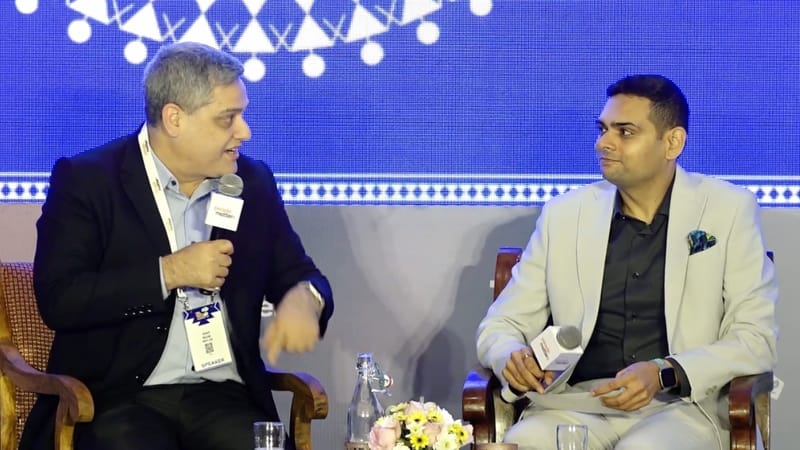
At TechHR Pulse Mumbai, Rohit Kilam outlines why AI, leadership and employability can no longer be treated as separate conversations.
As Indian organisations accelerate their adoption of artificial intelligence, the real fault line is no longer technology. It is people.
Rohit Kilam, Chief Technology Officer at HDFC Life, discussed the same during a session with Pushkaraj Bidwai, CEO, People Matters at the TechHR Pulse Mumbai. Drawing from his experience leading large-scale technology transformations, Kilam said that India’s success—or failure—in the AI era will be determined less by platforms and more by how organisations rethink leadership, skills and organisational design.
India’s advantage lies in human adaptability, not tools
Kilam began by situating India’s technology adoption in a global context. Indian organisations, he said, are among the fastest adopters of technology worldwide, a trend he attributed to human capital rather than infrastructure.
According to him, India’s diversity—across language, culture and context—has created an unusual level of adaptability. This, he said, enables organisations to absorb and deploy new technologies faster than many global peers.
He also pointed to India’s growing emphasis on frugal and inclusive technology, noting that local innovation has often focused on building solutions that work within constraints. This approach, he said, is increasingly visible in India’s AI and language-model efforts, which prioritise accessibility and scale.
At the same time, the leader acknowledged a structural gap:
-
Indic algorithms remain limited, and
-
Many global technologies still require adaptation to Indian realities rather than being designed for them from the ground up.
Why most transformation programmes fail
Kilam was direct in his assessment of transformation outcomes. Globally, he said, the majority of transformation initiatives fail—not because of weak technology, but because organisations misunderstand what transformation requires.
The distinction, he argued, lies between digitisation and transformation.
Transformations that succeed typically share three characteristics:
-
A clear reason for change, beyond technology adoption or competitive pressure
-
A layered approach, rather than an expectation of a single breakthrough outcome
-
A sustained focus on people adoption, not just system deployment
In Kilam’s words, technology itself is rarely the constraint. People are.
He stressed that even well-designed systems collapse if employees are unable—or unwilling—to adapt their ways of working. Transformation, he said, demands both adaptation and adoption.
The workforce is already becoming agentic
One of the session’s most consequential arguments concerned the changing nature of teams.
Kilam stated that organisational teams will no longer be fully human. Increasingly, they will include agentic systems—algorithmic agents working alongside employees.
In practical terms, this means:
-
Teams composed of humans and AI agents working together
-
Technology leaders owning algorithms and systems
-
People leaders remaining accountable for human capability, judgement and culture
He emphasised that this shift is already under way. As operational work is automated, organisations are moving towards what he described as “zero ops”, where routine operations are handled entirely by systems.
The implication for leadership is clear:
-
Humans move up the value curve
-
Cognitive work, judgement and decision-making become central
-
Operational roles shrink rapidly
Kilam warned that HR leaders who lack technological fluency risk being left behind as these changes accelerate.
Early signs are already visible in the labour market
Kilam pointed to recent contraction in the IT services sector as an early signal of this transition. As operational and repetitive work becomes automated, roles built around those activities are diminishing.
This, he said, is not a temporary cycle but a structural shift driven by algorithms replacing core operational tasks.
Education is still preparing people for an industrial-age economy
The discussion then turned to talent readiness and employability. Kilam argued that India’s education system remains anchored in an outdated model of work.
According to him:
-
Curricula continue to reflect industrial-age assumptions
-
Career paths are still designed as linear and long-term
-
Degrees are prioritised even when they do not translate into employability
Kilam questioned whether traditional careers will remain relevant over the next decade, suggesting that work will increasingly be organised around skills rather than fixed roles.
He illustrated the employability gap with everyday examples, pointing to the ease of purchasing products versus the difficulty of accessing skilled services. The problem, he said, is not demand—but preparedness.
What capabilities matter in an uncertain future
While rejecting the idea of a fixed skills list, Kilam identified several foundational capabilities that he believes will remain critical:
-
Logic, taught early, to enable structured thinking
-
Creativity, introduced as a core subject rather than an extracurricular activity
-
Mathematics, taught without fear and as a problem-solving tool
-
Philosophy, to embed ethics and values from a young age
-
Employable skills, introduced at the senior school level so work does not depend solely on degrees
He said that individuals should be able to enter the workforce with skills, without being compelled to spend years acquiring credentials with limited practical value.
Scaling AI skills requires more than policy intent
At a national level, Kilam framed AI skilling as both an education and infrastructure challenge.
He highlighted three priorities:
-
Early exposure to AI tools and usage, not just theory
-
Access to infrastructure at the grassroots level, enabling experimentation and learning
-
Incentives for innovation with societal outcomes, rather than purely individual gain
He also underscored a frequently overlooked factor: teachers. Without better incentives—financial included—India’s skilling ambitions, he argued, will remain constrained.
Why AI initiatives fail inside organisations
Within enterprises, Kilam cautioned against fragmented AI experimentation. Many organisations, he said, are launching isolated proof-of-concept projects without a clear view of outcomes or economics.
Effective AI deployment, he argued, requires alignment across:
-
Strategy and desired outcomes
-
People capability and training
-
Applications, data and models working together
Use cases that appear attractive often fail to generate returns when token costs, infrastructure and scale are taken into account. Without a clear business problem, AI initiatives struggle to move beyond experimentation.
India’s next leap may come from hardware
Contrary to dominant narratives, Kilam suggested that India’s next major technology leap could come from hardware rather than software.
As chips, minerals and manufacturing capabilities become increasingly scarce and geopolitically sensitive, hardware innovation may define future advantage. He pointed to emerging opportunities across manufacturing, IoT, drones and space technologies.
What CTOs expect from HR today
When asked what he expects from the HR function, Kilam outlined three priorities:
-
Machine-ready talent, capable of working with digital and physical systems
-
Organisational structures that enable innovation rather than delay decisions
-
Safe spaces to fail, without which experimentation and learning stall
Without these conditions, he argued, organisations will struggle to generate meaningful innovation.
As AI reshapes work and expertise becomes increasingly accessible, Kilam’s message was clear: leadership in the next decade will be defined less by control and more by judgement, capability and design. Technology may be the catalyst, but people will decide the outcome.
Topics
Author
Loading...