







Leadership
Why the world’s top companies want Indian CEOs & CXOs





From constraint-born ingenuity to cultural fluency, Indian leaders are redefining global leadership through lived complexity, not boardroom theory.
When Procter & Gamble announced in July 2025 that Shailesh Jejurikar would take over as its next President and CEO from January 1, 2026, the news reverberated far beyond corporate boardrooms. Jejurikar, who will become the first Indian-origin leader to helm the 187-year-old consumer goods giant, joins a rising cohort of Indian-origin executives whose ascent reflects a quiet but profound shift in global leadership—and where the world is now choosing to place its trust.
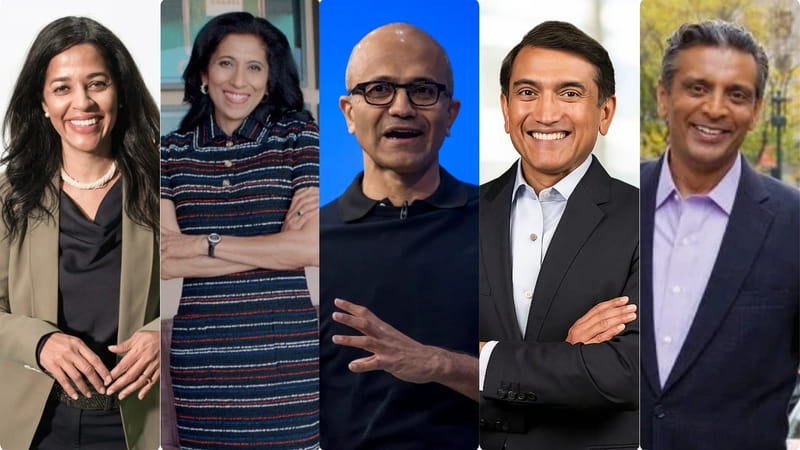
Today, Indian-born or Indian-trained leaders are at the helm of some of the world’s most influential companies—Microsoft, FedEx, Starbucks, IBM, Chanel, Palo Alto Networks. The list is not only growing, it’s diversifying. From luxury fashion and logistics to semiconductors, consumer goods and banking, Indian leadership has emerged not as a passing trend—but as a compelling global template.
So what explains this phenomenon? What is it about Indian CEOs and CXOs that makes them uniquely suited to lead across geographies, cultures and crises?
1. Resilience Forged by Friction
India does not offer its talent an easy path. It offers them something better: complexity from the very beginning. Navigating bureaucracy, unreliable infrastructure, demographic diversity, and rapid technological shifts isn't an occasional crisis—it’s the norm. The ability to not just survive this, but grow through it, creates a distinctive kind of leader.
Take Satya Nadella, who grew up in Hyderabad and now steers Microsoft through the age of generative AI. In his memoir Hit Refresh (2017), Nadella writes about “persisting through ambiguity and finding clarity in the fog.” That’s not just a poetic line. It’s a leadership principle born out of the day-to-day realities of India’s unpredictability. Under Nadella, Microsoft didn’t chase trends—it anticipated them, pivoting early to AI and cloud in ways that were both cautious and revolutionary.
Another example is C.S. Venkatakrishnan, CEO of Barclays, who stepped in to lead the UK-based bank during the turbulence of Brexit and post-pandemic recovery. Born in India to a family that had fled Idi Amin’s Uganda, he told Financial Times (2021) that such early upheaval instilled in him a deep sense of adaptability and perspective.
This is not resilience in the motivational-speak sense. It’s resilience as strategic foresight. These leaders aren’t just reacting to global uncertainty—they recognise it as the terrain they were trained to traverse.
2. Cultural Fluency: Not Learned, Lived
In most countries, multicultural competence is a skill. In India, it’s a condition of existence. To grow up here is to navigate a pluralism of language, caste, religion, gender, class, and ideology—often within the same neighbourhood, or even the same family. The result? A unique ease with navigating difference, conflict, and ambiguity.
Leena Nair, CEO of Chanel and former CHRO at Unilever, embodies this instinctive inclusiveness. In her interviews with BBC (2021) and Vogue, she spoke not of strategies, but of lived convictions: that listening can be more powerful than commanding, and that empathy is not a buzzword, but a daily discipline. At Chanel, she brought these values into a luxury space not known for cross-cultural inclusivity, proving that Indian-born leadership isn’t about transplantation—it’s about transformation.
Then there’s Laxman Narasimhan, the Pune-born CEO of Starbucks. His very first move upon joining the company? A global “barista immersion”—serving coffee behind counters from London to Seattle. As CNBC reported in March 2023, this wasn’t a PR stunt. It was a listening exercise rooted in a distinctly Indian principle: that leadership must touch the ground it seeks to change.
This fluency with difference—the ability to decode signals from below, not just above—is a major reason why Indian leaders excel in matrixed environments. As Harvard Business Review argued in its 2019 article “Why Indian CEOs Dominate Silicon Valley,” these executives are not baffled by bureaucracy or hierarchy—they’ve spent a lifetime learning to navigate both.
3. Frugality as Innovation, Not Scarcity
The Indian idea of jugaad—creative improvisation using limited resources—is often misunderstood abroad as a workaround or shortcut. But in the hands of Indian-origin global leaders, frugality has become a design philosophy. Not about doing less, but doing smarter.
Revathi Advaithi, CEO of Flex, is one such leader. In a 2023 interview with Forbes, she described embedding “resource consciousness” across the company’s global operations. For Advaithi, sustainability and cost-efficiency are not separate goals. They are part of the same strategic approach: leaner, decentralised, and accountable design.
Arvind Krishna at IBM took a similarly grounded route. When he assumed the role of CEO in 2020, IBM was at a crossroads. Rather than pursue flashy acquisitions, he doubled down on modular AI and hybrid cloud infrastructure. As Reuters reported, his decisions reflected a preference for scalable transformation—growth not for headlines, but for durability.
These are not flashy moves. They are measured ones. But in a world where shareholder patience is thin and resources finite, this restraint is not hesitation—it’s foresight.
A New Ethos for Global Leadership
It would be easy to chalk up this rise to Silicon Valley’s diversity optics or to India’s enormous STEM graduate pool. But that would be reductive.
Look beyond tech, and the pattern still holds. Consider:
Shailesh Jejurikar, now CEO of Procter & Gamble (P&G), one of the world’s most trusted consumer goods conglomerates (P&G Press Release, July 2024)
Raj Subramaniam, CEO of FedEx, leading logistics in the post-Amazon, post-pandemic economy
Nikesh Arora, Chairman and CEO of Palo Alto Networks, building cybersecurity resilience in the AI age
Anjali Sud, CEO of Tubi and former CEO of Vimeo, shaping the future of streaming
Sandeep Kataria, Global CEO of Bata, transforming a legacy brand through digital channels
Even in HR, Indian talent is making quiet but meaningful waves. Rohit Kapoor, appointed CHRO at Max Life Insurance in 2024, cut his teeth navigating India’s notoriously complex regulatory and demographic terrain. His “human-first” lens, honed in that environment, is now valued by multinationals looking to rebuild cultures post-COVID.
These leaders are not tokens. They are not chosen for their Indian identity, but for what that identity has demanded of them. Their ascent reflects not a geopolitical trend, but a human one: that adversity, when internalised with purpose, creates capacity.
In a world where leadership is less about command and more about context, the Indian experience—of managing scarcity, diversity, contradiction, and change—is no longer a disadvantage to be overcome. It’s an asset to be exported.
Topics
Author
Loading...