







Life At Work
Employee silence isn't data — don't import your diagnosis



 ||
||


Gen Z is challenging traditional workplace norms, pushing managers to rethink employee silence, motivation, career growth and leadership in the modern workplace.
By: Anand Shankar
Every instrument an Indian manager inherited runs on assumed motives. The performance review assumes he wants your approval. The retention conversation assumes she fears losing the job. The recognition ritual assumes praise is what people are actually short of. None of these instruments were ever really about feedback, or staffing, or recognition — they were about applying leverage to motives nobody had to ask about, because everyone in the room had signed up for the same ladder.
Gen Z broke the first assumption. AI broke all three at once. It does not fear you. It does not want your approval. It cannot be motivated. And once you have managed something that runs entirely without those levers, you start to notice how much of what you called leadership was never anything more than emotional leverage on a motive you never checked.
The vanishing levers
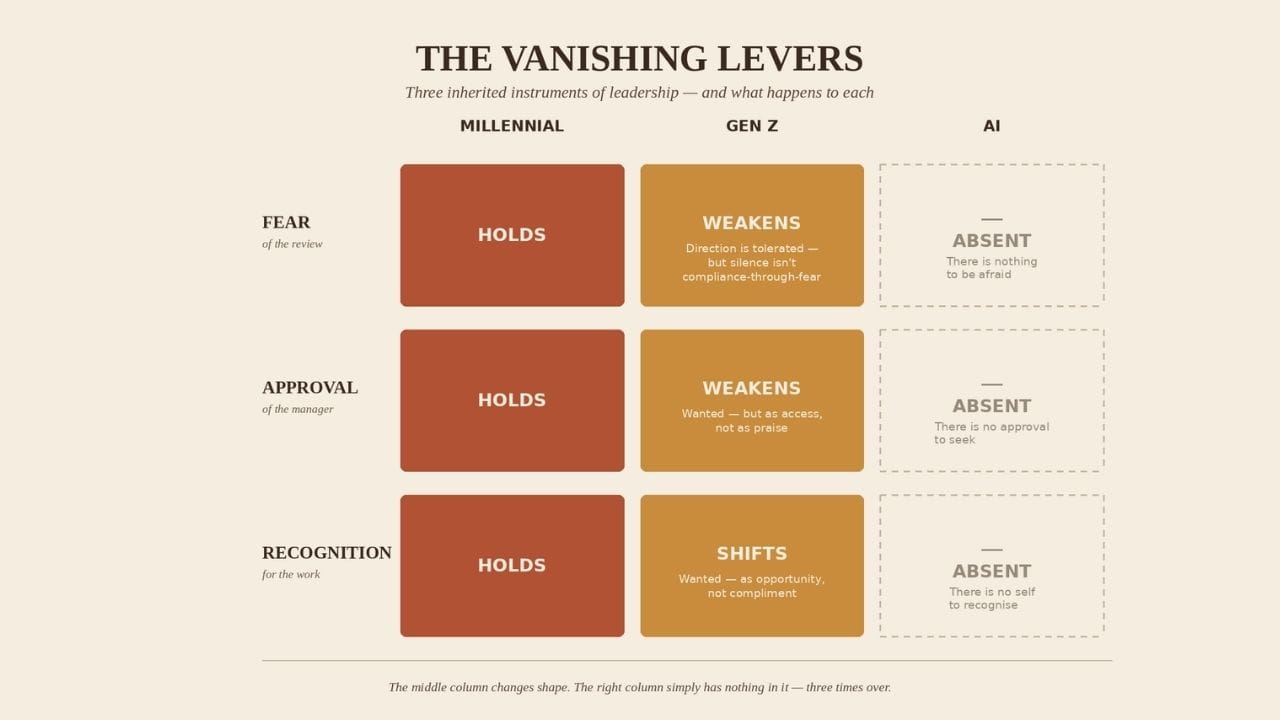
Read the middle column first. It doesn't collapse — it changes shape. Every one of these motives is still present in a Gen Z employee; what has changed is what satisfies it. That is a redesign problem, and this article's middle section is largely about redesigning correctly. Then read the right column. It doesn't shift shape at all. It simply has nothing in it, three times over, for a structural reason rather than a generational one — and that is a different kind of problem, one no amount of redesign solves.
That noticing is overdue in India, and India is the hardest place to have it — because the literature telling Indian managers how to lead Gen Z was not written about India at all.
It arrived the way most management literature arrives in India: fully formed, footnoted, and imported. A manager reads it, recognises the vocabulary — purpose, flexibility, feedback culture — and assumes the diagnosis underneath the vocabulary must be local too. It rarely is. The words travelled. The demographic reality that produced them did not.
An important diagnosis
Almost everything published on “leading Gen Z” comes out of economies that are ageing. The OECD's 2025 Employment Outlook is blunt about the shape of the problem it is describing: old-age dependency ratios at levels unseen in thirty-five years, youth cohorts shrinking, labour mobility slowing, GDP per capita growth decelerating unless something changes. In that world, a twenty-four-year-old is scarce. She has leverage the moment she walks in, because there are fewer of her every year and someone else will make her an offer by Friday. Naturally, the literature written for that world is about courtship — how to keep her, flatter her, redesign the ladder so she wants to climb it.
India's demography is the mirror image of that sentence. The constraint here is not people, it is jobs. And an Indian manager who picks up a Harvard Business Review piece on Gen Z retention, or a McKinsey slide built on European labour data, is diligently solving a problem that does not exist in the room he is standing in — while missing the one that does.
This is not a claim that Indian Gen Z are different in what they want. It is a claim about which problem the manager thinks he is solving. The Western manager reading his own literature is, roughly, correctly diagnosed — his talent pool genuinely is shrinking, and courtship genuinely is the rational response. The Indian manager reading the same literature has borrowed the prescription without checking whether he has the disease.
Some of what has become received wisdom about this generation is, in fact, true everywhere, India included, and worth stating plainly before we get to what is not.
What holds up everywhere
Three things travel well, because they were not observed in one geography and generalised — they were arrived at independently in different economies with different demographics, which is what makes them durable rather than a passing mood.
Growth has been redefined as capability, not rank. Naukri's Gen Z Work Code study — built on responses from more than 23,000 Gen Z professionals across over eighty industries in January 2026 — found that 57% define career growth as acquiring new skills, against 21% who point to salary and 12% who point to promotion. In creative fields, the skills-first figure rises to 78%. This is not a rejection of ambition; it is a redefinition of what ambition is measured against.
Recognition has moved from praise to access. The same study found 81% of respondents prefer recognition that functions as an opportunity — a stretch project, a seat in a room, exposure to a decision — over recognition that functions as a compliment. Deloitte's 2026 India market report, drawn from 806 respondents split between 506 Gen Z and 300 millennials, tells a consistent story on ambition itself: 96% of Indian Gen Z and 93% of Indian millennials are interested in eventually holding a senior leadership role. But only 9% and 8% respectively name it as their primary career goal right now. Interested, but not organising their week around it — that gap is the redefinition, not an absence of drive.
Refusal on values has become ordinary, not activist. Deloitte's India data shows roughly half of respondents have turned down a work assignment on personal or ethical grounds, and 48% of Gen Z specifically have turned down an employer altogether for the same reason. This is not the exceptional act of a values crusader. It has become baseline behaviour, and treating each instance as a special case — rather than a pattern the organisation should expect — is itself a sign of the diagnosis being out of date.
These three hold in Bengaluru and they hold in Berlin. What does not travel is everything that follows.
This is the part of the article that earns its place, because it contradicts almost everything currently in circulation — including, in places, what I have said myself in earlier work.
Indian Gen Z tolerate direct instruction better than Indian millennials do, not worse. The prevailing script says the newest generation wants to be consulted, not commanded — a fair reading of the Western data, where “conscious unbossing” (Robert Walters' term, from UK research finding 52% of Gen Z professionals actively avoiding middle-management roles, 69% of them calling the job high-stress and low-reward) suggests a generation opting out of hierarchy altogether. Notably, even that Western finding has a serious counter-argument: Glassdoor's analysis, reported by Fortune in July 2025, found no behavioural evidence for a mass avoidance — Gen Z entered management roles in 2025 at roughly the same rate millennials and the generation before them did. So even the “West” half of the received story is contested. But set that aside — because in India, what the data shows is closer to the opposite of the Western narrative. Direction is not experienced as an imposition by a generation that, on the whole, grew up inside more structured, more supervised, more instruction-dense households and school systems than the millennials who preceded them. I would offer that as a plausible explanation, not a proven one — it is an inference from a pattern, not a finding from a study, and it should be read that way. But the pattern itself — greater comfort with direct instruction — is what the India data shows, and it is close to the reverse of what every imported deck assumes walking into the room.
Ambition has not gone missing. It has stopped being primary. Return to that 96%-interested-but-9%-primary-goal gap. Read carelessly, that 9% looks like apathy. Read properly, it is 96% who have not ruled leadership out, filtered through a generation that has simply declined to organise its identity around it the way their managers' generation did. The manager who concludes “they don't want to lead” from that number has made an error of arithmetic, not observation.
The same India data offers a second clue worth sitting with. Deloitte's 2025 global survey found that only 6% of Gen Z name reaching a senior leadership position as their primary career goal — a figure close enough to India's 9% that this is plainly not a local peculiarity. What is more locally interesting is the 2026 global figure sitting alongside it: 25% of Gen Z and 21% of millennials, across more than 22,500 respondents in forty-four countries, say they actually prefer rapid progression — quick promotions, fast cycles — over the slower, more deliberate climb their organisations are generally built to offer. Put the two numbers together and what emerges is not a generation that has cooled on advancement. It is a generation that wants advancement on a different clock, and has quietly stopped believing the traditional one will deliver it in time to matter. That is a scheduling complaint, not a motivational one — and it is answerable by an organisation willing to ask the question, in a way that “they've lost their drive” is not.
Silence is the cultural default, so it carries no information. This is the single most expensive misreading in an Indian office. A Western manager who gets silence in response to a proposal has some basis for reading it as tacit agreement, because silence is a comparatively costly signal in a lower-power-distance culture — dissent, if it existed, would more often have been voiced. In a high-power-distance office, silence is simply what a junior person does by default, regardless of what they think. It is not a signal at all. Treating it as one — as agreement, as buy-in, as the absence of a problem — is reading noise as data, and it is the single most avoidable managerial error this article will describe.
Exit does not announce itself. The predictable arc — mounting friction, a difficult conversation, a resignation that follows logically from visible dissatisfaction — is largely a Western narrative convention, and I would offer, again as an interpretation rather than a proven finding, that it may not be the shape exit typically takes in an Indian office. What I would propose instead: compliance continues right up until the resignation letter, because the visible behaviour and the internal decision were never connected to begin with. If silence carries no information, then the absence of complaint cannot be read as the absence of a decision already made.
The family is in the room. Career decisions in India are rarely made by an individual acting alone against a market. The household is a co-decision-maker — sometimes silently, sometimes explicitly — in ways that Western retention frameworks, built around an atomised professional making autonomous choices, do not have a category for. A relocation that looks straightforward on a spreadsheet may not be straightforward at all once it is discussed at a dinner table the manager will never be invited to. A promotion that comes with more travel may be quietly declined for reasons that have nothing to do with the role and everything to do with an ageing parent, a spouse's own career, or an obligation the employee will not volunteer and the manager has no framework for asking about. This, too, I offer as a proposition worth testing against your own team rather than a settled finding, but it is one that should reorganise how a manager reads a hesitation, a delay, or a sudden change of heart that has no visible workplace cause.
There is a compounding effect worth naming across all five of these, because it is what makes the section more than a list. Each myth, taken alone, describes one misread signal. Taken together, they describe a manager operating on a five-fold deficit — reading compliance as agreement, competence as ambition's absence, silence as consensus, calm as security, and an individual's stated preference as the whole of the story — while genuinely believing he has excellent visibility into his team. The confidence is not misplaced arrogance. It is the natural result of a system that was never designed to surface the information he actually needs.
A note on sourcing, because getting this wrong in print would be worse than leaving it out: the hard numbers in this section and the one before it — the Deloitte and Naukri figures, the Gallup and OECD data, the Robert Walters and Glassdoor findings — are drawn from named studies with disclosed sample sizes and dates, and are verifiable against the original reports. The explanations offered for why those patterns hold — the upbringing argument for direction tolerance, the compliance-then-exit pattern, the family as silent co-decision-maker — are not from a study. They are propositions, offered because they fit the verified pattern and are worth testing against your own team, not because they have been independently confirmed. I have tried to mark that distinction as it occurs rather than let the confidence of the surrounding prose blur it, because the two kinds of claim do not deserve the same kind of trust.
Read more: Look before you leapfrog: Why Asia's AI shortcut may be a mirage
The second break
Whatever Gen Z made harder for the manager who leads by assumption, AI has made structurally impossible.
Every one of the instruments described in the opening — the review, the retention conversation, the recognition ritual — works by attaching a lever to an assumed motive. Fear of the review. Desire for approval. Need for recognition. A generative model sitting inside a workflow has none of these. It does not fear a poor evaluation. It does not seek your approval before producing output. It cannot be motivated by praise, autonomy, or purpose, because it has none of the internal state those levers are designed to move.
This is not a metaphor for what's changed about managing people; it is the mechanism made visible. Manage a team that includes an AI collaborator for long enough, and you start to notice how much of what you called leadership was never really about the work — it was about applying pressure to a motive. Remove the motive from one member of the team, and every lever built for it simply does nothing.
The Cybernetic Teammate study — Dell'Acqua and colleagues' pre-registered field experiment with roughly 776 professionals at Procter & Gamble, published as an NBER working paper and forthcoming in Organization Science — found that individuals working with AI matched the output of two-person teams working without it, and that AI use reduced the functional siloing that ordinarily separates, say, a technical specialist from a commercial one. That is a finding about output. The finding underneath it, for a manager, is about design: a huge amount of the coordination that used to require motivating two different people to want to talk to each other has simply stopped being a motivational problem at all.
Meanwhile, the labour market is quietly confirming that this shift is not theoretical. Research from Stanford's Digital Economy Lab, using ADP payroll data, found employment for 22–25 year-olds in the most AI-exposed occupations running roughly 19% below trend — driven not by layoffs of people already in post, but by a collapse in hiring at the entry level. The rung was never eliminated; it stopped being built.
This should trouble an Indian manager more than a Western one, not less. In an ageing economy, a thinner entry-level cohort is at least consistent with the underlying demographic story — there are fewer young people arriving either way. In India, where the entire premise of the imported literature was an abundance of young talent competing for a manager's attention, a collapsing entry rung is not consistent with anything the manager has been told to expect. It is a second, independent reason the borrowed playbook fails, arriving from an entirely different direction than the demographic one.
Put the two facts together and the imported Gen Z playbook looks doubly wrong for the Indian manager: it was solving a scarcity problem India does not have, using instruments — flattery, ladder-redesign, motivational leverage — that increasingly do not work on a growing share of the team doing the work, human and otherwise.
There is also a finding buried in the Deloitte India data that belongs here rather than in the myth-busting section above, because it is not a myth about Gen Z so much as a fact about the tool they have already adopted faster than their managers realise. Between 93% and 95% of Indian respondents across both generations report using AI daily, and Indian Gen Z report 85% confidence applying it — with millennials, at 91%, reporting even higher confidence still. Both figures run ahead of the global averages in the same survey. The employees a manager is trying to lead by assumption are, disproportionately, already using AI daily for exactly the kind of guidance — learning, career advice, working through a difficult moment — that an inquiry-based manager would otherwise be providing. If the manager is not asking, something else already is.
See Also: Look before you leapfrog: Why Asia's AI shortcut may be a mirage (Part Two)
What replaces assumption
If assumption is no longer available — because the newest human hire reads it as tone-deaf, and the AI collaborator has nothing for it to attach to — what replaces it is inquiry.
I have written before, in a different piece built around a masterclass on leading human and AI teams together, that purpose is what both “natives” of a modern team share — the human employee and the AI system both respond, in their different ways, to a clearly transmitted purpose. That claim still holds. But it was, on reflection, the easier half of the argument, and I want to extend it rather than repeat it here.
Purpose is what you transmit. Inquiry is how you earn the right to transmit anything at all.
In a high-power-distance office, this is expensive in a way it simply is not in a flatter culture, because the information a manager needs does not arrive on its own. Silence will not correct itself into candour. The junior colleague will not spontaneously flag the friction, or the family conversation happening at home, or the values line she has quietly decided not to cross. Every one of the misreadings in section three above is available to any manager who substitutes an assumption for a question — and every one of them is expensive precisely because the default behaviour of the office is to give you nothing to go on unless you ask.
This is the muscle that assumption-based leadership never had to build, because assumption made it unnecessary. You did not need to ask what someone wanted when you could safely assume they wanted what you wanted at their age. That assumption is gone — not because Gen Z announced it was leaving, in keeping with the pattern above, but because it simply stopped being true, quietly, the way most of what matters in an Indian office tends to.
The instrument does not need reinventing. It needs to be picked up and actually used — asked, not assumed, and asked in a way that does not require the other person to volunteer what a lifetime of cultural conditioning has trained them not to offer for free.
About the author: Anand Shankar is Chief Transformation Officer at Deloitte South Asia. He has spent over two decades in commercial, CEO, and functional leadership roles across Asia Pacific. The views expressed in this article are the author’s own and do not represent the views of Deloitte, any of its associated firms, or its clients. Anand regularly contributes to People Matters, with his articles published in the last week of each month.
Author
Loading...