







Life At Work
AI will change how we work, but not what makes us human : Prasoon Joshi at TechHR India 2026





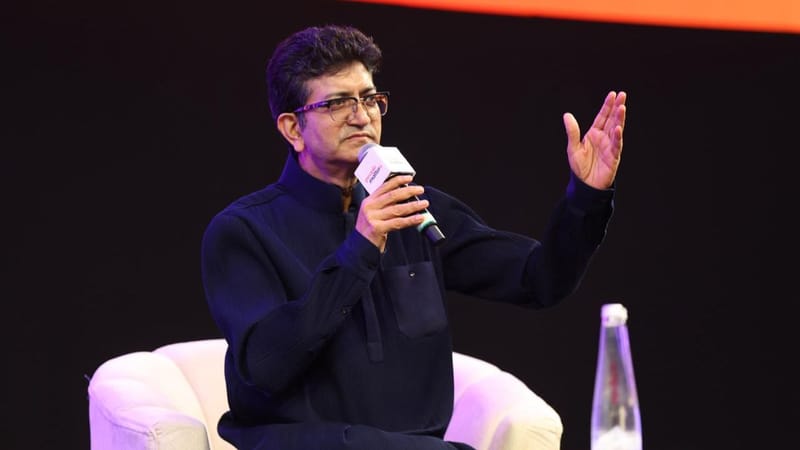
Prasoon Joshi explores how AI is reshaping work while creativity, judgement, culture and human values remain central to the future workplace at TechHR India 2026.
What happens when machines become better at producing the things humans once considered uniquely creative?
For Prasoon Joshi, the answer is not to compete with AI. It is to understand what remains deeply human.
At TechHR India 2026, Joshi joined Pushkar Bidwai, CEO, People Matters, for a wide-ranging conversation on creativity, trust, culture and the future of work. Their discussion moved beyond the usual debate around whether AI will replace people.
Instead, it explored a harder question: what should humans continue to own when machines can increasingly execute?
AI is not as artificial as we think
Joshi began by challenging the very idea of artificial intelligence.
“What is artificial about it? It's full of human data.”
AI has learnt from human knowledge, experiences and creative output. But access to that data does not automatically give it the human ability to create meaning from lived experience.
That distinction matters.
“Creativity comes from somewhere deeper than information. It comes from memory, emotion, culture, observation and experience,” said Joshi.
Much of his own creative instinct, he said, comes from his childhood and his connection with nature.
When he is stuck while writing, he returns to those memories.
Nature, he explained, teaches struggle without manipulation. It teaches trust. That becomes the raw material for stories.
The human advantage is meaning
Joshi sees storytelling as the bridge between information and meaning.
A product can remain just a product. A story can turn it into a brand.
“The moment I come towards the name and a little bit more about you, you become a story for me.”
That idea extends beyond advertising.
In workplaces, organisations increasingly have access to enormous amounts of information about people. AI can process that information faster than humans.
But information alone does not create connection.
People need context. They need meaning. They need to understand why something matters.
That is where human creativity continues to play a role.
When AI becomes the norm, exceptional becomes harder
The challenge with AI is not simply that it can create.
It is that it can be created at scale.
When everyone has access to similar models and similar datasets, there is a risk that creative output begins to converge.
“If you seek exceptional through artificial intelligence, there is a lowest common denominator of exceptional,” Joshi commented.
The implication is important for creative and business leaders.
AI can help generate options. It cannot decide what deserves to exist. That still requires taste, judgement and context.
The workplace needs an anchor
The conversation then moved from creativity to culture.
As AI becomes embedded in organisations, Joshi commented that the bigger question is not simply what AI can do.
It is what values will guide its use. “Where are we anchoring our people in future?”
That question becomes particularly important as AI begins influencing decisions that affect employees, customers and businesses.
Technology can optimise a process. It cannot determine what an organisation should value. That comes from culture. And culture, ultimately, comes from people.
Confusion is not the enemy
For professionals trying to navigate careers in a rapidly changing world, Joshi offered another unexpected thought.
“Confusion is good.” He described confusion as a liminal space. A period between what was and what comes next.
It can feel uncomfortable. But it can also be fertile.
In a workplace where AI is changing roles and expectations faster than many organisations can respond, the pressure to immediately find certainty can be counterproductive.
Sometimes the better response is to stay with the uncertainty long enough to discover new possibilities.
Creativity needs constraints too
The idea that creativity always requires unlimited freedom.
Reflecting on conversations with A.R. Rahman, he spoke about the role of deadlines and tension in creative work.
Too much time can sometimes reduce urgency. A constraint can force a decision. A deadline can create momentum.
For leaders, this offers a more nuanced view of productivity. Not every form of pressure needs to be removed. The challenge is knowing which constraints sharpen performance and which simply exhaust people.
The leader as conductor
Towards the end, Joshi offered a simple description of his own approach to work.
“I want to be a good conductor of the energies and ideas I get,” Joshi mentioned.
It is a useful leadership metaphor for an AI-driven workplace. A conductor does not create every instrument. The role is to bring different elements together and create harmony.
As AI becomes another source of ideas, analysis and execution, leaders may increasingly need to play that role.
They will need to connect people, technology, ideas and purpose.
Because the future of work may not be defined by whether AI can create more.
It may be defined by whether humans can still decide what is worth creating, why it matters and what it should mean.
Topics
Author
Loading...