







Organisational Culture
Everybody knows the POSH policy. Few trust the outcome






Organisations have spent years strengthening POSH compliance. Policies are in place, training is routine and reporting channels are well established. Yet employees continue to hesitate before speaking up. According to HR leaders, the biggest challenge is no longer awareness. It is trust.
The awkward truth about workplace harassment reporting is that most organisations have already done the visible work.
The policy exists. The Internal Committee exists. The mandatory training exists. The reporting email ID probably exists too.
On paper, workplaces today appear significantly better equipped than they did a decade ago.
Yet employees continue to hesitate.
Not because they do not know where to report. Because they are not entirely sure what reporting will cost them.
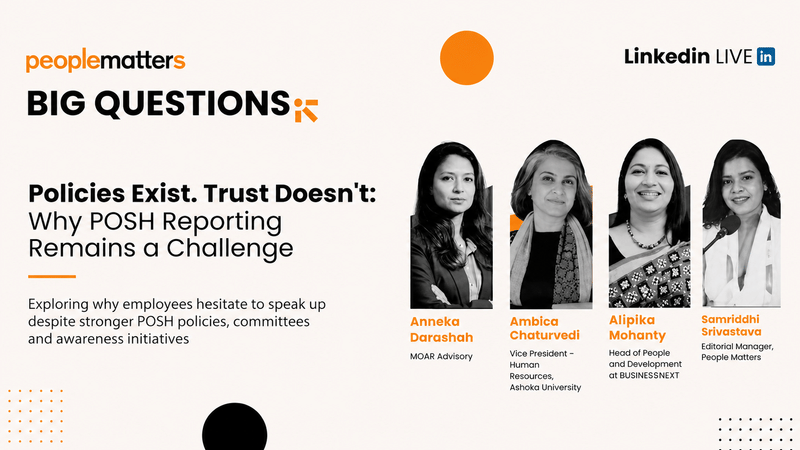
That tension sat at the centre of the latest People Matters Big Questions discussion featuring Lipika Mohanty, Head of People and Development at BusinessNext, Ambica Chaturvedi, Vice President Human Resources at Ashoka University, and Anneka Darashah of MOAR Advisory.
The conversation started with a simple but uncomfortable question: if organisations have invested heavily in POSH frameworks, awareness programmes and reporting systems, why do employees still think twice before speaking up?
The challenge has moved beyond awareness

For years, organisations treated awareness as the primary challenge. Employees needed to know:
• What constituted workplace harassment
• How complaints could be filed
• What protections existed
• Who they could approach
That work mattered. But the panel suggested the workplace conversation has evolved. Employees today are often less concerned about understanding the process and more concerned about understanding the consequences.
Will I be believed?
Will anything actually happen?
Will this affect my career?
Will I be seen differently by my manager?
Will I become known as the difficult employee?
Those questions continue to shape reporting decisions across workplaces.
According to Ambica Chaturvedi, psychological safety remains one of the biggest factors influencing whether employees choose to report concerns.
"It is the single most important factor," she said, noting that employees need to feel heard, respected and protected before they feel comfortable raising sensitive concerns. The reality, however, is that psychological safety is much easier to mention than to build.
Employees are not reading policies. They are reading signals

One of the strongest observations during the discussion came from Anneka Darashah, who highlighted the growing disconnect between compliance and culture.
When a high-profile workplace issue emerges, organisations typically activate compliance mechanisms immediately.
Investigations begin. Committees are formed. Statements are issued. Processes are followed. Employees, however, are evaluating something very different.
"They're really evaluating based on what they've experienced over months," Darashah said. That distinction is important.
Employees are not judging the organisation based on a single moment. They are judging it based on years of observation. They remember:
• Whether previous complaints were taken seriously
• How managers responded when concerns were raised
• Whether accountability applied equally
• Who appeared protected
• Who appeared supported
As Darashah put it, "Employees are watching what happens to the last person who raised their hand." That observation may explain why compliance alone rarely creates trust.
Why one badly handled case can undo years of training

Most organisations invest significant resources into POSH awareness. What they often underestimate is the power of organisational memory. A single mishandled case can travel through an organisation faster than any training programme. Mohanty pointed to this directly during the discussion.
"A single mishandled case can silence hundreds of employees from speaking out," she said.
The impact goes beyond the individuals directly involved.
Employees observe how investigations unfold.
They discuss outcomes.
They compare experiences.
They form conclusions about whether the system can be trusted.
Trust, therefore, becomes cumulative. It grows slowly and can disappear quickly.
The first POSH conversation usually happens long before HR gets involved

Another important theme emerged around where reporting journeys actually begin. Contrary to popular belief, most employees do not immediately approach HR or file formal complaints. Their first conversation is often with:
• A colleague
• A teammate
• A trusted friend
• An immediate manager
That makes managers one of the most influential actors in the entire process. According to Mohanty, employees often seek reassurance before they seek action. They want someone to validate their concern and help them understand whether they should escalate it further.
This creates a challenge many organisations overlook. A reporting framework may be strong. A policy may be comprehensive.
But if the first person an employee approaches responds poorly, the process may never progress any further. The trust gap can emerge long before HR even knows a concern exists.
Middle managers may be carrying more responsibility than organisations realise

The discussion repeatedly returned to the role of managers. Particularly middle managers. They are expected to deliver business outcomes, manage teams, resolve conflicts and support employee wellbeing, often at the same time.
Yet they frequently receive limited support once they move beyond initial management training.
Chaturvedi noted that many organisations focus on first-time manager programmes but invest far less in continuous coaching and leadership development.
The result is predictable.
Managers find themselves navigating highly sensitive situations without the confidence or experience required.
The panel suggested organisations need to stop assuming managers will automatically know how to handle difficult workplace issues.
Support, mentoring and continuous guidance remain essential.
The real test comes when a case becomes public

The conversation also explored how organisations communicate during high-profile workplace incidents.
In an era of social media scrutiny, leadership statements often become the centre of attention. The panel's view was clear. Employees care less about polished messaging and more about visible intent.
Darashah warned that communication can quickly lose credibility when it appears focused primarily on protecting the organisation rather than addressing employee concerns.
"The moment a statement sounds like it was written by legal," she said, "it signals that the priority now is liability."
That does not mean organisations should abandon due process. It means employees expect to see empathy alongside procedure.
According to the panel, the most trusted organisations are often those willing to communicate with honesty, acknowledge uncertainty and demonstrate action rather than relying solely on carefully crafted statements.
Trust ultimately comes down to accountability

As the discussion progressed, one theme consistently resurfaced.
Accountability.
Policies matter.
Training matters.
Communication matters.
But accountability remains the strongest signal employees receive.
The panel repeatedly stressed that employees want confidence that standards apply equally across the organisation.
Regardless of title.
Regardless of influence.
Regardless of performance.
Darashah pointed to situations where senior leaders quietly exit organisations after investigations, raising questions about whether accountability has truly been served. The issue, she suggested, is not simply procedural closure but whether employees believe meaningful consequences followed.
That distinction sits at the heart of the trust conversation. Employees do not just want investigations. They want confidence in outcomes.
The next phase of POSH will be about credibility

Most organisations today understand their compliance obligations.
The infrastructure exists. The regulations are established. The reporting channels are in place. The harder challenge is building belief in those systems.
The discussion made one thing clear. Trust is not created during an investigation. It is built every day through leadership behaviour, managerial consistency, employee experiences and visible accountability.
Organisations often ask why employees remain silent despite stronger frameworks. The answer may be simpler than it appears.
Employees do not judge workplace safety by what is written in policy documents. They judge it by what happens when somebody actually decides to use them. And increasingly, that may be the real measure of whether a POSH framework is working.
Topics
Author
Loading...