







Organisational Culture
Fairness as a business constraint: What India’s gig platforms must redesign before regulation forces it






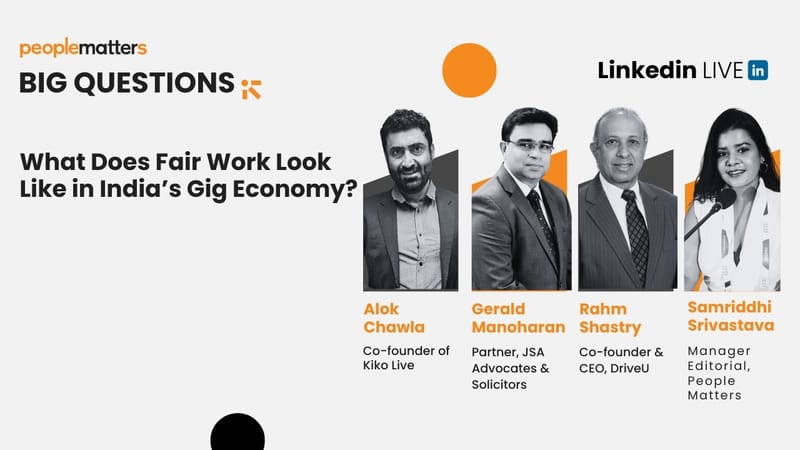
As states legislate and courts prod the Centre, gig platforms face a sharper test: can “flexibility” survive without fair pay, due process and credible safeguards?
India’s gig economy is no longer a feel-good story about flexibility and job creation. It is becoming a stress test for how the country wants work to function when algorithms supervise, regulation lags, and worker frustration spills into public view.
That shift framed the latest People Matters Big Questions session on a blunt prompt: what does fair work look like in India’s gig economy—right now? The panellists—Alok Chawla, co-founder of Kiko Live; Rahm (Ram) Shastry, co-founder and CEO of DriveU; and Gerald Manoharan, partner at JSA Advocates & Solicitors—largely agreed on one point: the system is straining under its own design choices. Where they diverged was on what can realistically change without breaking the model.
The urgency is not hard to explain. The scale is rising fast. A Ministry of Labour and Employment statement in November 2024, citing NITI Aayog’s 2022 estimate, said India had 7.7 million gig and platform workers in 2020–21, projected to reach 23.5 million by 2029–30.
The assumption that is breaking: workers are “expendable”
The first fault line, according to the panel, is an assumption many platforms have relied on: that gig workers are replaceable and will absorb almost any pressure so long as incentives exist.
Shastry put it plainly. The biggest assumption being challenged, he argued, is that gig workers are “expendable”—workers “put on a clock” and pushed to hit earnings thresholds through incentives. His point was not sentimental. It was operational: a system that treats the workforce as disposable will eventually create churn, incidents, and reputational risk.
Chawla took aim at the older narrative that the gig economy “creates jobs” and pays surprisingly well. Yes, he said, a delivery partner making ₹30,000–₹35,000 a month can look impressive compared with entry-level salaried work. The problem is trajectory. “A gig worker starting at 30,000 will remain at 30,000 for the rest of his life,” he warned, arguing that career progression is structurally missing. The pitch of empowerment, in other words, often hides a ceiling.
Manoharan offered a more legalistic framing: the gig economy can be a genuine flexibility engine, but it also carries a high exploitation risk because guardrails are thin. The Code on Social Security recognises gig and platform workers, he noted, but the framework is still “to evolve” in terms of enforceable protections.
Pricing is the original sin—and workers pay for it
If fairness breaks somewhere, Chawla said, it often starts with pricing. In India, platforms don’t build the model by adding worker welfare costs and charging consumers accordingly; they reverse-engineer everything from what the customer will tolerate.
He offered a diagnosis of Indian consumer behaviour: customers expect delivery to be free, even for low-value orders. When the customer refuses to pay, platforms squeeze the “middle”—vendors and workers—to make the numbers work.
This is where the “fair work” debate becomes uncomfortable: fairness costs money, and India’s price sensitivity makes that cost politically difficult to pass on. The panel’s subtext was clear: free delivery is not free—someone pays, and it is usually the worker through lower net earnings, tougher incentives, and tighter performance thresholds.
The business case for regulation, Chawla suggested, is not morality—it is a level playing field. If one platform voluntarily pays for benefits or due process while rivals do not, it risks getting undercut. If regulation forces everyone to absorb the cost, the market can reprice.
That logic is beginning to shape state policy. Rajasthan’s Platform Based Gig Workers (Registration and Welfare) Act, 2023—available via PRS Legislative Research—created one of India’s first statutory frameworks for registering platform workers and setting up a welfare architecture.
Karnataka has moved further: The Economic Times reported that in August 2025, the Karnataka Assembly passed the Karnataka Platform-Based Gig Workers (Social Security and Welfare) Act, 2025, mandating social security and occupational protections from aggregators.
These moves do not create employment permanence. But they do signal a direction: the state is starting to treat gig labour as a workforce that needs governance, not as an app feature.
The real manager is the app—and that changes power
At the centre of the fairness debate is the nature of control. Gig work is often defended as “independent” work. Yet the panel argued that independence is increasingly fictional when algorithms determine access to work, pay variation, ratings, penalties, and deactivation.
Manoharan described the core shift: the app has become the supervisor. In traditional workplaces, supervisors train, correct, and discipline. In platform work, the feedback loop is digital and impersonal—particularly for workers with limited language or digital literacy. Workers often “use their respective applications very mechanically”, he said, creating a system where misunderstanding and error are easy, and recourse is minimal.
Chawla did not argue against automation—he acknowledged scale makes manual decisions impossible. His demand was narrower: a credible appeal system. If an algorithm flags a worker incorrectly, there must be a quick escalation to a human review. Instead, he said, appeals often “end up going back to AI”, largely because human review costs money. His point landed as an accusation of economic design: cutting costs by denying due process becomes a strategic choice.
The legal and reputational risks are rising. In November 2024, the Supreme Court told the Union government that gig workers’ labour and social security rights cannot be denied under the guise of policy delay, Hindustan Times reported. That judicial pressure matters because it signals that worker rights are increasingly being treated as justiciable—not optional.
Incentives can become coercion
The panel’s most concrete fairness critique was not about wages alone. It was about how incentive structures drive behaviour.
Shastry drew a line between discipline and cruelty. Platforms need “carrot and stick”, he said—some form of incentives to reward reliability and penalties to manage misconduct. But he criticised extreme incentive designs seen in the market, where one delayed task can wipe out a day’s earnings or monthly incentive. In his telling, this pushes workers into unsafe choices—speeding, jumping lights, riding on footpaths—because the penalty for delay is existential.
This is the hidden governance problem: incentives are not neutral. They are behavioural policy. When they are designed for hyper-optimisation, they externalise risk—onto the worker’s body and the public road.
Chawla reinforced this through an anecdote about a salon worker on a services platform: a single unfair rating can drag down the score below a threshold, cost thousands in incentives, or even lead to deactivation. The issue is not customer feedback itself; it is the absence of proportionality and the lack of credible review when ratings are arbitrary or weaponised.
That links back to “fair work” as process, not just pay. A worker’s economic security depends not only on earnings but on how easily the system can switch them off.
Social security: inevitable, costly—and politically hard
If there is one area where consensus formed, it was social security. The disagreement is over who pays and how.
Chawla argued that social security contributions will hit hardest in low-margin, high-volume delivery models where per-order payouts are small. But he framed the solution as regulation-led cost-sharing. If everyone must contribute, platforms can reprice, and consumers will ultimately pay more.
Manoharan echoed the need for a level playing field, adding a reality check: policy must be viable. A law that assumes a stable employer–employee relationship will not map cleanly onto a workforce that joins and exits platforms rapidly. He argued that India will need more research, clearer structures, and sustained public debate to build workable legislation.
Shastry suggested a “portable” model where workers also contribute—small percentages from earnings matched by platforms—so the worker has “skin in the game” and benefits travel across platforms. He also highlighted a practical friction: health insurance is expensive and difficult to administer when workers churn.
This is the policy paradox: the more the gig economy is celebrated for flexibility, the harder it becomes to design benefits tied to continuity. Yet without such benefits, the gig economy risks becoming a treadmill—high activity, low security.
What “fair work” means now: not ideals, but guardrails
The panel did not offer a single blueprint. But its arguments converge into a clearer definition of “fair work” in today’s Indian gig economy:
Fair pay that reflects realistic costs and does not rely on permanent subsidy or punitive incentives.
Due process—especially around ratings, penalties, and deactivation—so algorithmic errors do not erase livelihoods overnight.
Transparent rules that workers can understand and contest, particularly in a low-digital-literacy workforce.
Portable protections, starting with accident cover and evolving towards health and social security frameworks that survive platform switching.
Limits on hyper-optimisation, especially when speed targets and incentive cliffs push unsafe behaviour.
The debate is no longer theoretical. As strikes and “log-off” protests flare, public patience is thinning; The Quint reported that on 31 December 2025, a nationwide gig-worker strike disrupted delivery platforms. Meanwhile, states are drafting and passing laws, courts are nudging the Centre, and the economic model is under pressure as cheap capital fades and investors demand profit.
In the end, “fair work” in India’s gig economy will not be decided by one speech or one bill. It will be decided by the cumulative choices platforms make about pricing, process, and power—and by how quickly policymakers convert intent into enforceable, scalable rules.
Because the era of invisibility is over. What replaces it will determine whether the gig economy becomes a durable employment engine—or a permanent reputational liability.
To learn more from leaders about some of the burning questions in today’s world of work, stay tuned to People Matters' Big Question series on LinkedIn.
Author
Loading...