







Organisational Culture
From one restaurant to 23: What Burma Burma teaches us about building culture at scale






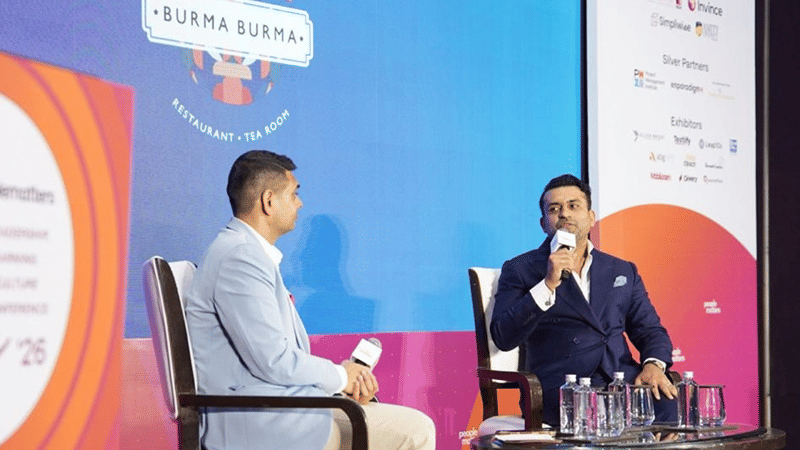
Even with high frontline attrition amid intense competition for restaurant talent, the company has retained several mid- and senior-level leaders through transparent policies and an open-door approach to communication.
When Ankit Gupta started Burma Burma in 2014, Burmese cuisine was largely unfamiliar to Indian diners. There was no established category to build on, little certainty that customers would embrace unfamiliar ingredients, and no ready-made playbook for taking a Burmese dining experience across cities.
Twelve years later, Burma Burma has grown from one restaurant to 23 outlets across India. But for Gupta, the more significant achievement is not the number of restaurants. It is whether the experience that made the first restaurant distinctive can still be felt across all 23.
Speaking at the People Matters LLC Conference 2026 with CEO Pushkaraj Bidwai, Gupta, co-founder of Burma Burma, said the business had evolved to become less about the food alone and more about the people who carry the brand's vision as it scales.
“It’s no more about the food; it’s about the people only.” The shift i.e. from founder-led execution to a culture that can be reproduced by hundreds of employees, has always been at the heart of Burma Burma's growth story.
A cuisine nobody knew became the starting point
Gupta's connection with Burma began through his mother, who spent more than two decades in the country before moving to India. When Gupta visited Burma in 2010, it was the people and their hospitality that made the strongest impression on him. The food came second.
That experience eventually led him to explore how Burmese food and hospitality could be brought to India.
The timing was also important. As India's restaurant market evolved, diners were increasingly moving beyond large multi-cuisine menus towards specialised concepts. For Gupta, that created an opportunity to introduce a cuisine that most Indian consumers had not encountered.
But the risk was obvious. Ingredients such as pickled tea leaves and Burmese mustard were unfamiliar to Indian diners. Before opening the first full-fledged Burma Burma restaurant, the team conducted pop-ups in different parts of the country to understand how people responded to the cuisine.
The experiments gave the founders enough confidence to make the leap.
The objective, Gupta said, was not simply to add another cuisine to India's restaurant landscape, but to give people an opportunity to experience something they had not encountered before.
The challenge changed after the first restaurant
Opening one restaurant allowed the founders to be present on the floor and personally translate what the brand stood for. Scaling to 23 restaurants made that impossible.
That is where Gupta says the role of culture became critical. The company could no longer depend on founders being physically present to ensure that the right food was served, the story of Burma was communicated or guests received the intended experience.
“The people,” Gupta said, are the ones who continue the vision of the brand.
He described Burma Burma's approach through four broad elements: people, product and the practices that shape interactions with guests and the team, with the broader emphasis being on ensuring that the brand's experience remains consistent as it expands.
Every three months, Gupta and the design team also travel to Burma to explore a different city and bring back new inspiration.
That continuous exposure to the country is part of how the company tries to prevent the brand from becoming a static interpretation of Burmese culture.
Culture is built through small moments
For Gupta, the clearest evidence that culture is working is not necessarily a formal employee engagement programme or a values document. It is what people do when nobody tells them what to do.
He recalled seeing a guest at one of the restaurants feeling cold. Before the guest asked for anything, a team member and manager noticed the non-verbal cue and offered a shawl.
Other examples include offering reading glasses and providing colouring sheets for children.
These are small interventions, but Gupta sees them as central to hospitality. And the idea is simple that the guest should feel that someone is paying attention.
The same principle applies to employees. Gupta shared the story of a team member who joined the business 12 years ago in an entry-level role at its first Mumbai restaurant. Over the years, he progressed from assistant steward to steward, then manager, and eventually took responsibility for the Bengaluru region.
For Gupta, watching that employee move through professional and personal milestones, including getting married and having children, represents a more meaningful measure of the organisation's growth.
The scale of the business, he said, has created a platform directly impacting around 1,800 team members and approximately 8,000 family members.
“The scale and the business is a byproduct,” Gupta said. “There’s a platform that we’ve created.”
Teach people the logic, not just the task
One of the more revealing aspects of Burma Burma's people strategy is how the company approaches frontline employees.
Gupta said the organisation does not simply tell new employees what to do. Instead, it tries to explain the logic behind what is expected of them. That includes making policies around salary, bonuses and expectations transparent from the beginning.
The approach is particularly important for entry-level employees, many of whom join after moving from different parts of India.
The company has also created a two-minute animation explaining practical aspects of employment, including when employees receive their salary, how bonuses are calculated and what is expected of them.
The purpose is to remove uncertainty. “When you’ve joined, things are very, very transparent,” Gupta said.
For a frontline employee entering an unfamiliar workplace, that transparency can become part of the culture itself.
Scaling culture requires systems, but not everywhere
Burma Burma's approach to technology is deliberately split between the back end and the guest experience.
At the back end, Gupta said the company uses technology to improve consistency. The restaurant sector has evolved significantly since the company started, with learning management, HR and restaurant-specific software now making it easier to manage a growing operation.
But at the customer-facing end, the company deliberately limits technology.
There are no QR-code menus in its restaurants. Gupta believes that when people go out to eat, they are looking to disconnect from the screens that dominate their everyday lives. The company therefore prefers a more traditional form of hospitality, a server making eye contact, recommending dishes and helping the guest decide what to order.
Even feedback is approached differently. Burma Burma does not use comment cards, which Gupta likened to giving customers “homework” at the end of a meal.
The philosophy is not anti-technology. It is about understanding where technology strengthens the experience and where it gets in the way of it.
Training becomes the bridge between culture and consistency
Technology alone, however, cannot reproduce hospitality. As the organisation has grown, Burma Burma has developed internal learning modules explaining what Burma is, what Burma Burma represents and how the food and service should be delivered.
The company recently launched an internal academy app through which team members can access courses as part of their onboarding and ongoing learning.
Another internal knowledge-management app, called “Mingalaba” — a Burmese greeting — gives employees access to information about products, allergens and other operational details.
The objective is to make knowledge accessible while reducing dependence on one person having all the answers. Gupta acknowledged that consistency is still a work in progress. But the systems are designed to make the experience as consistent as possible across locations.
That extends to ingredients. The company sources several key ingredients from single suppliers and distributes them across its restaurants, helping reduce variations that can arise when ingredients such as turmeric, tamarind or chickpea flour differ by region.
For a business where taste is central to the brand promise, operational consistency becomes a cultural issue too: customers should not have to relearn what Burma Burma means every time they visit a different outlet.
Gupta says Burma Burma’s approach is to represent Burmese cuisine as authentically as possible, rather than Indianising it or turning it into fusion. While some strong flavours are adapted for local diners, the brand stays rooted in Burmese ingredients, food and culture. The same philosophy extends to its restaurants, with each outlet drawing on research, artefacts and design elements from different parts of Burma — making no two locations identical.
Retention is still a work in progress
Despite the systems, training and culture-building, Gupta does not present retention as a solved problem.
The restaurant industry remains highly people-intensive, and entry-level churn continues to be a challenge. The proliferation of new restaurants also creates competition for frontline talent.
At the mid- and senior-management levels, however, the company has been able to retain several people who have stayed through much of its journey.
Gupta credited transparent policies and an open-door approach to communication between employees and management. The organisation also avoids framing its people simply as “employees”, reinforcing the idea that the business and its people are growing together.
But Gupta was clear that culture cannot compensate indefinitely for a business that does not grow.
The pressure, he said, is also on the company to expand because growth creates opportunities for employees — including increments, appraisals and career progression.
Protecting rituals as the company grows
For all the systems Burma Burma has introduced, some of the most important cultural practices remain deliberately low-tech and personal.
Gupta said he makes it a point not to miss staff parties. The company also organises an annual trip to Water Kingdom, while employees and management play box cricket together on Sundays.
There is also a small ritual involving a traditional thanaka paste, which is applied for guests who ask for it. These rituals may appear disconnected from restaurant operations. But that is precisely why they matter.
Culture is often most visible in the things organisations continue doing even after they become too large to need them operationally.
Burma Burma's next phase will test whether the same model can continue to work at greater scale. Gupta identified two major constraints: access to the right talent and suitable real estate.
Casual dining requires substantial space, and the availability of suitable properties remains limited. At the same time, maintaining service quality becomes harder as the organisation expands and the talent pool becomes more competitive.
Yet Gupta sees the business as being at an inflection point. The company began with a passion project, an attempt to bring a part of his mother's world and his own experience of Burma to India. The scale came later.
And that perhaps explains the central lesson: culture does not necessarily begin as a corporate strategy. It can begin with a founder's personal belief about what an experience should feel like. The difficult part is preserving that belief after the founder is no longer in every room.
The restaurant may be the visible product. But the real organisational challenge, and arguably its more transferable lesson for leaders, is building enough culture into the system that 1,800 people can deliver an experience the founder once delivered himself.
Topics
Author
Loading...