







Performance Management
Performance Management: The year that was & the road ahead in 2017



 ||
||


Looking back on the transformations that businesses have undergone in the realm of employee performance reviews, one finds that companies have been striving to create more intuitive performance review systems that not only help them push employee productivity but also help them in charting a successful journey of professional growth
Organizations and HR professionals, in specific, have always had a tough battle when it comes to pinning down the right way of assessing employee performance. Till today, the jury is still divided over the right way to conduct performance reviews. With a direct impact on other components of the employee’s experience within the company like compensation and engagement, performance management systems have been in a state of constant flux and improvement. Given the strong need to support business growth, HR professionals have begun to modify current performance management systems to capture the contribution of employees in a holistic manner. Traditionally done using tools like rating systems and annual reviews, 2016 had markets witnessing companies shifting from structured, generic and periodic reviews to more personalized and real-time performance gauging mechanisms.
2016 - The year that was
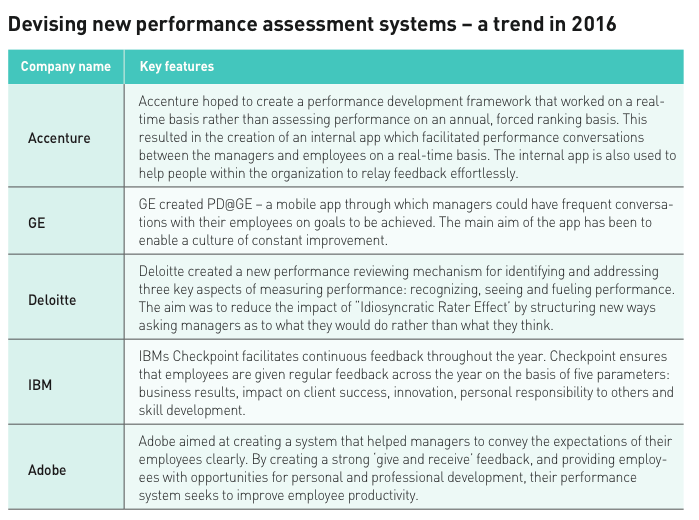
Performance initiatives are often characterized by components like regular feedbacks and personalization of assessments that help to improve employee productivity and in creating short-term goals for improvement. Companies across industries are rethinking their performance review mechanisms. In 2016, organizations questioned the viability of the bell-curve, did away with annual performance reviews, attempted to create their own personalized performance assessment methods that prioritized regular feedback, created short-terms goals to measure employee performance and included the scope for improvements on a real-time basis.
Drivers of Change
The year witnessed HR professionals across the board reassessing the viability of annual reviews in context to their company’s vision of growth. And one of the biggest challenges for most has been that they end up holding employees accountable for past performances in accordance to annual goals, often at the expense of improving current performance and taking a wider scope of performance into analysis. As a result to this limitation, HR professionals are slowly getting convinced of the opinion that performance assessments consisting of regular feedback along with expansive short-term goals help change the focus of the company – from being obsessed with assessments to focusing more on building the capabilities of a workforce. According to a report by Bersin by Deloitte, it is estimated that globally, about 70 percent of multinational companies are moving towards this model, even if they haven’t arrived at a final system quite yet. This shift throughout the year has been broadly attributed to the following reasons:
Dynamic business ecosystem
Ranking-based performance management systems don’t take into account the varied work of an employee. Most organizations are currently at the helm of undergoing transformation due to evolving business conditions. As companies enter the realm of business disruptions, employee KPIs require agility and fluidity to be able to respond to changing business needs. Following a continual performance management system that focuses more on feedback sessions to improve rather than waiting an entire year to assess employee has been a major contributing factor towards the shift.
Scope for better collaboration
Conventional ranking systems result in narrowing the field of performance analysis and pits employees against each rather than creating an incentive for employees to collaborate and work cross-functionally. With the bell curve pressing managers to reward only select few out of a highly motivated team, such performance review systems end up demotivating employees.
Cumbersome process
The shift away from traditional performance review processes has been partly due to the bureaucratic nature of such processes that make performance management and review systems cumbersome. Often, these rigid performance management systems are seen as time-consuming, excessively subjective and demotivating. Bell curve assessments often involve categorizing huge chunks of the company’s workforce into different ranks. In such cases, it does little to improve the performance of employees and may even undermine their performance as employees struggle to keep up with ratings, worry about compensation, making it difficult for them to make sense of performance feedback and work efficiently.
Impact
The impact of the above-mentioned drivers of change has been felt across sectors. A recent study done by PwC on Performance Management in India reveals that around 52 percent of the respondents surveyed have made changes or are planning to make changes to their existing performance management system while almost 16 percent have done away with individual ratings. The report noted that most companies in India today have the intent to make systemic changes indicating that bold approaches to performance evaluation and management will be a priority. Explaining the shift in preferences, Padmaja Alaganandan, Partner with PwC and leader - People & Change Consulting Practice in India states that “these changes are attributable to a growing discontent with the current systems and processes – only 12 percent of organizations state that they found their current performance management systems highly effective in meeting set objectives.” Companies today are looking at creating innovative rewards and appraisal models to boost employee motivation, which in turn influences their productivity. All this is hinged on a robust performance system that is relevant for the company and helps them in creating a culture where genuine performance is awarded while underperformance is improved through continuous feedback and a regular managerial interaction.
In 2016, organizations questioned the viability of the bell-curve, did away with annual performance reviews & attempted to create their own personalized performance assessment methods that prioritized regular feedback
To deal with a multi-generational workforce along with competitive business conditions, companies today intend to shift towards a more flexible performance management. Having a top to bottom, rigid and narrow structure of assessment using a rating based approach to assessing performance loses its relevancy when it comes to companies which today want to be lean and agile. To sync performance management with the objectives of the company, many have rehashed existing processes to make them more relevant for their employees. This has translated into the year 2016 performance management being characterized by three broad shifts:
A recent study done by PwC reveals that around 52% of organizations have made changes or are planning to make changes to their existing performance management system while almost 16% have done away with individual ratings
2017 - The road ahead
If companies already believe that making performance management systems more fluid, agile and employee-centric, shouldn’t that be an easy step forward in the evolution of performance management systems? Well, a closer look suggests that this is not that easy.
Moving ahead, HR managers will have to pay close attention to how they evolve their performance management systems. Even though the traditional way of assessing performance may not be suitable in the current contexts, they still have to keep its benefits in mind. The problem is that removing a fixed annual system of performance review just for the heck of it is no solution. Although these systems provide blanket assessments rather than individualized reviews, most managers are comfortable with the system. This comfort with the system often brings in inertia, making a shift to newer performance systems more difficult. These reasons often stop HR professionals from jumping into the bandwagon of changing existing performance management systems.
We are still to see what the coming year has got to show the world. As HR professionals head into the New Year, monitoring developments within performance reviews becomes imperative. The problem with newer tools and techniques is that we do not have enough data to prove their benefits in the long run. But what is important to understand is that the external world of businesses is fast changing. Times like these would mandate organizations and HR professionals to back to the drawing board and create performance review mechanisms that make sense for them and their company. Moving ahead, HR professionals would also need to keep in touch with the latest developments in the field of neuroscience (studies into the human mind) to understand employee behavior in a wholesome manner. With all this information, they would then have to reshape performance management systems that help them achieve their targets of meeting business expectations while helping employees to have the right job growth opportunities.
References
Topics
Author

Loading...