







Sustainability & ESG
Eco-anxiety is the new retention risk: HR’s role in turning fear into purpose





Climate shocks are disrupting safety, productivity and trust. Three HR leaders explain how to turn eco-anxiety into resilience—before the next storm hits.
In India, climate is no longer background noise. It is a daily management problem.
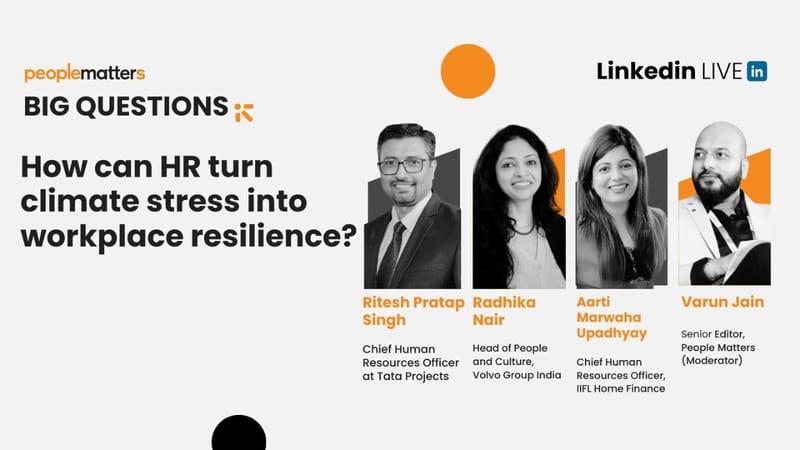
Every flood that paralyses a city, every heatwave that empties offices, every cloudburst that halts transport is not just “weather”; it is a workplace crisis. That was the unvarnished starting point for a recent People Matters Big Question with Ritesh Pratap Singh, CHRO at Tata Projects; Radhika Nair, Head of People and Culture at Volvo India; and Aarti (Marwaha) Upadhyay, CHRO at IIFL Home Finance.
The discussion avoided abstract sustainability rhetoric. It stayed with execution: keeping people safe, keeping operations moving, managing eco-anxiety, and turning climate pressure into advantage.
Climate volatility is here—and measurable
The science is settled. The IPCC estimates the world has already warmed by ~1.1°C above pre-industrial levels, increasing the frequency and intensity of heatwaves, heavy rainfall and extreme events.
The International Labour Organization warns that heat stress alone could wipe out 2.2% of global working hours by 2030 — equivalent to 80 million full-time jobs. The Wall Street Journal has reported that insurers are retreating from high-risk regions, tightening cover and raising premiums. The World Bank cautions that climate shocks could push millions into poverty by 2030 without climate-smart development.
India’s exposure is acute. Rising extreme-weather incidents and heat stress now translate directly into absenteeism, disrupted commutes, site shutdowns and safety incidents — forcing HR to treat climate as a core operating risk, not an exception.
For Singh, this is not theoretical. Tata Projects operates 100+ sites — from desert refineries to mountain transmission lines to water-logged metro works — where rain, heat and landslides can derail schedules and safety.
“It’s very much a here-and-now question,” he said. The response has two layers: process-led site hardening and people support, including for families affected far from project locations.
Volunteering is framed as engagement and recovery, anchored by the Tata Group’s Project Aalingana, with its net-zero 2045 ambition.
From eco-anxiety to agency
“Eco-anxiety could become a talent and retention issue,” warned Nair, especially among younger employees.
The antidote is not messaging but participation and skills. Her sequence is practical:
-
Acknowledge climate stress openly
-
Give employees real ownership of sustainability initiatives
-
Build climate literacy tied to daily work
-
Demonstrate authenticity through visible operational choices
At Volvo, where safety is a system value, credible action converts anxiety into engagement.
Equity, exposure, and human safety
Upadhyay was blunt: climate shocks distribute risk unevenly. Field staff, contract workers and vulnerable customers bear more exposure and fewer buffers.
“It’s thinking beyond business continuity,” she said, “with dignity, resilience and human safety at the centre.”
Her framework runs on three arms:
-
Employee safety — evacuation plans, drills, multilingual alerts, counselling; heat days and flood days are operational categories
-
Customer protection — priority servicing for elderly and disabled customers; continuity measured in trust, not just uptime
-
Continuity with humanity — NGO and hospital partnerships; contract workers included, not excluded
As insurance gaps widen, prevention, redundancy and social licence become forms of self-insurance.
Policy is necessary; culture scales it
“Policies are rules; culture ensures behaviour,” Upadhyay said.
The test of maturity: is climate resilience everyone’s job, or still ‘HR’s programme’?
Three levers stood out:
-
Co-creation with the front line — lived experience sharpens design
-
Talent systems wiring — sustainability embedded in hiring, goals and rewards
-
Visibility — dashboards, sustainability months, leader commitments
“Once we build awareness, we must create platforms where people can act,” Singh said.
Nair added a critical dimension: climate resilience is skills work — from green operations and circularity to climate data, risk analytics and scenario-based leadership.
The ILO’s heat-stress analysis translates directly into shift redesign, PPE adaptation, hydration protocols and manager decision rights based on temperature and air-quality thresholds.
Governance, budgets and HR’s connector role
Audience questions surfaced a hard truth: budgets signal ownership.
Without capex for cooling, drainage, backup power and transport, and opex for alerts, drills, counselling and partnerships, resilience remains rhetoric.
“HR has become a connector,” Upadhyay noted — translating climate roadmaps into onboarding, training, workforce design, benefits and leave policies, while brokering execution across functions.
For Singh, purpose now rivals pay. “Younger employees look for trust and meaning,” he said. At Tata Projects, per-capita volunteering hours are tracked, with many employees spending weeks in disaster-hit communities.
Nair echoed the logic: eco-anxiety drains energy unless people can act. Platforms, partnerships and shared ownership convert concern into contribution.
A practical operating manual
Taken together, the panel’s insights form a clear playbook:
-
Protect people and keep work going — define heat/flood days; redesign shifts; run drills
-
Put equity first — extend protections to contractors and vulnerable customers
-
Invest in climate literacy and green skills — mandatory induction and role-based certification
-
Wire it into governance — cross-functional councils, board oversight, hard KPIs
-
Let culture carry it — co-creation, visibility, volunteering, micro-innovation
The next five years will offer little pause. Warming will intensify extremes; insurers will price risk harder. The managerial question is unavoidable: is climate an externality, or a design principle for how work happens?
The panel’s answer was unsentimental. Start where you are. Fund prevention. Equip managers. Include contractors and customers. Measure impact. Build platforms for action.
As Singh put it, the shift begins with awareness and ends with action. Nair wants anxiety turned into agency. Upadhyay wants culture — not policy — to do the daily work.
Climate shocks will keep testing workplaces. The organisations that endure will treat resilience as everyone’s job — and fund it like strategy.
To learn more from leaders about some of the burning questions in today’s world of work, stay tuned to People Matters' Big Question series on LinkedIn.
Topics
Author
Loading...