







Sustainability & ESG
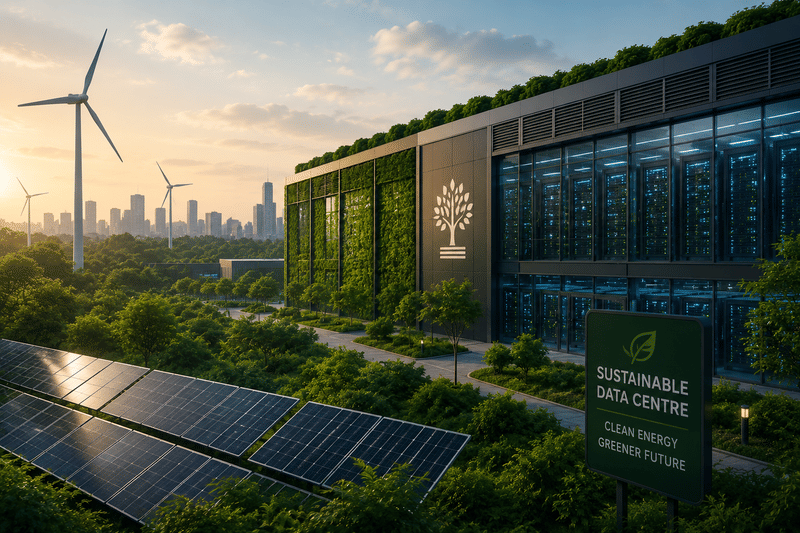
Karnataka planning sustainable data centre policy amid AI expansion, says KDEM CEO






At a Bengaluru AI roundtable, Karnataka Digital Economy Mission CEO Sanjeev Kumar Gupta warned that India’s AI boom cannot ignore its growing appetite for electricity, water and cooling infrastructure.
India’s AI conversation usually swings between two extremes. One side talks about trillion-dollar opportunity. The other talks about job disruption. Rarely does anyone ask the less glamorous question: who is paying the environmental bill for all this computing power?
At a closed-door media roundtable hosted by Avaali Solutions in Bengaluru, Sanjeev Kumar Gupta, CEO of Karnataka Digital Economy Mission, attempted to pull the discussion back to the physical realities behind artificial intelligence.
AI may look invisible on a chatbot window, but behind every prompt sits a very real network of data centres, cooling systems, electricity grids and water consumption.
And according to Gupta, India now needs to start treating that seriously.
“The demand of the AI enhances the interaction with the data centres and their consumption of electricity and water, enhancing impact on the climate. Absolutely, a direct relationship is established there,” he said during the discussion.
That statement landed differently in a room otherwise dominated by conversations around GPUs, enterprise AI adoption and scaling pilots.
Because while most AI discussions today revolve around speed, Gupta was talking about heat.
Literally.
AI’s hidden infrastructure problem
The modern AI race is not just about smarter models. It is also about who can power and cool them.
Large AI systems require enormous computing infrastructure. Those systems generate heat.
Data centres then consume significant electricity and water to keep servers operational. For most users, that reality remains invisible.
Gupta used a surprisingly simple analogy to explain it.
“It’s like turning on a tap without thinking about where the water comes from. We keep using AI, but somewhere the resources powering it are getting depleted too.”
In other words, AI prompts may feel weightless. The infrastructure supporting them is anything but.
That is now pushing policymakers to think beyond AI adoption and toward AI sustainability.
Karnataka’s green AI push
Gupta said Karnataka is already examining ways to reduce the environmental burden of AI infrastructure as investments in data centres and compute capacity rise.
One of the biggest levers is renewable energy.
According to Gupta, roughly 60% of Karnataka’s power production capacity already comes from renewable sources. The state is now considering whether dedicated green power allocation could support the AI and data centre ecosystem.
He suggested, "Karnataka could consider reserving up to five gigawatts of green power exclusively for deep-tech infrastructure such as data centres and AI operations."
The discussion comes at a time when India is aggressively scaling AI ambitions under the IndiaAI Mission, while states compete to attract data centre and AI investments.
Karnataka already hosts a large concentration of global capability centres and technology operations. That means the state will likely carry a disproportionate share of AI infrastructure growth.
And infrastructure growth brings resource pressure with it.
Cooling servers without turning up the climate
Interestingly, Gupta did not frame sustainability purely as a restriction problem. He positioned it as an innovation problem too.
He pointed to emerging experiments aimed at reducing cooling requirements and infrastructure intensity.
Among the examples he cited:
- An AI server developed by a Mysuru-based company that can operate at room temperature
- Smaller “AI in a box” systems designed to reduce dependence on massive computing setups
- Startup collaborations with institutions such as IISc aimed at lowering water and power consumption
- Investors exploring self-sustaining AI and data centre ecosystems
One proposal, Gupta said, even involved building large green buffer zones around future infrastructure projects.
It is the sort of sentence rarely heard in mainstream AI panels, where conversation typically revolves around productivity gains and automation.
A sustainable data centre policy is now being discussed
The clearest policy signal from the discussion came when Gupta confirmed Karnataka is working toward a sustainable data centre framework.
He said the aim is to define how data centre infrastructure can become more sustainable as AI deployment accelerates.
That could eventually include:
- Renewable energy requirements
- Sustainability parameters for infrastructure
- Water and power efficiency measures
- Green ecosystem integration around AI infrastructure
India does not yet have a widely discussed sustainability framework specifically focused on AI infrastructure. Most public AI policy conversations remain centred around innovation, talent, governance and regulation.
Environmental cost has largely stayed in the background.
That may now be changing.
“Use AI wisely”
Perhaps the most striking moment came toward the end of Gupta’s response, when he shifted responsibility away from governments and toward users themselves.
His message was simple: not every task needs AI. “If you’re using an AI, use it wisely.”
That sounds obvious. But in an industry currently obsessed with adding AI to everything from note-taking to shopping lists, it also sounds quietly radical.
Across enterprises, AI adoption has become a race. Gupta himself acknowledged elsewhere during the discussion that organisations are rapidly deploying AI pilots, often without fully thinking through readiness, governance or long-term impact.
Now the same question is emerging for sustainability too.
Not just can AI scale.
But should every use case scale the same way?
The next AI debate may not be about intelligence at all
India’s AI ambitions are growing rapidly. Governments are investing. Enterprises are experimenting. Startups are building.
But as Gupta’s comments suggested, the next phase of the conversation may become far more physical than digital.
Electricity grids. Cooling systems. Water access. Renewable power. Sustainable infrastructure.
The AI economy, it turns out, still runs on very old-world resources.
And Karnataka appears to be preparing for that reality before the bill becomes too large to ignore.
Topics
Author
Loading...