







Talent Management
AI as a “Buddy”? Inside the debate at TechHR Pulse Mumbai 2026





AI is not about efficiency alone. It is about enabling HR to move from administrative stewardship to business contribution
Is AI a co-pilot or quietly becoming the pilot?
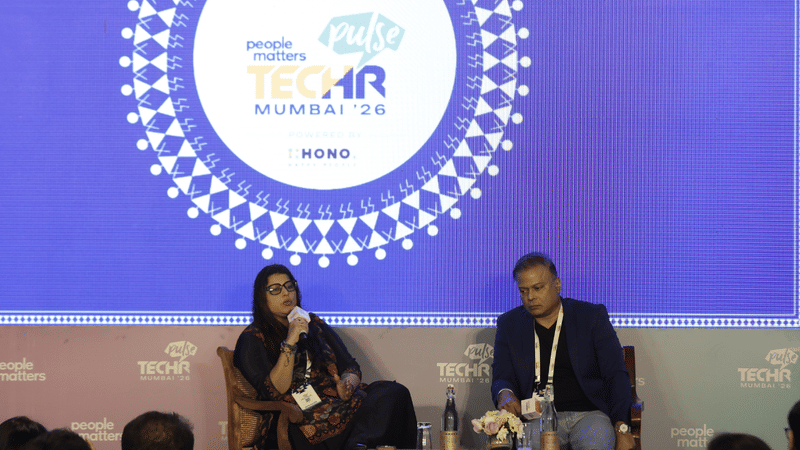
That question shaped one of the most candid conversations at TechHR Pulse Mumbai 2026, where Beena K More, Strategic Leader, SVP & CHRO, Bank Of India Investment Managers and Rajesh Padmanabhan, Chair of Board and Advisor For Western India, HONO unpacked what it truly means to position AI as HR’s “buddy.” in a fireside chat on “Automation To Autonomy: Making AI A Buddy At Work”, powered by HONO.
The discussion moved beyond adoption statistics and focused instead on governance, productivity, and cultural impact. The framing of AI as a “buddy” had already generated reactions. “When we used the word buddy, we got pushback. What do you mean by buddy?” he noted, setting up the central theme of the conversation.
AI is not the pilot, it’s the co-pilot
The data shows AI is already mainstream. Nearly 78% of businesses globally report some level of AI adoption. HR adoption sits closer to 45%, with India slightly ahead of global averages. Beena added another dimension: “Approximately 47% of AI-driven decision-making is happening across BFSI, pharma and cognitive business services. AI is already part of our daily decisions.”
But adoption does not equal autonomy.
“AI helps you make decisions in a more informed manner,” Beena clarified. “Wherever you have people influence, emotion regulation, legal aspects, AI supports you. But it is not the tool you should be completely dependent upon.”
“AI is a strong advisor, not a decision-maker. It’s a co-pilot. It’s an amplifier.” Rajesh noted. “AI can perfectly fly an aircraft. But how many of us are ready to sit in a pilotless aircraft?”
The enterprise model emerging, he suggested, is an 80–20 balance, 80% AI-enabled assistance across workflows, but 20% firmly anchored in human judgment. And that 20% is where credibility lives.
Productivity is real, but only with governance and courage
Rajesh shared examples of AI deployments creating measurable impact. In one case,
absenteeism sensing in blue-collar environments directly influenced EBITDA outcomes. In high-volume hiring scenarios, predictive analytics improved show-rate visibility and workforce planning accuracy.
“There are admissions of failures,” Rajesh said plainly. “At the client level. At our level. You have to be bold enough to say that.”
“In industries like ours, there is massive data infusion — from employees to investors to clients. Leadership must focus on framework and legal aspects. Data privacy is not optional.” She also raised a caution around blind reliance on systems.
“Today we are slowly becoming prey to what AI produces. It is a human-fed technology. Just because an ATS shortlists a profile does not mean that profile defines the person.” AI can screen thousands of resumes. But it cannot read ambition. It cannot sense grit. It cannot measure cultural fit through nuance.
“The mouth sits between the heart and the mind. HR sometimes decides with the heart. Sometimes with the brain. Sometimes we regret both. AI must sit in that space — between logic and empathy. If you blend it right, you win.”
Without change management, AI fails. Without soul, AI dies inside organisations.
The real risk is cultural anxiety, not automation
Perhaps the most honest moment of the session came when the discussion shifted to fear. “There is a lot of talent fear in the market,” Beena acknowledged. “People feel their jobs will be taken away. especially in IT, pharma, BFSI.”
But the bigger risk, she suggested, is not just displacement. It is emotional disengagement. “Culture is not only about supporting employees. Culture is also built with the times. With AI coming in, change has become dominant.”
Because while AI accelerates workflows, it also amplifies uncertainty. Emotional intelligence, rewards frameworks, and transparent communication, these are not peripheral issues. They are stabilisers.
When asked about the future, Rajesh reframed the evolution of HR itself. “Earlier, HR managed the four Ps: People, Processes, Practices, Policies. The shift I see is toward the four Cs: Culture, Capabilities, Contribution to business, and Credibility.”
AI is not about efficiency alone. It is about enabling HR to move from administrative stewardship to business contribution, and to earn credibility at the boardroom table.
If AI is truly to be a “buddy,” it must remain a thinking aid. not a thinking replacement. And perhaps that is the real leadership challenge the session left behind.
Author
Loading...