







Talent Management
Transformation, not tools: How AI Is redefining the future of HR





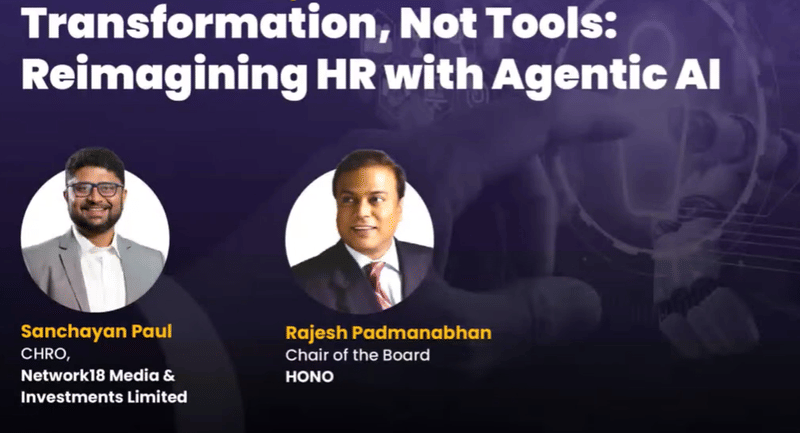
The fundamental shift in HR is in the workflow. When workflows are redesigned, everything else follows: roles, structures, and even what counts as work.
By 2028, according to Gartner, one-third of enterprise software will include agentic AI, with at least 15 % of everyday business decisions being made autonomously. That is a staggering projection for a world where very few organisations have AI embedded across their workflows. The gap between those two data points, ambition and reality, is exactly where the transformation gap lies.
In this context, People Matters, in partnership with HONO, brought together two of India's most experienced voices in HR leadership to discuss what the future of transformation is going to look like. Sanchayan Paul, Chief Human Resources Officer at Network18 Media & Investments, and Rajesh Padmanabhan, Chair of the Board at HONO, examined how enterprises move from AI activity to structural impact, exploring what it truly takes to redesign work, strengthen decision-making, and convert rapid AI adoption into sustained business performance.
The adoption gap is the real story
A live pulse check at the start of the session made the challenge concrete. Around 36% of attendees said they were experimenting with AI in specific functions. Roughly 17% had begun automating certain processes. Only 7% were actively redesigning work and decision-making around AI, and just 2 per cent had AI embedded across their workflows.
This is not an India-specific lag. Deloitte's 2026 State of AI in the Enterprise report, drawing on over 3,200 senior leaders across 24 countries, found that only a third of organisations are using AI to deeply transform their businesses. The remaining two-thirds are either optimising existing processes or using AI in a surface-level capacity. Productivity gains exist. Structural reinvention remains rare.
"Most organisations are using AI as a support tool. The question is how to make it a structural advantage." Rajesh Padmanabhan, Chair, HONO
The real shift is in the workflow
For long, HR conversations centred on the future of work, the worker, and the workplace. The speakers were direct: that framing is no longer sufficient. The more fundamental shift is in the workflow itself. When workflows are redesigned, everything else follows: roles, structures, and even what counts as work.
This workflow-first lens also disrupts a long-held assumption in HR: the idea of owning the employee lifecycle. In a world where careers are increasingly fluid and talent moves between organisations and platforms, what enterprises can own is not the employee but the value individuals create and the experience they deliver while doing so. The vertical internal career path is giving way to a more dynamic, market-facing model of growth.
"The conversation has moved from the future of work to the future of the workflow. That is where the real redesign needs to happen." - Sanchayan Paul, CHRO, Network18 Media & Investments
Leadership in an era that does not reward certainty
If workflow redesign is the structural shift, leadership mindset is the enabling force. Most leadership teams, both speakers acknowledged, are not native to this technology wave. Projecting certainty in a space evolving this rapidly is not a strength; it is a constraint. The more effective posture is vulnerability: acknowledging what leaders do not know, staying open to learning, and creating cultures where insight flows upward as readily as direction flows down.
This is the logic of reverse mentoring. Practical intelligence about AI tools and workflows often lives in the middle of organisations. Leaders who cannot access it will consistently operate with incomplete information. The session framed this through the C.O.W.S. lens: Curiosity, Ownership, Workflow thinking, and Systems thinking. Together, these represent a shift from managing functions to orchestrating systems.
"Leaders need to accept that they do not know enough. In this environment, vulnerability is not a weakness. It is the starting point for learning." - Rajesh Padmanabhan, Chair, HONO
Measuring what actually matters
The measurement conversation was deliberately grounded. At this stage of the adoption curve, the goal is not a sophisticated metrics framework. It is a foundational capability: AI literacy across teams, well-organised data, and clarity on governance before scaling.
Three early operational indicators were identified: speed, how quickly HR can respond and execute; coverage, how effectively it can reach employees, candidates, and alumni at scale; and personalisation, how relevant the experience becomes for each individual. Alongside financial outcomes, social value is also entering the measurement conversation: how results are achieved, not just what is achieved. Sustainability, ethical practice, and employee well-being are no longer add-ons. They are constituent parts of how value is defined.
Where human judgment remains non-negotiable
The speakers were unambiguous on decision-making. AI will increasingly power analysis, prediction, and recommendation. The final call still sits with humans, not because humans are always more accurate, but because accountability requires a human anchor.
AI is not replacing judgment. It is reducing noise: removing repetitive tasks, improving foresight through predictive signals, and raising the quality of inputs that human judgment works with.
Practical applications already in production illustrate this: workforce planning that predicts absenteeism in advance, hiring models that forecast offer-to-join ratios and trigger backup pipelines proactively, and attrition tools that anticipate exits and model business impact with reasonable accuracy.
As AI absorbs transactional work, the distinctive value of human capability shifts toward judgment, empathy, ethical reasoning, and genuine care for people.
AI can drive the system. But the organisation cannot simply ask the system where it is going. Direction must still come from human intent.
Sanchayan Paul, CHRO, Network18 Media & Investments
Where organisations should start
For those still in exploration mode, the starting point is not technology. It is clarity: what is the biggest business problem HR can solve using AI today? From there, a four-step model applies. Delegation, identifying what work can be handed to AI.
Description, providing the context that allows AI to deliver meaningful outputs. Discernment, applying human judgment to validate what AI produces. And Diligence, ensuring ethical use and responsible deployment throughout.
The direction is clear. Work will be redesigned around workflows, not functions. Leadership will shift from certainty to adaptability. HR will move from process ownership to value orchestration. The organisations that move early will not simply become more efficient. They will become fundamentally different in how they operate and create value.
The technology is no longer the constraint. The design of work, the courage of leadership, and the clarity of intent are what will separate those who lead from those who follow.
Watch the full conversation here
Author
Loading...