







AI & Emerging Tech
Going digital globally





Whilst many organizations recognize the importance of digitization, most are struggling to achieve and deliver the business benefits
Speaking at the Cisco Live! 2015 conference in Milan, Italy, Cisco’s VP, David Bevilacqua, said “Most digitization projects customers are doing will fail because they are failing to re-imagine. The digital strategy should be fully in-line with the business strategy. You can’t do this without first looking at how you drive, as a vision, the digitization of your journey.” Bevilacqua added that organizations were failing to think about the sort of business they wanted to be, and not just how they wanted to evolve. “We need a new kind of strategy where business and digital strategy are as one,” he said.
Whilst many organizations recognize the importance of digitization, most are struggling to achieve and deliver the business benefits. For example, some retailers have ceased trading in the High Street and gone totally online requiring a catastrophic change in how they operate while losing their traditional trading knowledge as they struggle with the new. Some retailers have developed new web-based online selling in competition with their own High Street stores which immediately gives them a dilemma when customers browse in store to see and evaluate products hands-on, only to return home and surf to buy from their online division.
“Most digitization projects customers are doing will fail because they are failing to re-imagine. The digital strategy should be fully in-line with the business strategy” - David Bevilacqua, VP, Cisco Systems.
Apart from new organizations that are born digital, most digitalization involves not abandoning history and throwing away established core business and totally transferring to a new IT way of doing business, but combining the strengths of both. The research evidence from our consulting practice reveals that leaders and managers find themselves up against a number of key dilemmas when seeking to digitize. By confronting these dilemmas and seeking effective reconciliations between their competing demands, organizations can embed new solutions that synergize older traditional businesses with the new worlds of IT.
Digital dilemmas across cultures
Organizations have to define new paradigms for electronic commerce and enable, facilitate, sustain and reward interaction between consumers and its organization. They can exploit potential markets by having a website to promote and market their products and services. With the rapid growth of the Internet, it would be foolhardy for companies to ignore its powers and potential. More and more companies are jumping on the bandwagon and getting their businesses wired to stay afloat in today’s competitive environment.
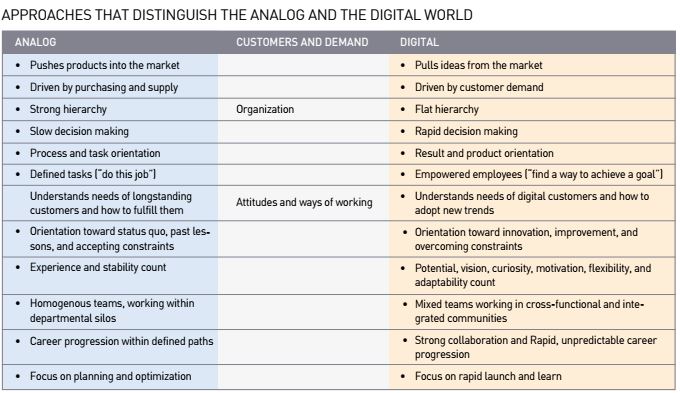
Mostly quoted dilemmas between Analog and Digital
Some argue that many customer-facing businesses installed digitally-enabled organizations, processes, and systems to remain competitive by building multichannel experiences. This approach, however, is not enough in itself and often results in a divided company: “one part moving into the future, the other clinging to traditional sales channels — and a delay in the much-needed transition to a multichannel operating model.”
A suggestion is that a culture needs to be created that embraces digital media and multichannel capabilities; a culture that can be created by using formal (people processes and role definitions) and informal levers (role models and behaviors) in an integrated fashion so that it can help people adapt to new ways of doing business and enable companies to deliver the multichannel experience that customers want. It is to the integrated approach in our ways through thorough thinking that we find value can be created. But it assumes that the crucial dilemmas need to be reconciled.
I raise the following approaches that distinguish the analog and the digital world.
Going for the clicks that stick
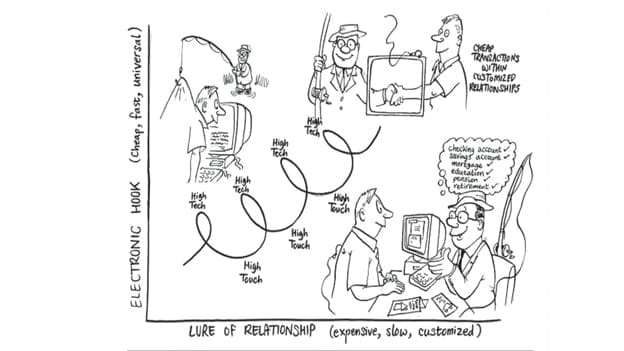
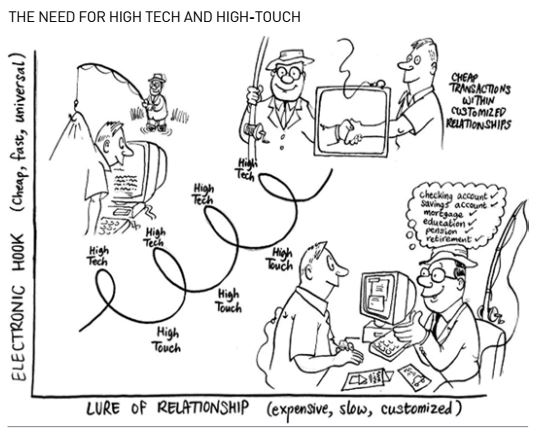
The challenge to Financial Service Companies for example, has come in part from the unbundling of services into specific pieces. The dilemma can be analyzed as follows. On the one axis, we find low-cost specific data and transactions on the Internet where the risk is that you create a High Tech Solution where brokers are by-passed by technology. On the other axis, we find the rich, meaningful, diffuse personal relationships that brokers have developed with their clients which maintains a High Touch environment where one is (over) paying for one’s own dependence. Merrill Lynch has found a situation where Charles Schwab’s high level Internet services were eating away quite some of the market share. The answer of ML was close to brilliant. They well understood that instead of relationships being eclipsed by the Internet, these get more and more important in interpreting the possible meanings of data flows, as what is available grows ever larger than what is relevant to each client.
Merrill Lynch’s response to its dilemma was to refocus its efforts on reconciling new technology with customer service. Its strategy was announced by John Steffens at Forrester Conference in May 1999. “By combining technology with skilled advisors, clients are given the convenience of interacting when, how and where they want.”1 Dave Komansky clarified the policy.
“Anyone, anywhere, at any time can log into the Internet to get free quotes, market data, and stock picks from a variety of chat rooms. Yet at Merrill Lynch we are confidently making unparalleled billion dollar investments in our Financial Consultants, research analysts and in our technology and products. We’re doing this because we know success in the online world – as it was in the offline world – will be defined by meaningful content for the individual.”2
We need High Tech but we also need High-Touch. The more those numbers rain down upon you, the more you need to talk to someone about these. ML is using the Internet to give better personal service (using high technology) to its high-touch customers but also uses the Internet to identify those high-tech customers for whom it makes good business sense to offer high touch.
It is quite interesting to note that where the high-touch and Bricks organizations are trying to integrate the digital high-tech through clicks, there is a countervailing development where we see that Amazon is going to build shops. Bookstore owners often think of Amazon.com as the enemy. Now it’s becoming one of them. The online retail giant has open its first-ever brick-and-mortar retail store in its 20-year life, in University Village. The store, called Amazon Books, looks a lot like bookstores that populate malls across the country. Its wood shelves are stocked with 5,000 to 6,000 titles, best-sellers as well as Amazon.com customer favorites.
There is some irony in Amazon’s opening a physical store. For years, it could undercut physical retailers on price because it didn’t have brick-and-mortar locations. But those stores offered something Amazon couldn’t: the instant gratification of owning an item the second it was purchased, as well as the personal touch of a knowledgeable sales clerk.
Amazon is betting that the troves of data it generates from shopping patterns on its website will give it advantages in its retail location that other bookstores can’t match. It will use data to pick titles that will most appeal to Seattle shoppers. And that could also solve the business problem that has long plagued other bookstores: unsold books that gather dust on shelves and get sent back to publishers. More than most book retailers, Amazon has deep insight into customer buying habits and can stock its store with titles most likely to move.
References:
1. The Role of Online Advice - Launny Steffens Forrester Conference, NJ May 24, 1999
2. ibid
Author
Loading...