







Training Development
From classroom to capability: Scaling L&D for AI-driven talent transformation






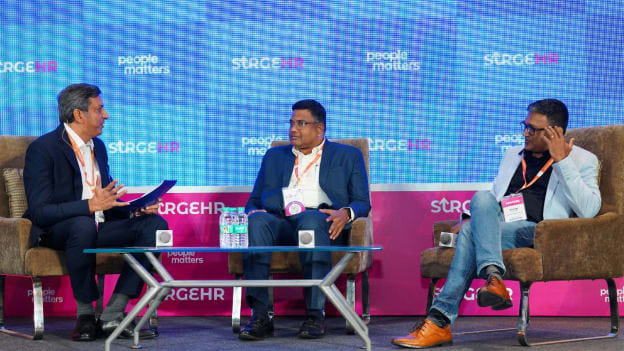
The L&D mandate is expanding, from skill-building to driving performance, readiness, and transformation. Here’s how leaders are scaling capability with agility and measurable value.
How do you prepare employees for problems that haven’t yet surfaced? How can learning ecosystems stay relevant when the shelf life of skills keeps shrinking? And how do organisations ensure their L&D investments contribute directly to agility, readiness, and business value?
These pivotal questions sparked a dynamic conversation at People Matters Surge HR Chennai, where George Koshi, Director – L&D at Sify Technologies, and Yahya Rasheed, Global Head – L&D and Talent Transformation at HCLTech, joined moderator Jagdish Sharma, CEO of Cedro Systems Pvt. Ltd., for a forward-looking panel on reimagining the future of capability building
L&D is shifting its centre of gravity
The era of static, schedule-bound training programmes is giving way to dynamic learning ecosystems that respond to changing business needs in real time. Generative AI has further altered the landscape by making content easy to produce, but harder to contextualise meaningfully.
The focus is now on enabling learning that can be applied, adapted, and scaled. Peer-led learning, internal communities, and real-time problem-solving are becoming core building blocks.
Reframing L&D as a business capability
As business models are reshaped by AI, shifting customer expectations, and talent shortages, L&D is being called to operate at a different level. The challenge today isn’t just about equipping employees with skills but about building capabilities that keep pace with change and directly support business agility, resilience, and growth. Rasheed outlined a three-part framework to position L&D as a core business enabler:
At HCLTech, learning design starts with real-world business outcomes and every programme is closely linked to measurable value on the ground.
Addressing skill gaps through structured development
As demand for talent in areas like cloud, AI, and cybersecurity intensifies, organisations are building structured internal pipelines that reduce dependency on external hiring.
At Sify, Koshi highlighted an initiative that brings academic faculty into industry to encourage shared learning and real-world exposure. HCLTech’s model is built on internal mobility, skill-based incentives, and outcome-based validation, ensuring that development leads to demonstrable performance.
With four generations working side by side, a uniform approach to learning no longer works. The panel highlighted the importance of multi-modal learning environments designed to meet varied preferences and career stages:
Koshi offered a practical insight on learner engagement:
Making learning immersive and measurable
Simulation-based learning is emerging as a powerful enabler of behavioural and technical capability. AI-powered scenarios are helping employees build confidence in areas like coaching, negotiation, and leadership conversations. At the same time, technical simulations, supported by partners such as AWS, Microsoft, and NVIDIA, are enhancing practical skills across cloud, data, DevOps, and AI.
This focus on active learning is helping organisations ensure that skill development leads to real-world readiness.
The capability that will define tomorrow’s leaders
As the discussion closed, both speakers were asked to identify one capability that organisations must prioritise to stay relevant:
A new mandate for L&D
What emerged clearly from the discussion is that L&D is evolving into a core business function, tightly linked to performance, growth, and long-term relevance. Organisations that invest in building adaptive, connected, and context-rich learning ecosystems will be better prepared for disruption, more confident in their talent strategy, and more equipped to lead in an AI-powered world.
Topics
Author
Loading...