







Wellbeing
Why presenteeism is passé — and what leaders think will replace it





Long hours no longer equal productivity. Indian leaders say the future lies in autonomy, outcome-driven KPIs, and well-being — not endurance at a desk.
On any given night in Gurugram, you can still spot the glow of high-rise offices long past dinner time. For decades, those late lights were shorthand for ambition: if you stayed the longest, you were working the hardest. It was the gospel of India’s corporate middle class — diligence measured not in output but in hours logged.
But that gospel is being challenged like never before. Attrition in IT has surged, burnout has become endemic, and generational debates — from Narayana Murthy’s controversial call for 70-hour workweeks to viral memes about hustle culture — show how uneasy India has grown with presenteeism. The Covid-19 pandemic dealt the decisive blow, proving that value can be created outside offices, beyond time clocks.
And yet, as new labour reforms permit 12-hour shifts in Karnataka and Odisha or open night shifts for women in Maharashtra’s factories, organisations face a pressing question: will returning to long hours restore productivity, or deepen fatigue?
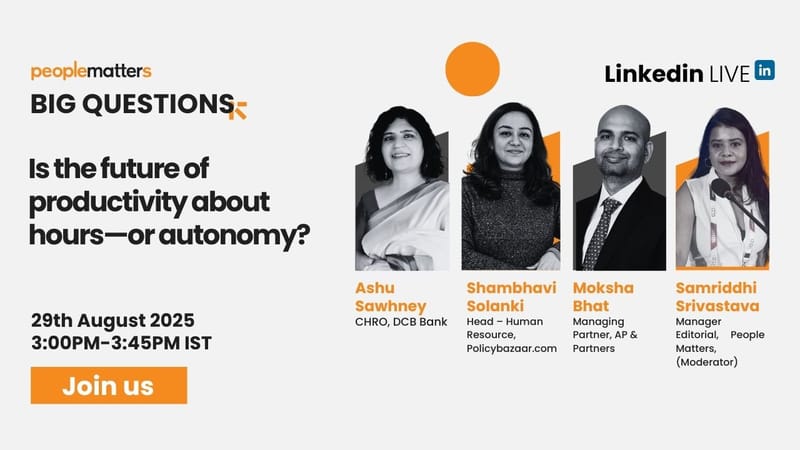
This tension sat at the heart of the latest Big Questions session at People Matters, where leaders from law, banking, and digital-first HR weighed in:
Moksha Bhat, Managing Partner, AP & Partners
Ashu Sawhney, CHRO, DCB Bank
Shambhavi Solanki, Head – Human Resources, Policybazaar.com
Their consensus was clear: presenteeism has become a liability. But what replaces it is not as simple as work from home or four-day weeks. It is about autonomy — structured, compliant, and built on trust.
The Productivity Paradox
Mr. Bhat cut to the chase: “Productivity is not a function of endurance.” In professional services, he argued, quality and responsiveness — not desk time — define performance. Labour law changes may expand flexibility, but they do not redefine what productivity actually means.
At Policybazaar, hours were never central to culture. Ms. Solanki described a workplace where SMART goals, dashboards, and frequent check-ins keep output visible without managers hovering. Autonomy here is not freewheeling — it is operationalised through clarity.
Banking offered a harsher reality. Ms. Sawhney posed a blunt arithmetic: “You have 24 hours. Twelve in the office, three in traffic, eight asleep — what time remains for living?” For urban employees balancing caregiving and commutes, the math of a 12-hour day collapses quickly.
Together, the panel reframed the paradox: longer hours may signal diligence, but performance comes from autonomy, clarity, and human limits.
Autonomy: Not Licence, but Structure
If presenteeism is fading, autonomy is the successor — but not without guardrails.
Mr. Bhat emphasised the legal backbone. Experiments with four-day weeks or compressed shifts must involve explicit employee consent, revised contracts, and documented reversibility. Without this, flexibility risks becoming entitlement — or litigation.
At Policybazaar, autonomy translates into dashboards tracking leading and lagging indicators, clearly defined KPIs, and managers trained to oversee without micromanaging.
At DCB Bank, autonomy and well-being are inseparable. Ms. Sawhney pointed to Employee Assistance Programmes rolled out pre-pandemic, with utilisation nearly double the industry average. Flexibility, she argued, only works when psychological safety is explicit.
The panel rejected the idea that autonomy belongs only to white-collar roles. On shop floors, it can mean self-managed shifts or frontline ownership of output against clear KPIs. As Ms. Solanki noted, “With the right guardrails, factory roles can embrace autonomy just as much as software engineers.”
Still, Mr. Bhat warned: health and safety are non-negotiable. Fatigue-driven errors and misaligned compensation can erase any productivity gains.
Globally, the direction is clear. Japan has legislated against excessive hours, scarred by decades of karoshi. Singapore links autonomy to skills upgrading as a productivity lever. India, the panel suggested, must decide whether it will cling to presenteeism or pivot to outcomes.
If Not Hours, Then What?
The panel converged on one replacement: holistic KPIs.
At DCB Bank, performance is measured not only on sales, but on regulatory compliance, customer value, and enterprise-wide contributions. At Policybazaar, service quality sits alongside revenue. For Mr. Bhat, this clarity is essential: vague metrics invite disputes in a system where termination requires just cause.
The panel also stressed the economics of well-being. Long hours may inflate short-term numbers, but attrition, burnout, and reputational damage impose heavier long-term costs.
Audience questions inevitably turned to the four-day week. Ms. Solanki framed the future as choice, not ideology — some will opt for compressed schedules, others will not. The real challenge lies in systems that can support both.
Ms. Sawhney offered caution, recalling a U.S. nurse working three 12-hour shifts: “Even with four days off, the exhaustion is crushing.” Compression alone, she said, is not a solution.
The consensus: flexibility must be voluntary, sector-specific, and operationally aligned.
A Framework for Leaders
The discussion distilled into five principles:
Outcome-driven focus — replace hours with results
Structured autonomy — empower within guardrails
Well-being as strategy — embed breaks, flexibility, and EAPs
Sectoral tailoring — adapt models to factories, offices, and services
Compliance and fairness — align with labour codes, contracts, and ESG norms
These principles demand a cycle: diagnose gaps, design compliant autonomy models, and deploy pilots with feedback loops.
As labour law reforms evolve — through code consolidation, expanded social security, and ESG pressures — the temptation to equate time with productivity will persist. But as the panel made clear, the smarter path is autonomy.
As Mr. Bhat concluded: “The future of productivity is not about enforcing hours. It is about designing systems that combine flexibility, ownership and clear outcomes.”
For India’s leaders, the message is stark: productivity cannot be measured by endurance. It must be designed through trust.
To learn more from leaders about some of the burning questions in today’s world of work, stay tuned to People Matters' Big Question series on LinkedIn.
Topics
Author
Loading...