







AI & Emerging Tech
Google bets on Private AI Compute to balance AI power and user privacy






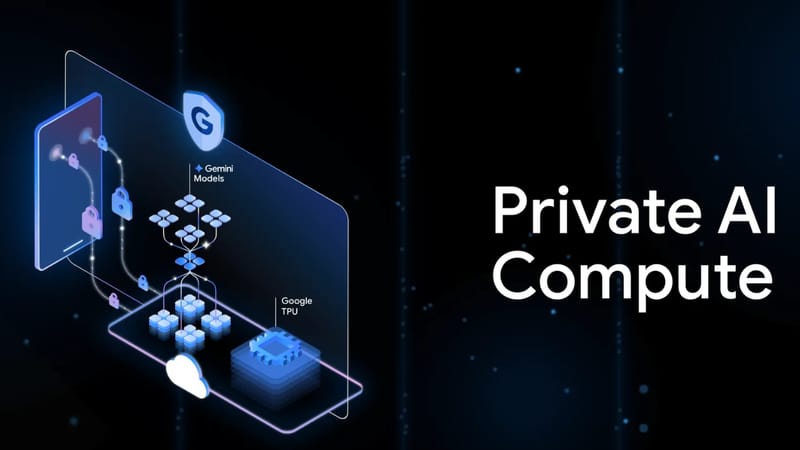
The new system combines Google’s Gemini models with hardware-level privacy protection to keep user data sealed from external access.
Google has announced Private AI Compute, a new privacy-focused platform designed to process artificial intelligence workloads in the cloud while keeping user data isolated and secure. The company said the system combines the computational power of its Gemini models with the same privacy assurances traditionally associated with on-device processing.
The launch marks Google’s latest step in what it calls “responsible AI development,” aimed at balancing capability and privacy. The platform is part of the company’s long-term work on privacy-enhancing technologies (PETs) — tools designed to protect user data while allowing AI to deliver personalised and predictive experiences.
As AI evolves from reactive systems to tools capable of reasoning and anticipating user needs, Google said more advanced computational power is required — power that can exceed the limits of smartphones or personal devices. Private AI Compute bridges that gap by enabling AI models to process data in a “sealed cloud environment”, ensuring that personal information remains accessible only to the user.
“Private AI Compute allows you to get faster, more helpful responses while keeping your data private — even from Google,” the company said in a statement.
A multi-layered privacy system
Google said the platform operates within a hardware-secured, encrypted enclave, forming part of its Titanium Intelligence Enclaves (TIE) infrastructure. The system uses remote attestation and end-to-end encryption to establish trusted connections between devices and the cloud.
Running entirely on Google’s integrated stack powered by Tensor Processing Units (TPUs), Private AI Compute is designed so that neither Google employees nor external parties can access user data. “It’s a secure, fortified space for processing data, with privacy built in from the ground up,” the company said.
The platform builds on Google’s Secure AI Framework (SAIF), which outlines standards for AI safety, fairness, and transparency. Within this architecture, Private AI Compute processes data such as voice commands, contextual preferences, and activity summaries that would otherwise stay on-device.
Integration and future applications
Google has already integrated Private AI Compute into several products, including Magic Cue on the new Pixel 10 phones — which now delivers smarter, real-time suggestions — and the Recorder app, which can summarise transcriptions across more languages using cloud-assisted processing.
The company said these examples demonstrate how combining cloud AI with hardware-level privacy can enhance productivity without compromising user control.
“Private AI Compute opens up a new set of possibilities for helpful AI experiences now that we can use both on-device and advanced cloud models for the most sensitive use cases,” Google said.
Broader implications
The move underscores how major tech firms are racing to address public concern over AI privacy. As generative AI tools handle increasingly personal data, companies like Google, Apple, and Microsoft are developing hybrid models that combine localised privacy with cloud-scale computation.
Google said more products will adopt Private AI Compute in the coming year, positioning it as a cornerstone of the company’s approach to responsible AI infrastructure.
Topics
Author
Loading...