







AI & Emerging Tech
IKEA uses AI to reskill 8,500 employees instead of cutting jobs





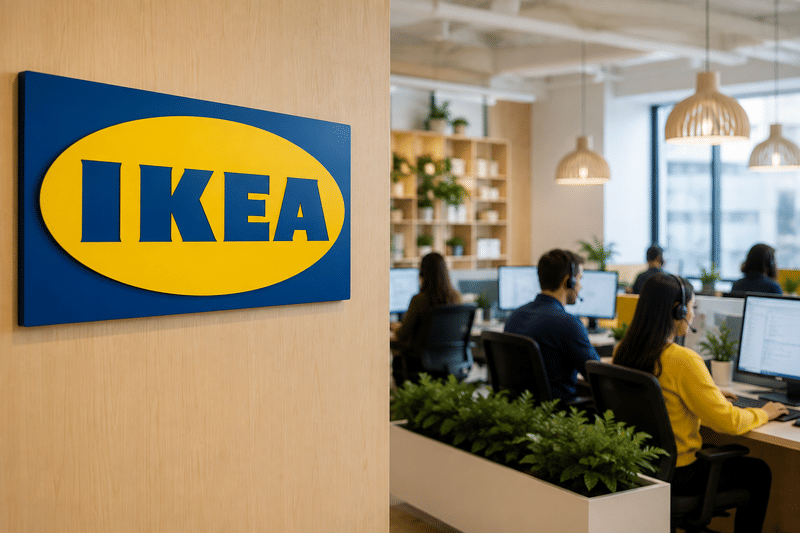
The furniture retailer has retrained thousands of call centre employees after deploying its AI assistant Billie, shifting workers into higher-value customer service and sales roles instead of reducing headcount.
IKEA has retrained around 8,500 call centre employees after introducing its AI-powered customer service assistant Billie, choosing to redeploy staff into more specialised service and sales roles rather than eliminate jobs.
The initiative offers a different approach to AI adoption at a time when many organisations are using automation to reduce customer service headcount. Instead, IKEA has used AI to automate routine enquiries while investing in workforce reskilling and redeployment.
Routine queries move to AI, people move to complex work
IKEA launched Billie in 2021 to manage repetitive customer service requests, including store opening hours, order tracking, stock availability and return policy enquiries.
The AI assistant's capability has expanded steadily.
According to Fortune, Billie was able to assist 47% of customers using the tool during its first two years. That figure has since increased to 74%.
Rather than reducing the workforce as automation handled more enquiries, IKEA retrained employees to support more complex customer interactions.
Many now manage detailed service requests or work as remote interior design sales advisors, helping customers redesign rooms, configure kitchens and furniture, and complete purchases through remote sales channels.
AI becomes a workforce investment
The company's approach reflects a broader strategy of using AI to create capacity for higher-value work instead of treating automation purely as a cost-saving measure.
Key outcomes reported so far include:
- Around 8,500 call centre employees retrained
- Billie now assists 74% of customers using the AI tool
- Employees redeployed into complex customer service and interior design sales roles
- Remote sales centres generated €1.25 billion in revenue during the last financial year, up from €1.08 billion a year earlier
- Customer happiness scores increased to 89%, compared with 60% before Billie's rollout
According to Fortune, IKEA's remote sales centres, which support customers across the 31 countries where Ingka Group operates IKEA stores, have become the company's fastest-growing sales channel over the past three years, recording annual growth of 15% to 20%.
AI shifts the focus from efficiency to expertise
The reskilling programme illustrates a different interpretation of AI-driven productivity.
Instead of measuring success solely by the number of customer enquiries handled by automation, IKEA redirected employees towards work requiring judgement, product expertise, empathy and consultative selling.
The approach stands in contrast with recent workforce actions across parts of the customer service industry, where companies have announced job reductions alongside AI adoption.
Examples include Uber, which recently reduced 10% of its customer service workforce as it expanded the use of AI. Other companies, including Salesforce, Verizon, Oracle and Klarna, have also faced scrutiny over automation's impact on customer service staffing.
Reskilling takes time and investment
IKEA's model also demonstrates that workforce redeployment requires long-term planning rather than simply deploying new technology.
According to Fortune, the retailer's reskilling programme took around two years to complete, while new customer service recruits now receive five to six weeks of training.
The initiative involved skills mapping, workforce planning, product training and redesigning customer service processes to identify interactions where human expertise continues to add value.
Topics
Author

Loading...