







AI & Emerging Tech
OpenAI’s GPT-5.2 goes live: What the new model means for enterprise problem-solving






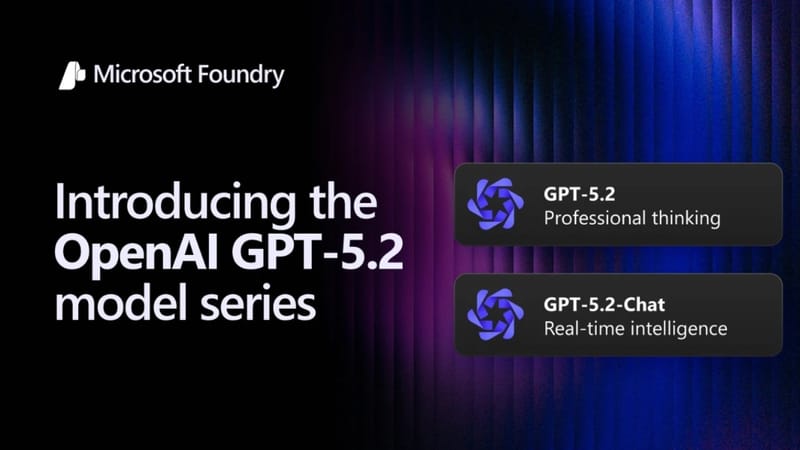
OpenAI’s GPT-5.2 launches on Microsoft Foundry, aiming to move enterprise AI beyond chat into auditable, end-to-end execution.
OpenAI has released GPT-5.2 for enterprise use, positioning the new model as a step change from conversational AI to systems designed to handle complex, high-stakes organisational work.
The model is now generally available through Microsoft Foundry on Azure, which OpenAI and Microsoft describe as the enterprise foundation for deploying large-scale AI. The launch comes as businesses increasingly demand AI systems that can plan, reason and execute multi-step workflows, rather than simply generate text.
According to Microsoft, GPT-5.2 has been built to address enterprise requirements such as structured outputs, explainable reasoning and secure deployment. The Wall Street Journal reported that large companies have grown cautious about deploying generative AI at scale without stronger governance, reliability and auditability.
GPT-5.2 succeeds GPT-5.1 and introduces deeper logical reasoning, expanded context handling and so-called “agentic execution” — the ability to coordinate tasks across design, coding, testing and deployment. OpenAI said the model can generate shippable artefacts such as design documents, runnable code, unit tests and deployment scripts with fewer iterations.
Two variants are being released: GPT-5.2, positioned as a high-end reasoning model for complex professional tasks, and GPT-5.2-Chat, a lighter version optimised for day-to-day knowledge work such as technical writing, translation and guided problem-solving.
Microsoft said GPT-5.2 is optimised for enterprise “agent” scenarios, where AI systems must ingest large volumes of internal data — including project briefs, codebases and operational documentation — and produce decisions that can be traced and justified. Reuters has previously reported that enterprises in regulated sectors such as financial services and healthcare have been slow to adopt generative AI without these safeguards.
OpenAI said the model has been trained on the GPT-5.1 dataset but uses a new architecture that improves reasoning depth and efficiency. It also includes enhanced safety features and tighter integrations with enterprise identity and policy controls within Azure.
Use cases highlighted by Microsoft include analytics and decision support, application modernisation, data pipeline auditing and customer service automation. The company said the model can help organisations explain trade-offs, generate defensible plans for stakeholders and reduce manual oversight in long-running workflows.
Pricing for GPT-5.2 starts at $1.75 per million input tokens for standard global deployment, with higher rates for output tokens and data-zone-specific hosting. Both GPT-5.2 and GPT-5.2-Chat are available under the same base pricing structure, according to Microsoft.
The launch underscores a broader shift in enterprise AI adoption. Rather than experimenting with chatbots, organisations are now looking to deploy AI as an operational layer — one that can reason, act and remain accountable. Whether GPT-5.2 delivers on those expectations is likely to shape how quickly enterprises move from pilots to production in the next phase of AI adoption.
Topics
Author

Loading...