







AI & Emerging Tech
When an app can stop your vehicle, it can stop your livelihood too





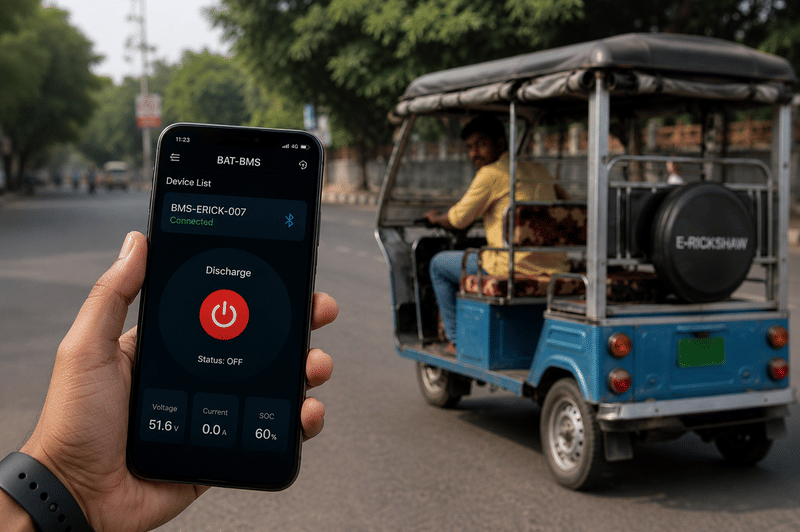
Viral videos showing e-rickshaws being remotely switched off through battery management apps have triggered fresh concerns over cybersecurity, exposing how connected technology can directly disrupt the livelihoods of India's gig and informal workforce.
What began as a series of viral social media videos has evolved into a broader conversation about cybersecurity and worker safety.
Reports of people remotely switching off compatible e-rickshaws using smartphone applications have prompted the Delhi government to seek a report, while a reality check by NDTV suggests the issue extends beyond a single battery management app.
For thousands of e-rickshaw drivers who rely on their vehicles for daily income, the concern is no longer limited to technology. A remotely disabled vehicle can mean lost earnings, stranded passengers and interrupted work.
Viral videos expose a security concern
The controversy emerged after videos circulated on Instagram, YouTube and X showing users connecting to compatible e-rickshaw batteries via Bluetooth and remotely turning off the battery's discharge function using the BAT-BMS application.
The clips showed vehicles stopping unexpectedly, leaving drivers unable to restart them without reconnecting through the same application.
The Delhi Transport Department has been asked to verify the application's authenticity and examine the claims surrounding its use after Transport Minister Pankaj Singh said the issue had been brought to his attention.
While no formal written complaint had been received, Singh told NDTV he had directed officials to gather accurate information on the matter.
Investigation suggests issue is wider than one app
The concern is not confined to BAT-BMS.
The broadcaster reported that while BAT-BMS now prompts users for a password before allowing access to the switch-off function, another battery management application, Epoch Li-ion, was able to connect to a compatible battery and power down an e-rickshaw with a single tap during testing.
The demonstration showed the vehicle's display turning off completely, with the e-rickshaw remaining inoperable until it was switched back on through the application.
The test was carried out on a compatible battery management system and does not establish that all e-rickshaws or battery systems are vulnerable in the same way. It does, however, indicate that the issue is not limited to a single application.
Dealers report rising complaints
Dealers say the number of affected vehicles has increased in recent days.
According to NDTV, e-rickshaw dealer Insaaf Khan said his workshop had received between 40 and 50 vehicles over the previous four days with similar complaints.
He said:
- Earlier cases could be resolved using password-protected applications.
- New incidents are now being linked to different battery management apps.
- Battery manufacturers need to strengthen security as new vulnerabilities continue to emerge.
A cybersecurity issue with workplace consequences
For many drivers, the incident has immediate financial consequences rather than merely technical implications.
E-rickshaw driver Raushan Lal said an unexpected shutdown could halt his work for the day.
He explained that the vehicle is his family's primary source of income and said an unexpected stoppage while carrying passengers could also affect customer trust and daily earnings.
The incident illustrates how connected technologies are becoming part of the workplace infrastructure for India's growing gig and informal workforce. As vehicles become digitally connected, cybersecurity failures can translate directly into interrupted work and lost income.
Experts call for stronger security standards
According to NDTV, cybersecurity expert Advocate Saakshar Duggal said the incident highlights the need for stronger safeguards across India's expanding electric vehicle ecosystem.
He called for stricter guidelines for EV manufacturers and dealers to address vulnerabilities in connected battery management systems before they can be misused.
A senior Delhi government official also told NDTV that the applications are primarily designed to monitor battery parameters such as voltage, temperature and current. The official said their control functions could be misused where adequate authentication mechanisms are absent.
Why the story matters beyond e-rickshaws
Battery management applications are commonly used to monitor battery health, charging status and system performance. Some also allow authorised users to remotely manage battery functions.
The latest controversy highlights a broader challenge for industries increasingly dependent on connected devices. As digital tools become embedded in vehicles and workplaces, cybersecurity is becoming more closely linked with worker productivity and income security.
While investigations continue and the Delhi government examines the issue, the episode has already raised larger questions about digital trust, connected mobility and the protections needed for workers whose livelihoods increasingly depend on software as much as machinery.
Topics
Author
Loading...